The Little Spacecraft That Stared Down Jupiter
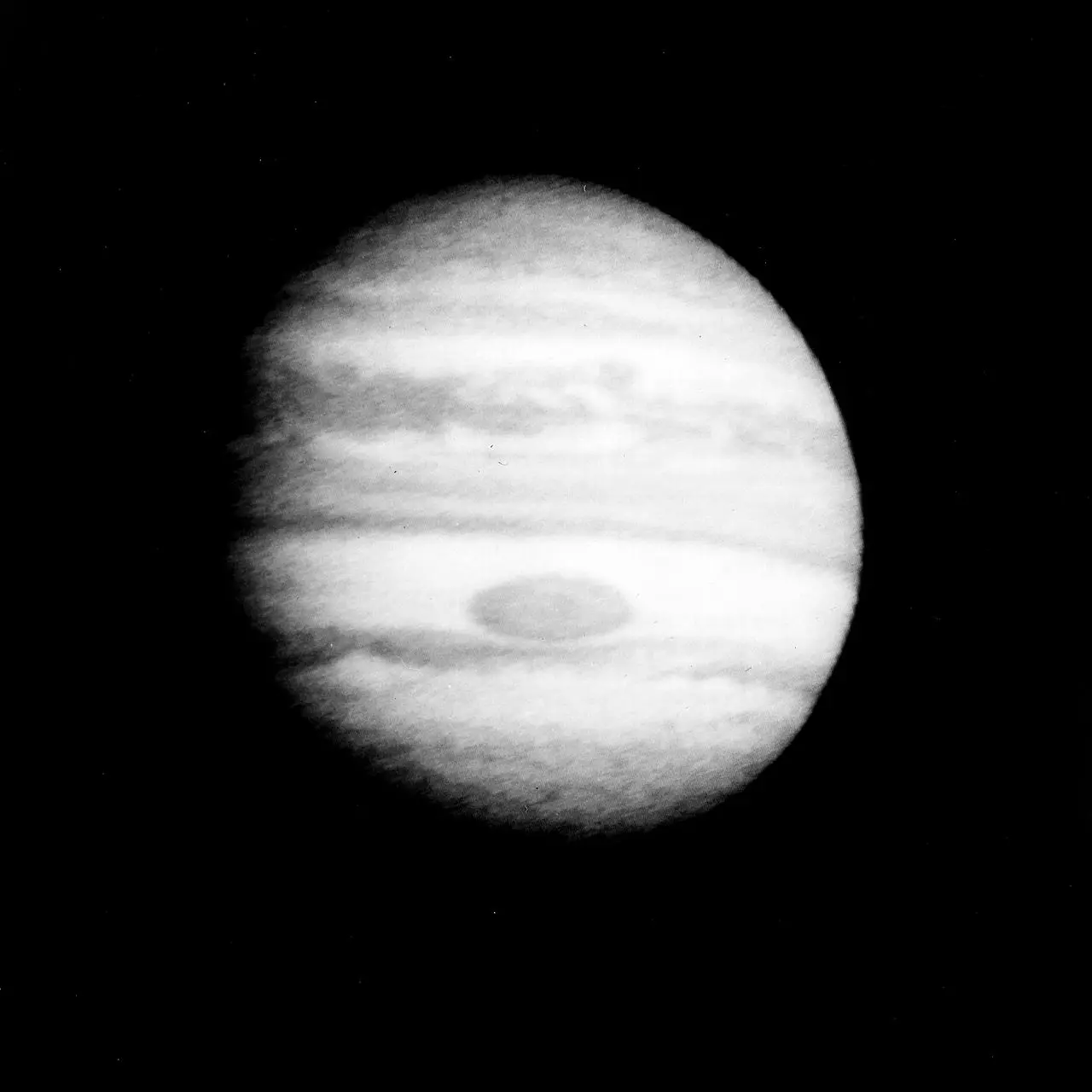
On December 3, 1973, NASA's Pioneer 10 swept past Jupiter, returning humanity's first close-up images of the giant planet.
Nobody knew if the asteroid belt would shred it. Nobody had ever photographed Jupiter up close. On December 3, 1973, a machine the size of a car found out.
Pioneer 10 had launched from Cape Canaveral on March 2, 1972, aboard an Atlas-Centaur rocket — at the time, the fastest human-made object ever built, passing the Moon just eleven hours after liftoff. Built by TRW and managed by NASA's Ames Research Center, it was the first probe designed to travel beyond the inner planets, powered by four plutonium generators in a realm where sunlight was growing too weak for solar panels.
First it had to survive the asteroid belt, which it crossed from July 1972 to February 1973. Some scientists feared the spacecraft would be sandblasted to junk; instead it found the belt mostly empty, the particles tiny — good news for every mission that followed.
Then came Jupiter. After a twenty-one-month voyage, imaging began in early November 1973, and at 9:25 p.m. Eastern on December 3, Pioneer 10 swept just 82,178 miles above the giant planet's cloud tops — closer than anyone had ever been. It returned more than 500 images: the first close-up look at the banded, storm-wracked world, its Great Red Spot staring back like an eye. Its instruments mapped a magnetic field far stronger than expected and measured radiation belts a thousand times fiercer than Earth's — data that engineers used to armor the Voyager and Galileo spacecraft that came later. It also discovered that Jupiter radiates more heat than it receives from the Sun, proof of a hot interior.
Tucked aboard was a golden plaque, designed by astronomers Carl Sagan and Frank Drake, etched with a map of Earth and figures of a man and woman — a message in a bottle for anyone who might ever find it.
Pioneer 10 kept flying long after its Jupiter triumph, crossing the orbits of the outer planets and heading for interstellar space. Its last faint signal reached Earth on January 23, 2003, from nearly 12 billion kilometers away. Its science mission formally ended on March 31, 1997, but tracking continued for years more. It is still out there, silent and drifting.
Why it still matters: Pioneer 10 was the scout that made everything after it possible. Before that December night, the outer solar system was theory. After it, it was a destination.
Photo: NASA, public domain (via Wikimedia Commons).