The Lark That Put Canada in Orbit
On September 29, 1962, Canada launched Alouette 1 — the first satellite designed and built by any country besides the U.S. and the Soviet Union.
The engineers had never built a satellite. Their country had no rockets, no launchpad, and no space program at all. In 1962, Canada decided to build one anyway.
The reason was practical. Five years after Sputnik, Canada's vast northern territories depended on long-distance radio — and the aurora borealis kept scrambling it. Nobody fully understood the ionosphere, the electrically charged layer of the upper atmosphere that bends radio waves around the planet. After NASA invited international partners into its young satellite program in 1958, two scientists at Canada's Defence Research Telecommunications Establishment — John Chapman and Eldin Warren — proposed something bold: Canada would design and build its own satellite to study the ionosphere from above.
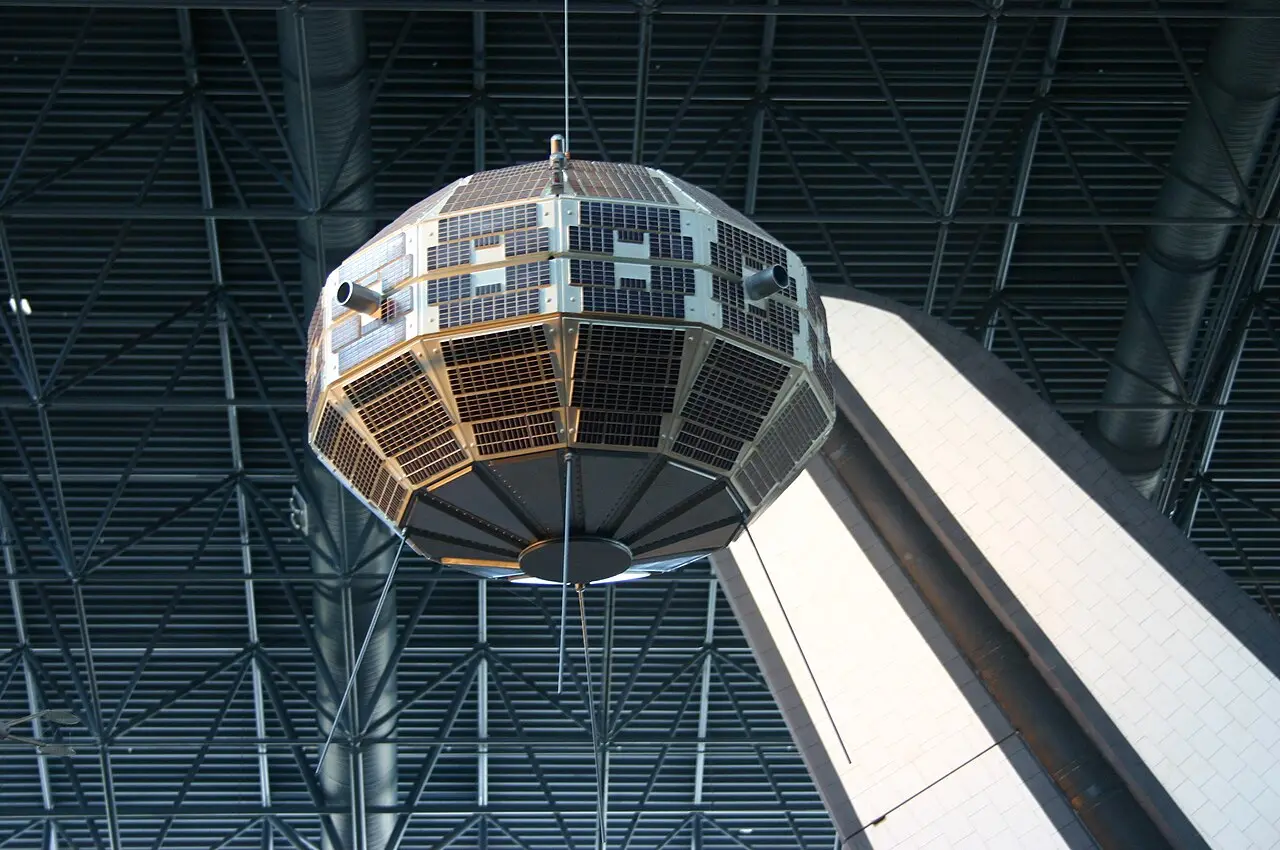
The small team that took on the job had zero experience with spacecraft, and progress was slow and riddled with engineering problems. But new technologies were arriving just in time: transistors and solar cells made a compact, reliable satellite possible. The result was a cylinder about five feet across and seven feet tall, wrapped in 6,480 solar cells and stuffed with some 7,000 components and long spindly antennas. Contractors RCA and Spar Aerospace cut their teeth on their first space hardware — Spar's roll-up antenna would later fly on American satellites.
On September 29, 1962, at 7:05 a.m. Universal Time, a Thor-Agena B rocket lifted off from Vandenberg Air Force Base in California and carried the satellite into a near-circular orbit about 1,000 kilometers up. The team named it Alouette — French for "lark," the high-flying bird of one of Canada's best-known folk songs.
Alouette 1 was designed to work for a single year. Instead it transmitted data for more than ten, outlasting every other satellite of its era. It mapped the ionosphere in unprecedented detail, and its measurements fed more than a thousand scientific papers and reports. Follow-on satellites — Alouette II in 1965, ISIS-I in 1969, ISIS-II in 1971 — kept the program running until 1984. The original satellite is still up there, silent, expected to circle the Earth for centuries. Sixty years after launch, engineers rescued its aging magnetic tapes and digitized the data for a new generation of science.
With that one launch, Canada became the first nation after the two superpowers to design and build its own artificial satellite. The ionosphere maps it produced underpin the long-distance communications the modern world takes for granted. And it all came from a team that started out knowing nothing about building spacecraft — and learned by doing it.
Photo: Ryan Somma, CC BY-SA 2.0 (via Wikimedia Commons).