The Night the Bobbies First Walked London
On September 29, 1829, about a thousand men in blue coats and top hats stepped onto London's streets — the world's first modern police force.
At six o'clock on the evening of September 29, 1829, Londoners saw something they had never seen before: men in dark blue walking the streets in pairs, each following a fixed route, each watching everything. They were not soldiers. They carried no muskets. They belonged to a brand-new institution: the Metropolitan Police.
London needed them badly. The city held nearly a million and a half people, yet it was policed by only about 450 part-time parish constables and 4,500 night watchmen — a patchwork force that was easy to bribe, useless by daylight, and no match for the city's crime. Punishment was brutal, but preventing crime in the first place was nobody's job.
The man who changed that was Sir Robert Peel. As Home Secretary since 1822, Peel had already built a police force in Ireland, where he had been Chief Secretary — a Peace Preservation Force in 1814 and county constabularies in 1822. In 1829 he pushed the Metropolitan Police Act through Parliament, creating a single professional force for the whole of London.
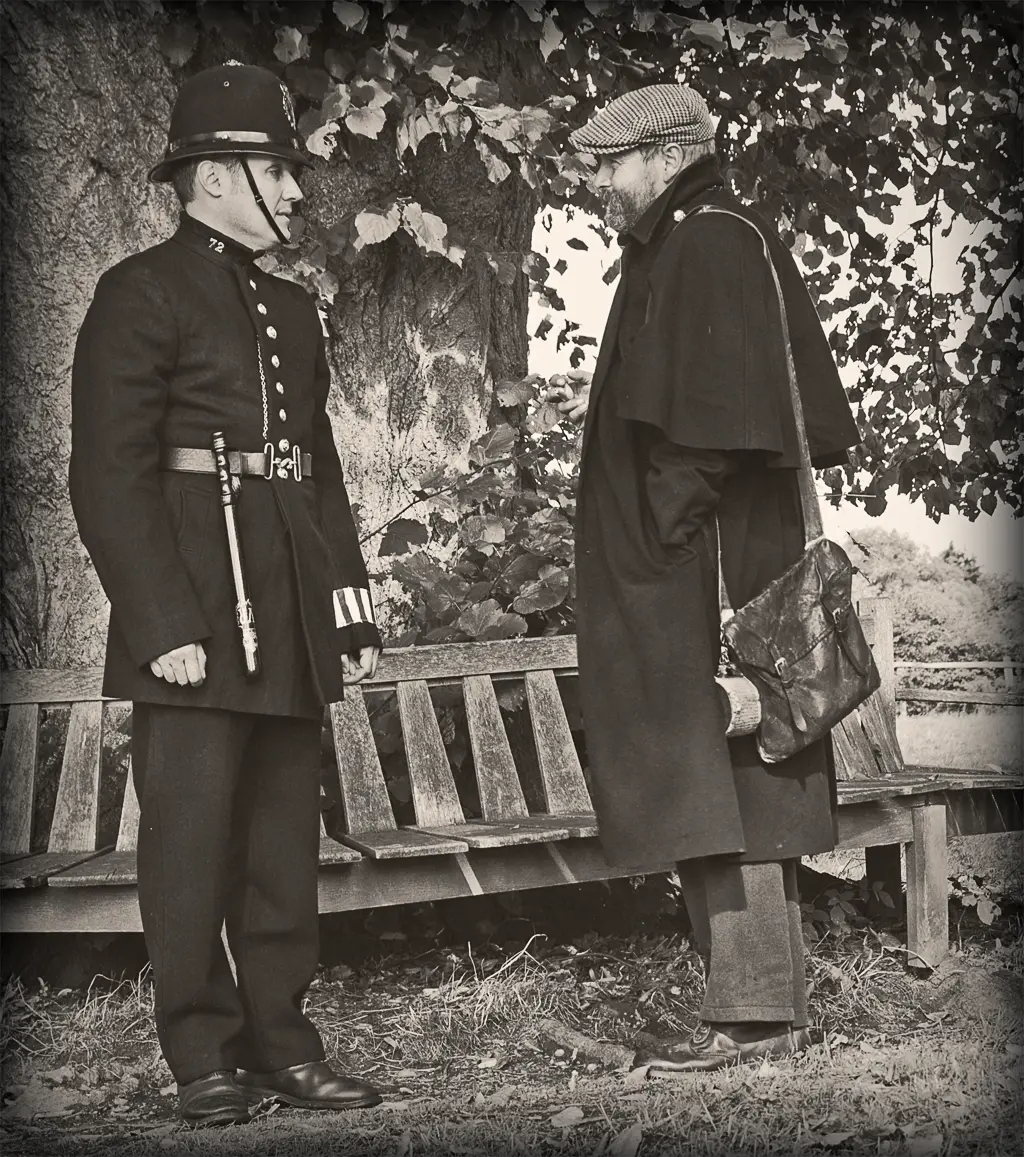
That September evening, roughly a thousand men marched out of the force's headquarters at 4 Whitehall Place onto their beats: 895 constables, 88 sergeants, 20 inspectors, 8 superintendents, and two commissioners. Their look was deliberate: blue coats and top hats — civilian dress, pointedly not the red of the army — with wooden truncheons, handcuffs, and rattles to raise the alarm. They carried no guns.
The standards were strict. Recruits had to be physically fit, literate, between 20 and 27, at least 5 foot 7, with no criminal record. They earned a pound a week, worked all but five unpaid days a year, had to wear the uniform even off duty, and were barred from voting — lest policing ever mix with politics. Officers were posted far from their own neighborhoods, so they would serve the law rather than their friends.
London did not welcome them with open arms. The new constables were mocked in cartoons and jeered in the streets; many feared Britain was building a French-style secret police. The satirists had a field day — and the nicknames they coined, "peelers" and "bobbies" after Robert Peel, stuck for the next two centuries. The headquarters soon moved near Great Scotland Yard, giving the force its other famous name.
What made Peel's experiment revolutionary was its philosophy: prevent crime rather than just punish it, and police by consent rather than by force. In the words long attributed to Peel himself, "the police are the public and the public are the police." The blue-coated constable walking his beat became one of the most recognizable figures in British life — and the model for professional police forces around the world. Every bobby on a London street today walks in the footsteps of those thousand men from 1829.
Photo: Antony McCallum, CC BY-SA 3.0 (via Wikimedia Commons).