
The Hindenburg Burns at Lakehurst
On May 6, 1937, the German airship Hindenburg caught fire while landing at Lakehurst, New Jersey, killing 36 people and ending the age of the passenger airship.
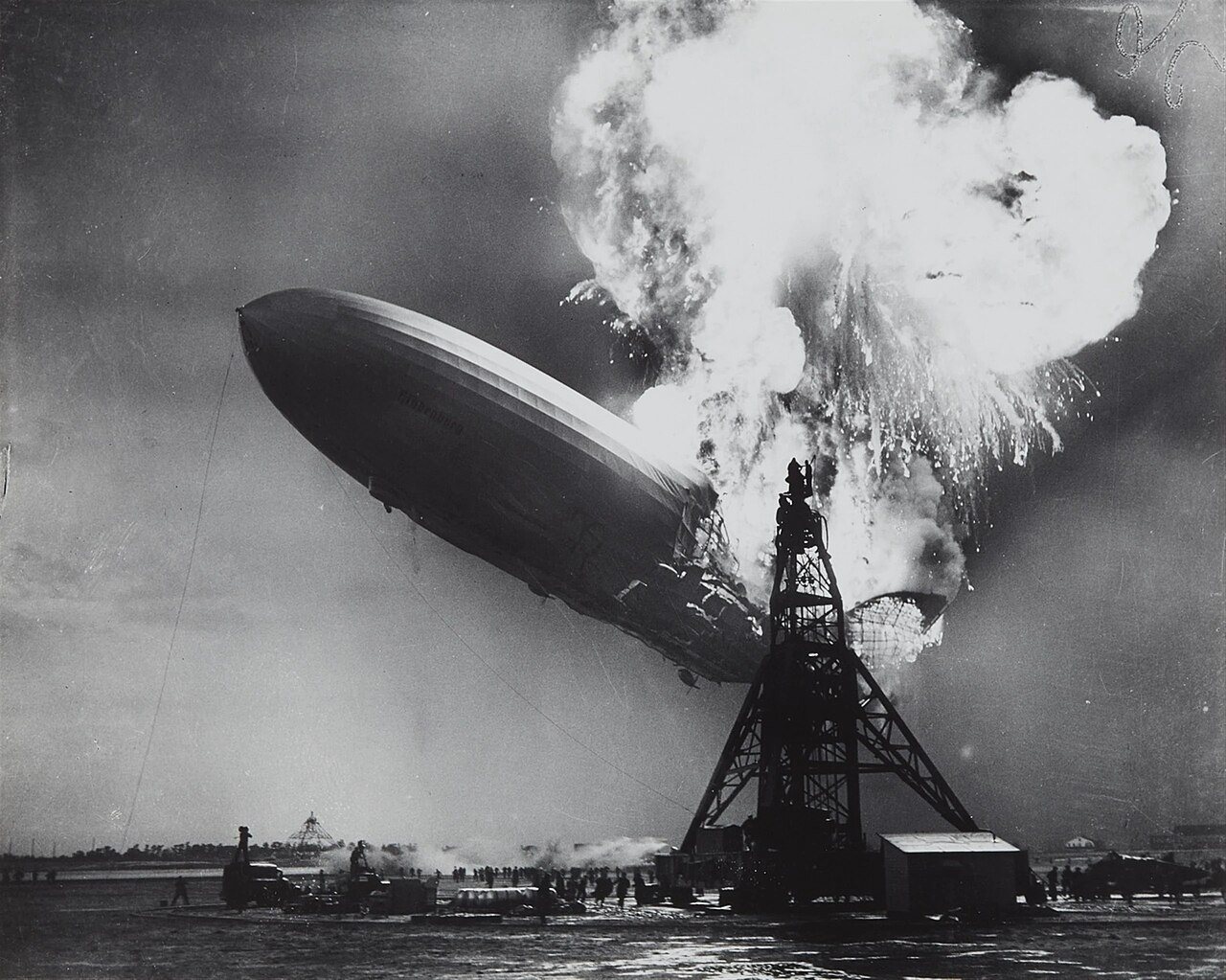
The evening of May 6, 1937, felt like a festival at Naval Air Station Lakehurst in New Jersey. Reporters, photographers, and newsreel cameramen crowded the landing field, and radio announcer Herbert Morrison of Chicago station WLS was on hand to narrate the arrival of the largest aircraft in the world. Then, at 7:25 p.m., the sky caught fire.
The LZ 129 Hindenburg was the pride of Nazi Germany and the biggest thing that had ever flown: an 804-foot rigid airship, longer than three football fields, filled with seven million cubic feet of hydrogen. Named for the late German president Paul von Hindenburg, it had been designed to float on helium, but the United States would not export the gas to Nazi Germany, so the ship flew on highly flammable hydrogen instead. In 1936 the Hindenburg had inaugurated commercial transatlantic service, carrying 1,002 passengers on ten round trips between Germany and America.
This crossing was the first of the 1937 season. The ship had left Frankfurt on May 3, and thunderstorms over New Jersey had kept it circling for hours. As Captain Max Pruss eased the giant airship toward its mooring mast, flames suddenly appeared near the tail. In roughly half a minute, the largest aircraft of its day became a burning skeleton on the sand.
Ninety-seven people were aboard — 36 passengers and 61 crew. Thirty-five of them died: thirteen passengers and twenty-two crewmen, along with one man of the ground crew caught below. Sixty-two people survived, some jumping from the burning frame as it settled. Morrison, who had been cheerfully describing the landing a moment before, wept into his microphone: "Oh, the humanity, and all the passengers screaming around here!" His broadcast aired the next day, and his words became a permanent part of American speech.
Investigators never established the exact cause with certainty. The official German inquiry blamed a discharge of atmospheric electricity igniting a hydrogen leak; others suspected sabotage, a spark, or the ship's flammable skin. What was certain was the consequence: because cameras and microphones were already rolling, the whole world watched the disaster play out in theaters and on the radio. Public confidence in the giant passenger airship collapsed overnight.
The Hindenburg disaster marked the abrupt end of the airship era. The age of luxury travel through the skies died at Lakehurst, New Jersey, on a spring evening — just as the age of the airplane was beginning. The wreckage is long gone, but the lesson of that night, about the price of cutting corners on safety, still travels with every flight.
There was mail aboard too — more than 17,000 pieces, carried as a matter of course on the great airship. Only a little over 150 pieces survived the fire in recognizable form, charred but deliverable; the post office delivered every one with a legible address, and one scorched letter now rests in the Smithsonian's National Postal Museum. It is a small, stubborn reminder that behind the headlines were ordinary lives and ordinary errands.
The disaster also changed how the world watched tragedy. It was the first major air disaster caught on still and motion film and on live radio, and shown in theaters the next day. The exact cause was never settled — theories ranged from a hydrogen leak to sabotage to the flammable doping on the ship's fabric — and the mystery has kept the story alive for nearly ninety years.
Photo: Sam Shere, public domain (via Wikimedia Commons).