
The Gold Nugget That Launched 100,000 Stampeders
On August 16, 1896, four prospectors found gold on a Yukon creek and sparked the Klondike Gold Rush, one of history's greatest migrations.
Imagine reaching into the water and pulling up a handful of gravel that glitters gold. That was August 16, 1896, on a creek no one much cared about — and it set off one of the wildest migrations in history.
On that late-summer day, an American prospector named George Carmack was camped with his wife Kate (Shaaw Tláa), her brother Skookum Jim Mason, and their nephew Dawson Charlie along Rabbit Creek, a tributary of the Klondike River in the Yukon. Three of the four were Tagish First Nations people; George was the son of an American forty-niner. That day they found nuggets in the creek bed — the first real gold of what would become a legendary strike.
Who actually spotted the gold is still disputed. Most historians now call Carmack, at best, a co-discoverer: Skookum Jim insisted he had found it by right of discovery, while Carmack claimed an Indigenous man's claim would never be registered. So Carmack staked the discovery claim, sharing half the interest with Jim — a pact that also let him stake a second claim. The party had come on prospector Robert Henderson's tip from the Indian River nearby.
They wasted no time. The next morning they staked claims along the creek, which was soon renamed Bonanza Creek, and within weeks every inch of it had been claimed by local prospectors. But the Yukon was so remote that the outside world heard almost nothing — until July 1897, when prospectors sailed south carrying sacks of Klondike gold. Then the news exploded. Roughly 100,000 people set out for the Klondike; only 30,000 to 40,000 ever made it, and only a tiny handful grew rich.
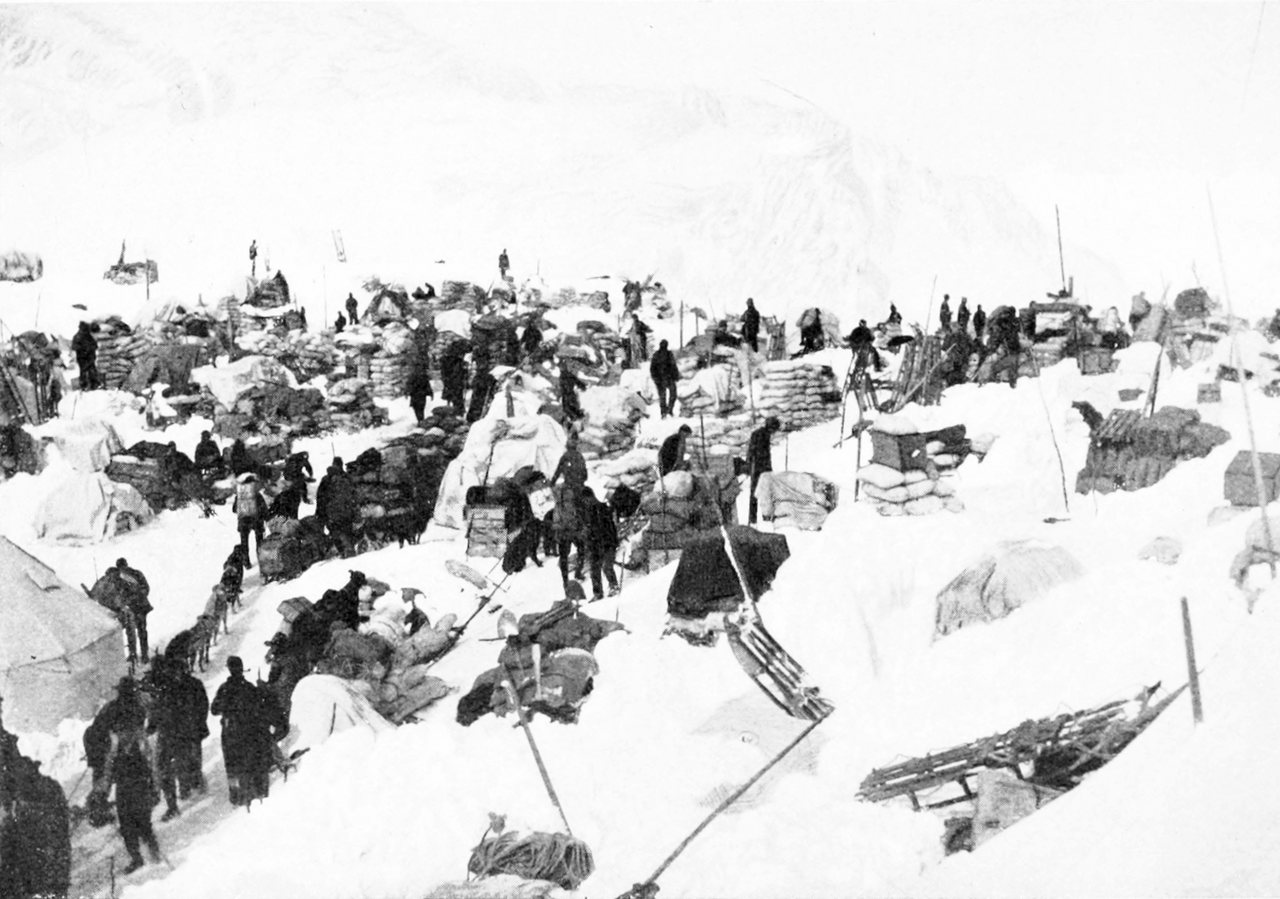
Those who came faced one of the hardest journeys in history. Canadian authorities required every stampeder to carry a year's worth of supplies — about a ton of food, clothes, and gear — over the brutal Chilkoot Pass, where thousands climbed a frozen staircase of ice hauling their goods on their backs. Towns like Dawson City mushroomed from nothing; gold dust became currency; saloons stayed open all night. The Yukon was made a territory of Canada in June 1898, drawn into existence almost entirely by the rush.
Among the thousands who hauled their ton of goods over the Chilkoot was 21-year-old Californian Jack London. He arrived in the summer of 1897 with his brother-in-law and staked claims on the Stewart River — but found no fortune, and scurvy drove him home the next spring. He rafted some 2,000 miles down the Yukon to catch a boat back to California, returning nearly penniless but rich in material: the winter he spent in a cabin near Dawson City became the raw stuff of The Call of the Wild and White Fang. The Klondike made few men rich; it made London immortal.
The discoverers had mixed fates. Carmack abandoned Kate in 1900, remarried in Seattle, and grew wealthy in real estate — yet he never stopped hunting gold, and died in 1922 at sixty-one, still working a new claim. Skookum Jim earned a huge income from royalties but kept prospecting until his death in Whitehorse in 1916; his 1905 Daisy Mason Trust, created to protect his fortune for his daughter, later built Whitehorse's Skookum Jim Friendship Centre. Dawson Charlie spent lavishly and died in an alcohol-related accident. Together the men had pulled nearly a million dollars in gold from their claims — and only one's legacy still serves the Yukon.
The strike changed the North forever. It mapped the Yukon, built Dawson City — the "Paris of the North" — and left an enduring frontier legend. For the Tr'ondëk Hwëch'in people whose land the gold lay beneath, it meant dispossession and hardship, a reminder that every gold rush has a shadow side. In the Yukon, the day is still celebrated as Discovery Day, a statutory holiday honoring the morning the creek turned golden.
Photo: public domain, unknown author, via Popular Science Monthly 1898 (via Wikimedia Commons).