The Dictionary That Gave America Its Own Words
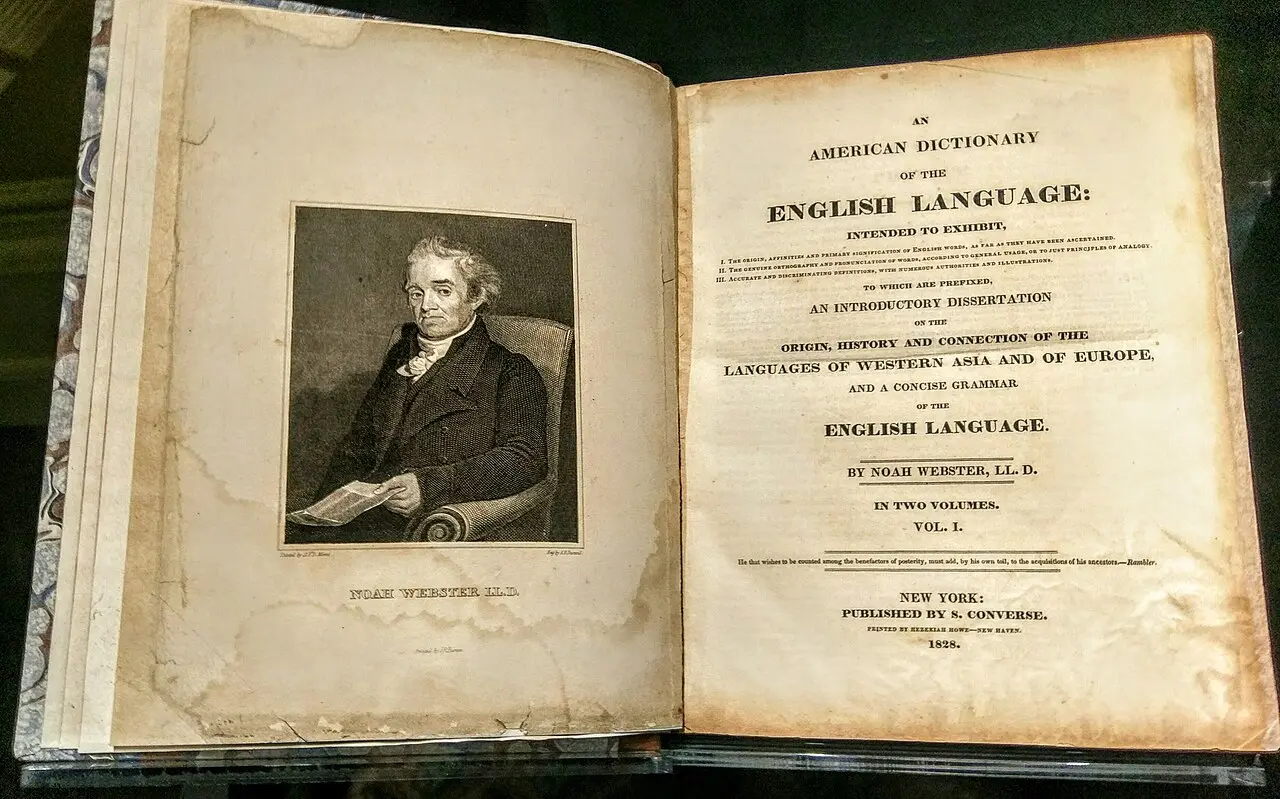
On April 14, 1828, Noah Webster published his American Dictionary of the English Language — 70,000 words in two volumes that gave the young United States its own spelling and voice.
America had won its political independence. It still spoke Britain's English — until April 14, 1828.
On that day, a 70-year-old former schoolteacher from Connecticut published the book that would give the young United States its own words. An American Dictionary of the English Language, by Noah Webster, came out in two fat quarto volumes from the New York publisher S. Converse: 70,000 entries, the largest English dictionary ever compiled to that point, with more than 10,000 distinctly American words that had never appeared in a dictionary before.
Webster had spent more than two decades on it. A Yale-educated lawyer who had turned to teaching, he believed the new republic needed its own language as a badge of independence — that a nation which borrowed its words from London was still, in some sense, a colony. In 1807 he began the dictionary in earnest, and he did not finish compiling it until 1825, spending three more years polishing it before publication. To trace the roots of words properly, he taught himself 26 languages, from Old English and Latin to Greek, Hebrew, Arabic, and Sanskrit.
The book did two things at once. It recorded America — skunk, squash, hickory, applesauce, opossum, chowder, succotash, and thousands of other words born of the new continent. And it reformed English spelling. Webster argued that English was cluttered with needless letters, so his dictionary made the American case: color instead of colour, center instead of centre, check instead of cheque. In the preface he declared: "It is not only important, but, in a degree necessary, that the people of this country, should have an American Dictionary of the English language." Public usage, he believed, would decide what stuck — and it did.
Success was not instant. The first run was 2,500 copies at $20 for the two-volume set — a steep price — and sales were slow until Webster cut the price to $15. By 1836 the edition was exhausted, and the book's authority was becoming unassailable. Amusingly, it had arrived almost exactly 63 years after Samuel Johnson's famous Dictionary of the English Language, published April 15, 1755 — the British standard Webster had set out to dethrone.
Webster himself lived on only to 1843, but his name outlived him: every American dictionary since, including the Merriam-Webster line that still defines the language today, descends from the work he finished at 70. The next time you write "color" without the u, you are using a spelling that one stubborn Connecticut schoolmaster argued into existence — on April 14, 1828.
Photo: Cullen328, CC BY-SA 3.0 (via Wikimedia Commons). An open 1828 first edition of Noah Webster's dictionary (California State Library copy), with the author's engraved portrait and the original title page.