Reading the Book of Life: The Genome Decoded
On April 14, 2003, an international consortium announced it had finished sequencing the 3 billion DNA letters of the human genome — the instruction book of every one of us.
Imagine reading a book with three billion letters — written in an alphabet of just four.
On April 14, 2003, in Bethesda, Maryland, scientists announced they had finished reading it. The International Human Genome Sequencing Consortium, led in the United States by the National Human Genome Research Institute and the Department of Energy, declared the Human Genome Project complete — more than two years ahead of schedule. For the first time, humanity possessed an essentially complete, highly accurate map of its own DNA: the 3 billion letters, the A's, T's, C's and G's, that spell out a human being across 23 pairs of chromosomes.
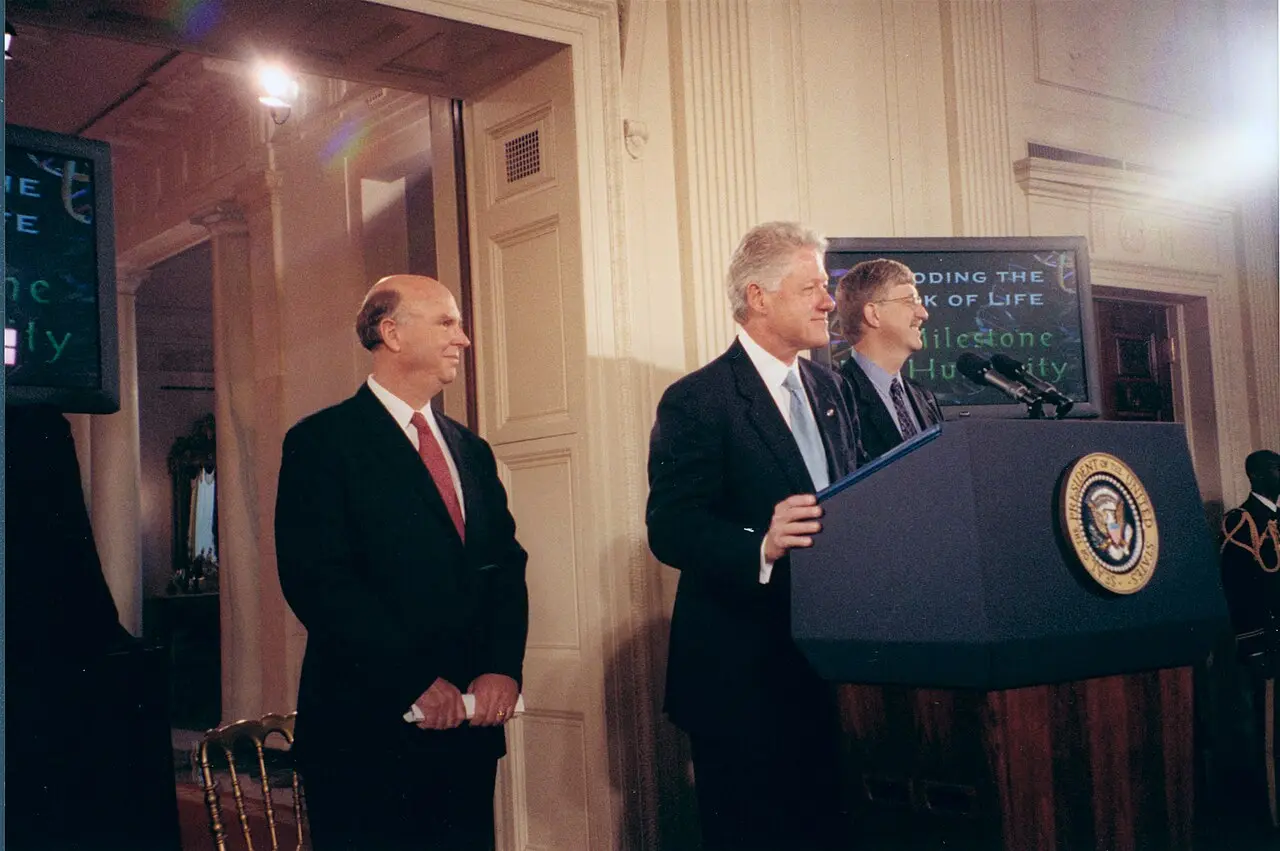
It was, as the announcement put it, one of the most ambitious scientific undertakings of all time — "even compared to splitting the atom or going to the moon." The road had been long. The idea took shape at Department of Energy conferences in the mid-1980s; the National Institutes of Health created a dedicated genome center in 1989, with DNA co-discoverer James Watson as its first leader. A rough working draft was celebrated at the White House in June 2000; three more years of grinding laboratory work filled in the gaps. All told, it took six to eight years of active sequencing and cost roughly $1 billion — far less than the original estimates.
NHGRI Director Francis Collins, who had led the project since 1993, called it "an amazing adventure into ourselves, to understand our own DNA instruction book, the shared inheritance of all humankind." The timing was deliberate: the announcement coincided with the 50th anniversary of the landmark 1953 paper in which Watson and Francis Crick described DNA's double helix — the structure that made reading the genome possible at all.
What did "complete" mean? Scientists then estimated the genome held around 30,000 genes, and the reference sequence gave every researcher on Earth a common map to work from. The race against a private effort — Craig Venter's Celera Genomics — had sharpened the pace and kept the data public. And the technology curve was already bending: in 2003, sequencing a second human genome would have taken three to four months and cost $30 to $50 million.
The payoff is still unfolding: precision medicine, cancer therapies matched to a tumor's mutations, ancestry tracing, forensic science, and a biotechnology industry built on cheap sequencing all trace back to this map. On a spring day in 2003, humanity finished reading the instruction book it had been written in — and opened the first page of the era of the genome.
Photo: National Human Genome Research Institute, public domain (via Wikimedia Commons). President Bill Clinton with NHGRI's Francis Collins and Celera's Craig Venter at the White House announcement of the genome's working draft in June 2000 — shown as an illustration, not an image of the April 2003 completion announcement.