The Day the World's Smallest Country Was Born
On June 7, 1929, the Lateran Treaty's ratification took full effect, ending a 59-year standoff and creating Vatican City as an independent state.
It is smaller than many shopping malls — about 44 hectares, or 110 acres — and yet it is a fully sovereign country, with its own stamps, its own coins, its own head of state. And it all began, officially, on June 7, 1929.
For nearly six decades before that day, the pope and Italy had been locked in one of the strangest standoffs in modern history. When Italian unification swept through the peninsula in 1870, the new Kingdom of Italy seized the Papal States, the broad belt of central Italy the popes had ruled for centuries. The pope at the time, Pius IX, refused to accept it. He would not recognize the Italian state, and the Italian state would not recognize his sovereignty. So every pope after him considered himself, in the famous phrase, a "prisoner in the Vatican" — a head of state without a state, who would not set foot outside the small enclave around St. Peter's Basilica because to do so would imply accepting Italy's authority. This deadlock was known as the Roman Question, and it poisoned relations between the Catholic Church and the Italian state for 59 years.
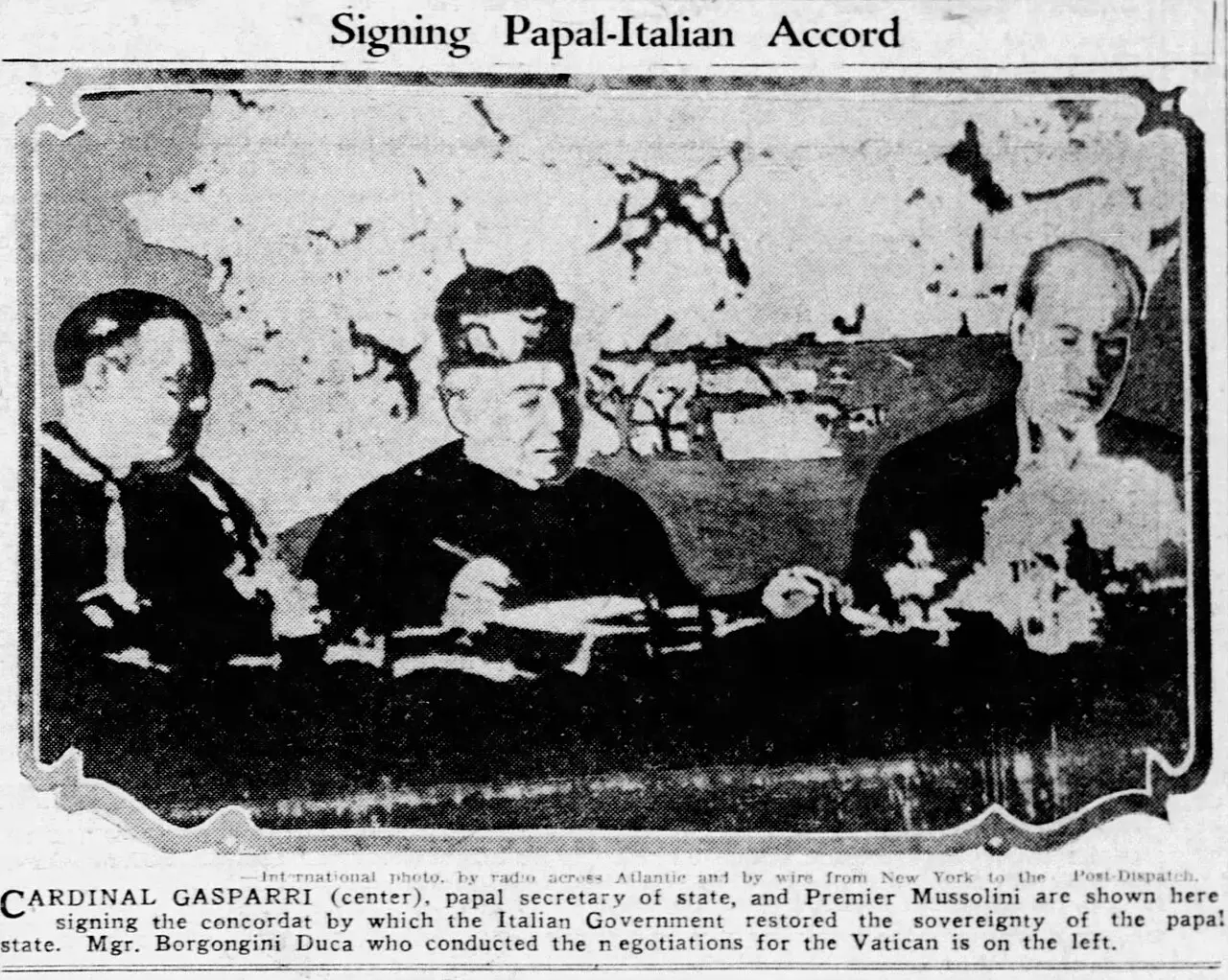
The thaw began in 1926, when the government of Benito Mussolini opened negotiations with the Holy See under Pope Pius XI. Mussolini, for all his brutality, wanted the prestige of settling the question; the Church wanted its independence secured. The talks produced the Lateran Pacts, signed on February 11, 1929, in the Lateran Palace in Rome. Cardinal Pietro Gasparri, the papal secretary of state, signed for the Holy See; Mussolini himself signed for King Victor Emmanuel III.
The pacts had three parts. The political treaty recognized the full sovereignty of the Holy See in a new State of Vatican City — the world's smallest independent state. The financial convention settled the Church's claims for the lost Papal States with 750 million lire in cash and a billion lire in Italian government bonds. And the concordat regulated the Church's position in Italian life, making Catholicism the state religion of Italy — a status it kept until the treaty was revised in 1984 — and requiring bishops to swear loyalty to the state.
But a signed treaty is not yet a living state. That came on June 7, 1929, when the Italian Parliament ratified the pacts and they went into full effect. On that day, the "prisoner in the Vatican" became, in the eyes of the world, the sovereign of a real country. The Vatican began issuing its own postage stamps and coins, ran its own post office, and took its seat among the nations. To mark the reconciliation, Mussolini commissioned the Via della Conciliazione — the Road of the Conciliation — a grand avenue linking St. Peter's Square to the heart of Rome. In 1948, the new Italian constitution formally recognized the Lateran Treaty as the basis of church-state relations.
The treaty also bound the pope to perpetual neutrality in international affairs — a pledge that shaped the Vatican's wartime and Cold War diplomacy — and declared Rome the "centre of the Catholic world."
Why it matters: the birth of Vatican City is proof that even the most entrenched standoff can end at a negotiating table. A pope and a dictator, for entirely different reasons, each decided the impasse had to end — and from their bargain came a country with no army, no exports, and outsized influence, still standing as the smallest sovereign state on earth.
Photo: International Photo, public domain (via Wikimedia Commons).