The Day the European Union Was Born
On November 1, 1993, the Maastricht Treaty took effect and the European Union was born, turning a trading bloc into a political union of 12 nations.
No shots were fired, no crowds filled the squares. On November 1, 1993, a treaty simply took effect — and twelve countries woke up as something the world had never quite seen before: a union.
The road to that morning had been long. After the Second World War, European leaders began stitching their economies together so tightly that war between them would become unthinkable: first coal and steel in 1951, then the broader common market of the 1957 Treaty of Rome. By the early 1990s, with the Cold War over and Germany reunified, the moment had come to go further — from a trading bloc to a political union.
The leap was negotiated in the Dutch city of Maastricht, where the treaty was signed on February 7, 1992. The Maastricht Treaty formally created the European Union, replacing the old European Community with a new structure built on three pillars: the shared economy, a common foreign and security policy, and cooperation on justice and home affairs. It set a timetable for a single currency — the euro — and created something entirely new in international law: citizenship of the European Union, giving every citizen of a member state the right to live, work, and vote anywhere in the Union.
Ratification was anything but smooth. Denmark initially rejected the treaty in a 1992 referendum and only approved it a year later after winning opt-outs. Britain's parliament fought over it through the turmoil of the 1992 currency crisis. France approved it by the narrowest of margins. One by one, though, all twelve member states signed on, and on the first morning of November 1993 the treaty entered into force.
The new Union started with twelve members and about 340 million people. The euro arrived for electronic transactions in 1999 and in cash in 2002. Membership would eventually grow to 28 — before Britain's 2016 Brexit vote made it the first country to leave, a reminder that the union was voluntary or it was nothing.
Skeptics at the time called the whole project an impossible dream: a continent that had spent centuries at war, sharing a currency, open borders, and a parliament. Three decades on, the dream is dented but standing — the world's largest single market, and a standing bet that cooperation beats conquest.
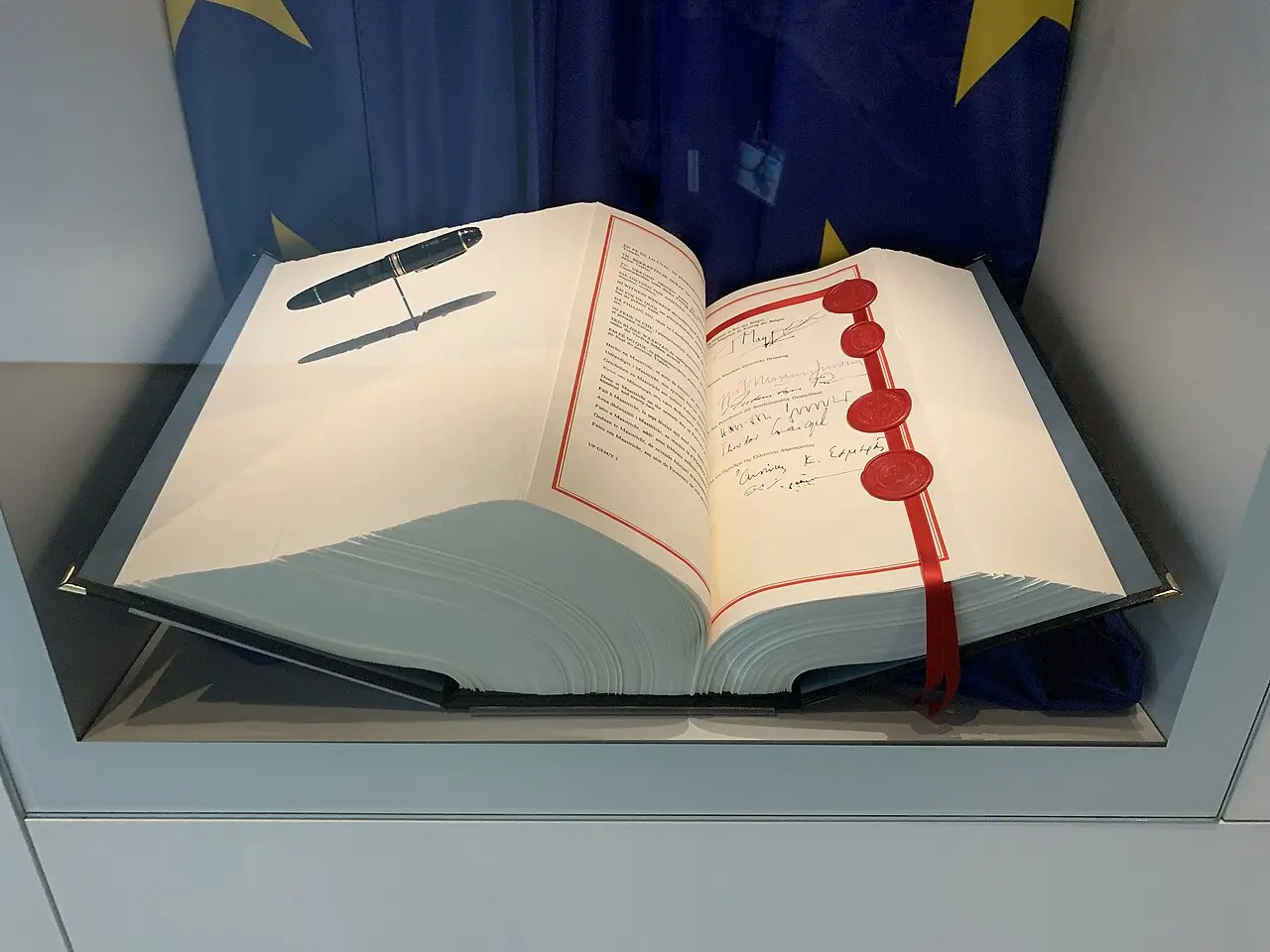
The treaty book above, with its signatures and red seals, sits in a museum in Regensburg — the paperwork of a quiet revolution.
Photo: Mateus2019, CC BY 2.0 de (via Wikimedia Commons).