Four Years on a Scaffold: Michelangelo's Sistine Chapel Ceiling
On November 1, 1512, the public saw Michelangelo's Sistine Chapel ceiling for the first time — four years of painting on a scaffold, 60 feet above the floor.
In the spring of 1508, Pope Julius II gave an unwilling sculptor the most famous painting job in history. Four and a half years later, on All Saints' Day 1512, the public climbed the stairs of the Sistine Chapel and looked up — and art was never the same.
Michelangelo was 33, and he insisted he was no painter. Julius wanted the chapel ceiling repainted, and Michelangelo — who considered himself a sculptor — protested that painting was not his craft. The pope insisted. So Michelangelo designed his own scaffolding, anchored to holes in the walls high above the floor, and went to work mostly alone, lying on his back or craning upward for hours at a time.
The physical cost was brutal. In a joking poem to a friend, he described the torment: his beard pointing at heaven, his brush dripping paint onto his face, his spine twisted like a bow. His eyesight suffered so badly that for months afterward he could only read by holding pages above his head.
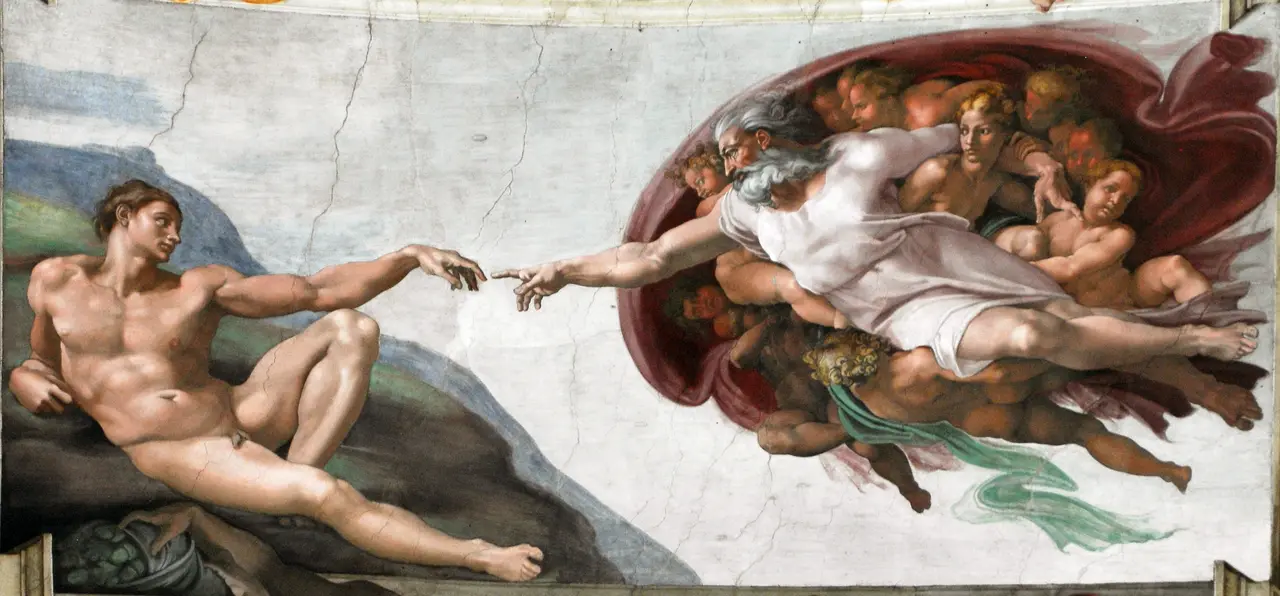
The result covered more than 5,000 square feet. Down the center run nine panels telling the story of Genesis — from the separation of light and darkness to the drunkenness of Noah. The most famous, the Creation of Adam, shows God sweeping through the sky in a swirl of drapery, his finger extended toward a languid Adam on a hillside, their hands nearly touching. Around the center, in a complex architectural framework of Michelangelo's own invention, stand prophets, sibyls, and the ancestors of Christ — more than 300 painted figures in all, each one muscled and twisting as if carved from marble.
The ceiling was finished in October 1512, and tradition holds that it was first shown to the public on November 1, All Saints' Day, with the pope celebrating Mass beneath it. The effect was immediate and overwhelming. Artists flocked to see it; the young Raphael is said to have studied it in awe. Giorgio Vasari, the great chronicler of the Renaissance, later wrote that the work was a beacon that lit the way for all painters who followed.
It had not been easy on the relationship that produced it. Julius was famously impatient — legend says he once threatened to have Michelangelo thrown off the scaffold for working too slowly — and Michelangelo fled Rome more than once in frustration. But the pope got his ceiling, and the sculptor who did not want to paint produced the single most famous painted surface in the world.
Five centuries later, the crowds still come, necks craned, phones raised against the rules. The fingers of God and Adam still do not quite touch — the most famous almost-moment in art.
Photo: Michelangelo, public domain (via Wikimedia Commons).