The Day Lisbon Fell: The 1755 Earthquake That Shook the World
On November 1, 1755, a massive earthquake, tsunami, and fire destroyed Lisbon, killing tens of thousands and shaking Europe's faith in a rational world.
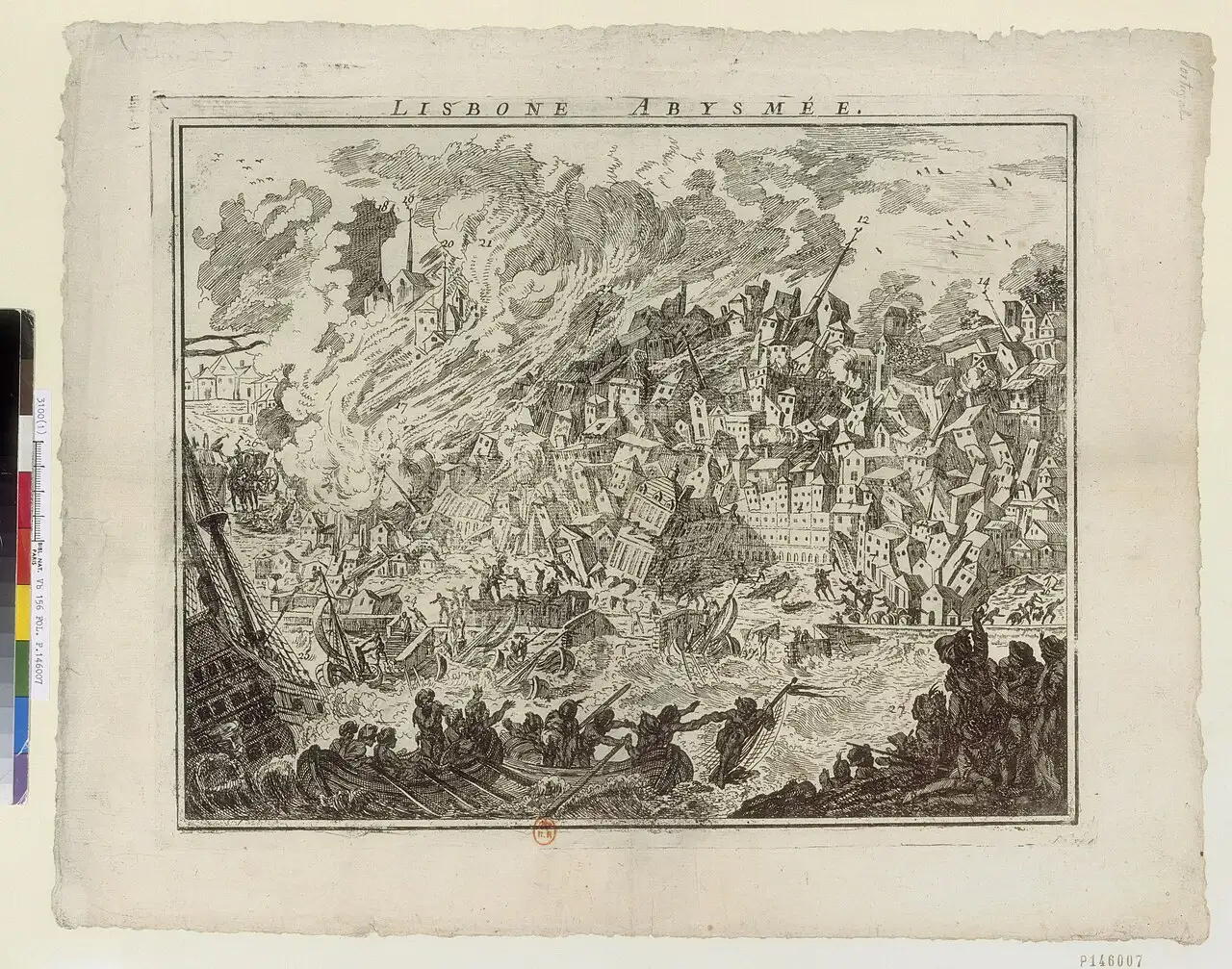
The morning was a holy day, and the churches were full. Then the ground began to move, and Lisbon — one of the richest cities in Europe — was about to be unmade in less than ten minutes.
On November 1, 1755, at about 9:40 in the morning, a massive earthquake struck off the coast of Portugal. It was All Saints' Day, so much of the city's population, roughly 200,000 people, was packed into churches lit with candles. The shaking went on for several minutes — long enough to bring down nearly every grand building in Lisbon: the royal palace, the opera house, churches, convents, and most of the homes in the old quarters.
What followed made it worse. About forty minutes after the quake, the sea drew back from the harbor and then rushed in as a tsunami, smashing ships and drowning many who had fled to the waterfront for safety. Then came the fires. Toppled candles and cooking hearths lit blazes that burned out of control for five or six days, finishing what the shaking and the water had started.
The death toll will never be known exactly. Modern historians generally place it between 30,000 and 60,000 — perhaps a quarter of the city's people — though some early accounts ran far higher. What is certain is that the disaster was among the deadliest earthquakes in European history.
Portugal's king, Joseph I, survived — he and the court had left the palace that morning — but he was so shaken that he reportedly refused to sleep under a roof afterward. Real power fell to his chief minister, Sebastião José de Carvalho e Melo, the Marquis of Pombal. Pombal is traditionally credited with the order that defined the response: "Bury the dead and feed the living." He organized food distribution, set up field hospitals, deployed troops against looters, and — in what may have been the first systematic earthquake investigation in history — sent a questionnaire to every parish asking when the shaking started, how long it lasted, and how many had died.
The rebuilding was just as remarkable. Pombal cleared the ruins of the Baixa district and laid it out on a modern grid, using some of the first earthquake-resistant construction in Europe — flexible wooden frames, tested by having soldiers march around full-scale models. The roofless skeleton of the Carmo Convent was left standing as a memorial; it still stands today.
But the earthquake's greatest aftershock was philosophical. How could a just God destroy a devout city on a holy day? Voltaire, who had once praised the optimism of the age, wrote a poem on the disaster and then savaged the idea of a best-of-all-possible-worlds in Candide. Rousseau argued that the calamity was made worse by people crowding into tall buildings. The young Immanuel Kant wrote three essays on earthquakes. Out of the rubble came modern seismology, modern urban planning, and a modern argument about whether the universe cares about us at all.
Lisbon rebuilt itself in Pombal's image — orderly, rational, defiant. But every November 1st, Portugal remembers the morning the earth moved, the sea rose, and the sky burned.
Photo: Bibliothèque nationale de France, public domain (via Wikimedia Commons).