
The Day Sound Learned to Stay
On February 19, 1878, Thomas Edison received U.S. Patent No. 200,521 for the phonograph — the first machine that could both record and play back sound.
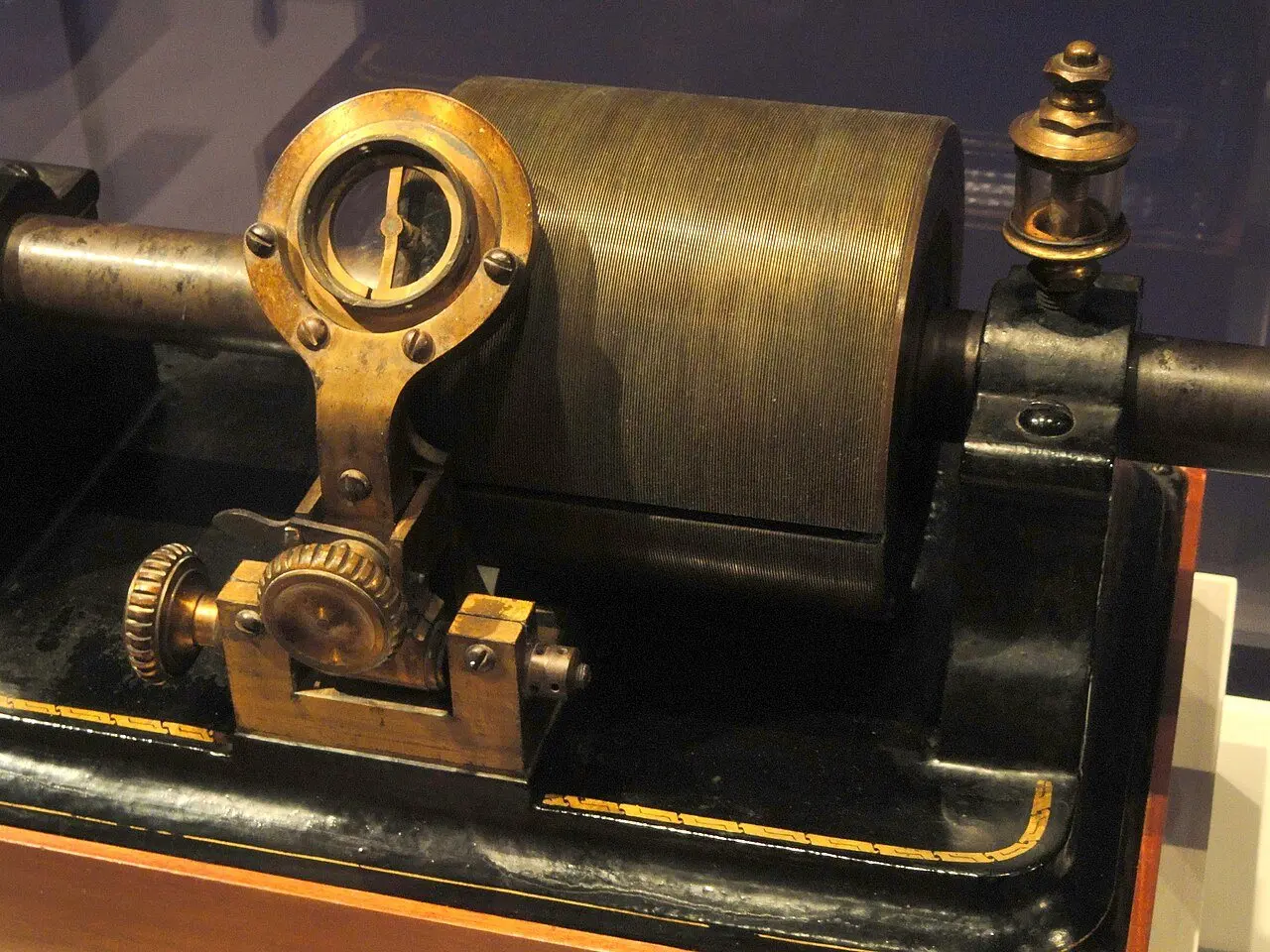
Until one winter day in 1877, every sound in human history had vanished the instant it was made. A mother's lullaby, a president's speech, a favorite song — heard once, then gone forever into the air. Thomas Edison changed that.
Edison was 30 and working at his laboratory in Menlo Park, New Jersey, trying to improve the telegraph. While tinkering, he noticed that a strip of paper tape, pulled quickly under a needle, gave off a noise that sounded like muffled speech. It was a spark of an idea: if sound could make a mark, maybe a mark could make a sound.
He sketched a design for a machine that would record sound on a grooved cylinder wrapped in tinfoil: a needle would trace the vibrations of a voice into the foil, and running the same needle back over the marks would make the machine speak the sound back. He built it, leaned in, and shouted into the mouthpiece. According to the story Edison himself told for the rest of his life, he recited the nursery rhyme "Mary had a little lamb" — and the machine recited it back to him.
On Christmas Eve 1877, Edison filed a patent for the device. The U.S. Patent Office granted it as Patent No. 200,521 on February 19, 1878. He called his invention the phonograph — literally, "sound writer" — and it was the first machine that could both record and play back sound.
The world had never seen anything like it. Newspapers called Edison the "Wizard of Menlo Park." At first the phonograph was a novelty, a parlor trick that made audiences gasp when a metal box spoke. But Edison saw bigger things: the machine could take dictation in offices, record the voices of loved ones, teach languages, and preserve the music of the day. Within a decade, phonographs were playing songs in parlors, and the foundation of the entire recorded-music industry — every record, every tape, every streaming song you have ever heard — was laid.
Edison would go on to patent more than a thousand inventions, including the practical light bulb and the motion picture camera. But when asked, he often said the phonograph was his favorite. The man gave the world the light to see by — but first, he gave sound a way to stay. It remains one of the most human inventions ever made: a machine whose whole purpose is memory.
Photo: Daderot, CC0 (via Wikimedia Commons).