The Day Oklahoma Became a State
On November 16, 1907, Theodore Roosevelt signed the proclamation admitting Oklahoma as the 46th state — born from the merger of two territories.
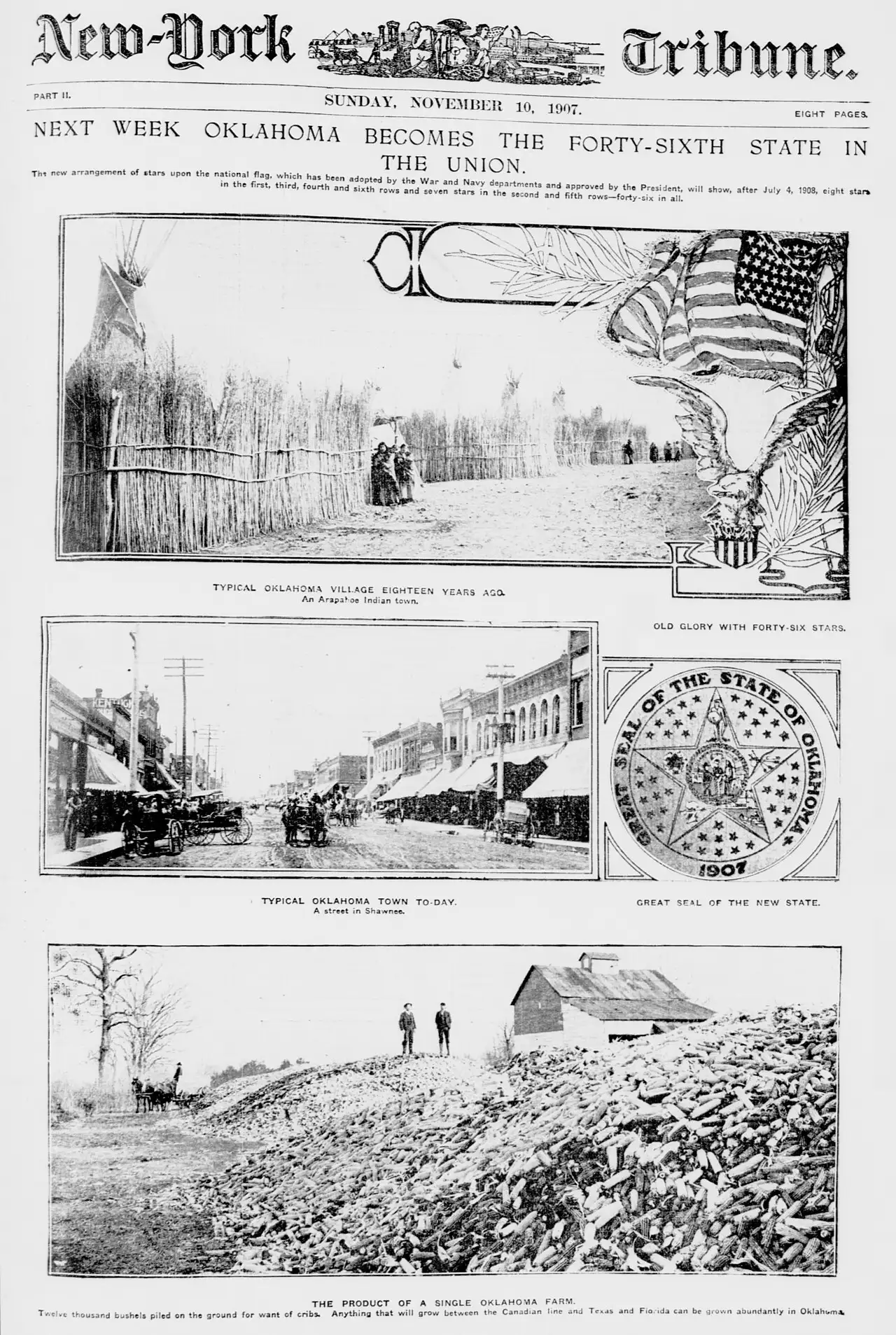
The proclamation was one sentence long, and it took a generation to earn. On November 16, 1907, President Theodore Roosevelt signed Proclamation 780, admitting Oklahoma to the Union as the 46th state — and two territories disappeared from the map in the same instant.
The land that became Oklahoma had been two different worlds. The western half was the Oklahoma Territory, organized in 1890. The eastern half was Indian Territory, set aside decades earlier as the forced destination for tribes removed from the east, and it had been shrinking for years. Washington's answer to statehood pressure was to join them: the Enabling Act of June 1906 authorized the people of both territories to write a single constitution and seek admission as one state.
The constitutional convention met at Guthrie from November 1906 to the following September, with delegates from both territories hammering out a government for the combined state. Its product — at the time the lengthiest governing document of any government in the United States — was ratified on September 17, 1907, by a vote of 180,333 to 73,059. The same ballot made Democrat Charles N. Haskell the state's first governor, defeating territorial governor Frank Frantz, and it was Haskell's adopted constitution the president would sign off on two months later.
It had not been the first try. Two years earlier, the people of Indian Territory had voted overwhelmingly — 56,279 to 9,073 — for a constitution to enter the Union separately as the state of Sequoyah, a Native-led bid with its own government drafted at a convention in Muskogee. Congress set it aside, and Roosevelt himself had long preferred a single combined state. The Enabling Act of June 1906 settled the matter: Oklahoma and Indian Territory would come in together, or not at all.
That merger made Oklahoma unlike any other state: half of it had been organized as a territory for white settlement, and the other half had been promised, decades earlier, as a permanent home for tribes removed from the east. Statehood meant both histories would now be written under one flag.
So on a Saturday in November, the paperwork of empire became the paperwork of statehood. The territorial governments dissolved, the star for Oklahoma took its place among 46 on the flag, and a brand-new state began electing its first legislature, its first judges, and its own future.
A century later, Congress marked the centennial by noting that the state had been shaped by "adventurous and daring individuals" — and by the vibrant Native American history and culture that still enrich it. The frontier that Oklahoma closed in 1907 turned out to be the beginning of its story, not the end.
Photo: New-York Tribune, November 10, 1907, via the Library of Congress, public domain (via Wikimedia Commons).