The Day Canada Hanged Louis Riel
On November 16, 1885, Métis leader Louis Riel was hanged at Regina, turning a prairie uprising into one of the deepest wounds in Canadian history.
The men who built the gallows had to finish before winter closed in. The prisoner wrote letters to the end, forgave his enemies, and climbed the steps in what witnesses called a state of inner peace. When the trapdoor fell, the young nation of Canada acquired one of its deepest wounds.
Louis Riel was the voice of the Métis — the mixed-heritage people of the western plains — and twice he stood between them and a distant government in Ottawa. In 1869 he had led the Red River Resistance and forced the creation of the province of Manitoba. Banished for five years afterward, he lived in exile in the United States, teaching school in Montana, until a Métis delegation crossed the border in 1884 to bring him home. The grievances were familiar: settlers pouring into the Saskatchewan Valley, land titles ignored, and Ottawa unmoved.
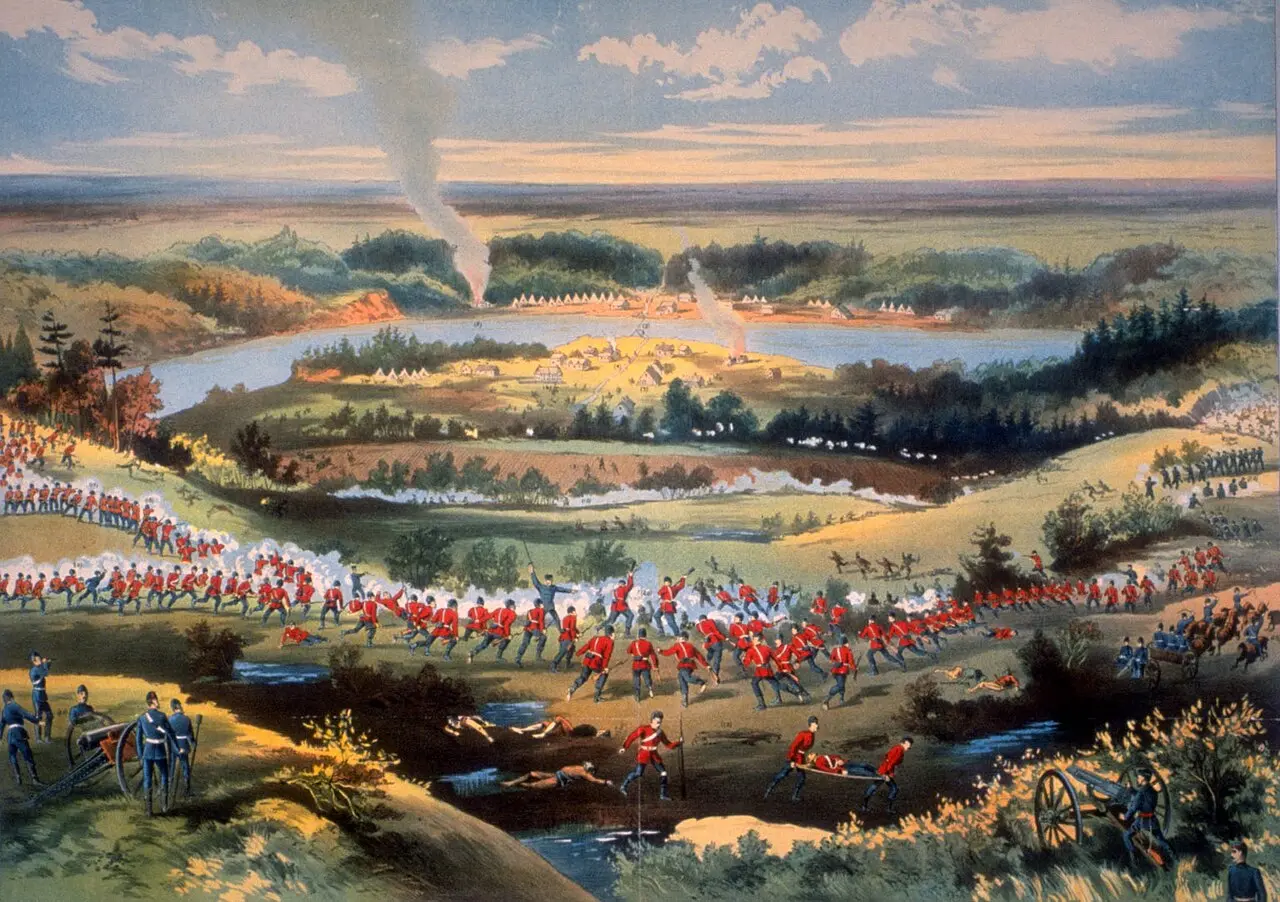
The result was the North-West Resistance of 1885. Riel set up a provisional government at Batoche. Ottawa answered with troops, and in May the settlement fell after a four-day battle — captured in the print above. Riel surrendered three days later and was taken to Regina to stand trial for high treason.
The trial, which opened on July 28, was a five-day political storm. Riel's own lawyers wanted to plead insanity — he had spent time in two Quebec asylums — but he refused, arguing that an insanity verdict would dismiss the reasonable demands of the Métis as the ravings of a lunatic. "Life, without the dignity of an intelligent being, is not worth having," he told the court — a line that sealed his fate and his legend at once. A jury of six Anglo-Protestant settlers found him guilty but recommended mercy. Judge Hugh Richardson sentenced him to hang.
Prime Minister John A. Macdonald — reported, though the wording is uncertain, to have remarked that Riel would hang "though every dog in Quebec bark in his favour" — refused to intervene. Requests for a retrial and an appeal to Britain's Privy Council were denied. On the morning of November 16, 1885, at the North-West Mounted Police barracks in Regina, Riel received his spiritual advisor, Father André, thanked those who had shown him kindness — one account says his last words were "Remerciez Madame Forget" — and was hanged for treason.
Quebec never forgave Ottawa. The execution split the country along language and faith, and for generations Riel was villain or martyr depending on who told the story. Over time the verdict of history softened: many of the things he fought for — provincial rights, respect for Métis land, a voice in Confederation — were eventually met. He was buried at St. Boniface in Winnipeg, the parish of his birth, where his grave remains a place of pilgrimage.
The gallows at Regina are gone. The wound he left — and the question he posed about whose country Canada would be — is still very much alive.
Photo: Seargent Grundy, public domain (via Wikimedia Commons).