The Day Napoleon Crowned Himself — in Front of the Pope
On December 2, 1804, Napoleon Bonaparte crowned himself Emperor of the French at Notre-Dame, with Pope Pius VII watching from the sidelines.
The Pope had traveled all the way from Rome. It made no difference.
By the spring of 1804, Napoleon Bonaparte had already seized power as First Consul. On May 18, the Senate formally vested the government of the French Republic in an emperor, and a referendum of the French people confirmed it. But Napoleon wanted more than a title — he wanted legitimacy, the kind that would make his new dynasty look inevitable to royalists, Catholics, and the courts of Europe.
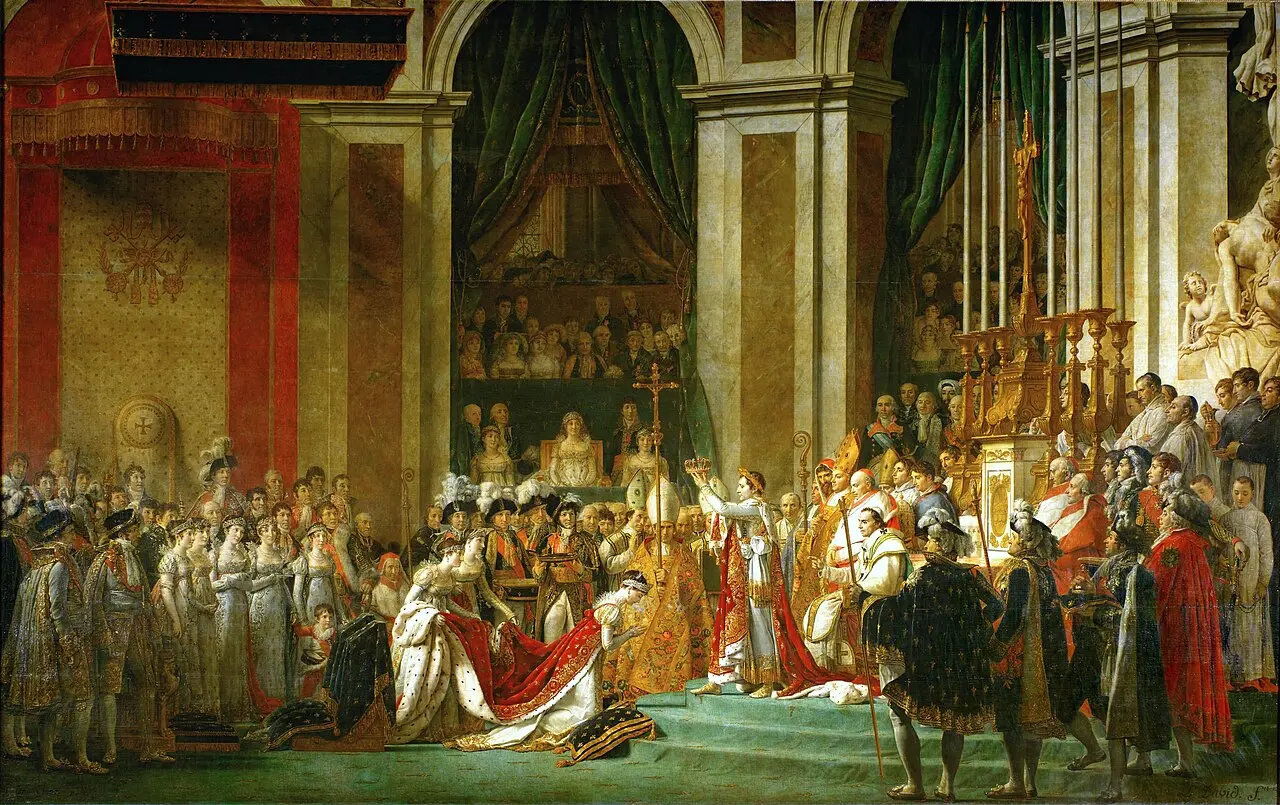
So he staged a coronation unlike any France had seen. It was, as one historian put it, a transparently masterminded piece of modern propaganda: months of preparation, thousands of guests, and a ceremony deliberately designed to borrow the sacred weight of Charlemagne's crowning as emperor on Christmas Day in the year 800 — Napoleon even timed echoes of that date and that papal presence into his own script. Instead of Reims, where French kings had been crowned for centuries, he chose Notre-Dame de Paris. Instead of receiving the crown from the Church's hands, he designed a ceremony blending Carolingian tradition, the old monarchy's rituals, and the Revolution's symbolism — and on December 2, 1804, before thousands of guests, he lifted the crown himself and placed it on his own head. Then he crowned his wife Joséphine as Empress. Pope Pius VII, who had come from Rome to bless the proceedings, watched it happen. When the formalities concluded, Napoleon presented imperial standards to his assembled regiments — soldiers swearing loyalty to a man rather than an abstraction.
The message was unmistakable: Napoleon's authority came from Napoleon — from his victories, his merit, his will — not from God, the Church, or ancient bloodlines.
The painter Jacques-Louis David immortalized the scene in a canvas more than thirty feet wide — begun in December 1805, finished in January 1808 — which still hangs in the Louvre. Napoleon even had the ritual repeated in miniature: a year after Notre-Dame, he was crowned again, as King of Italy in Milan, with the medieval Iron Crown. A decade later, the empire collapsed at Waterloo.
Why it still matters: the coronation was the birth of modern political theater — power staged as spectacle, legitimacy manufactured in front of cameras that did not yet exist. Every choreographed inauguration and flag-draped rally since owes something to the afternoon a general decided no one was above him, not even the Pope.
Photo: Jacques-Louis David, "The Coronation of Napoleon" (1807), public domain (via Wikimedia Commons).