
The Day Congress Launched the U.S. Navy
On October 13, 1775, the Continental Congress voted to arm two small ships — and the United States Navy was born.
In the autumn of 1775, the American rebellion had an army but no navy. George Washington's troops were besieging British-held Boston, while British supply ships sailed the Atlantic unmolested, feeding the redcoats and starving the rebellion. In Philadelphia, the Continental Congress faced a blunt question: could a revolution survive without ships?
On October 13, 1775, Congress answered. In a spare, businesslike resolution, the delegates voted to fit out two armed vessels — "a swift sailing vessel, to carry ten carriage guns, and a proportionate number of swivels, with eighty men" — and send them hunting British supply ships. The two ships were the brig Andrew Doria and the schooner Cabot. With that vote, the Continental Navy — and the United States Navy — was born.
It was a staggering gamble: authorizing a navy to fight the Royal Navy, then the most powerful fleet on earth, with two converted merchant vessels. The Andrew Doria and the Cabot were small and lightly armed, crewed by men who had never fought a naval war. But Congress understood something the British did not: a rebellion that could not touch Britain's supply lines could not win.
The gamble paid off faster than anyone dared hope. The little fleet grew. By December, Congress had appointed Esek Hopkins as its first commander-in-chief, and among the first officers commissioned was a young lieutenant named John Paul Jones. The new navy's ships began snapping up British supply vessels, and in the spring of 1776 the fleet scored its first victory, raiding Nassau in the Bahamas and seizing desperately needed gunpowder and cannon.
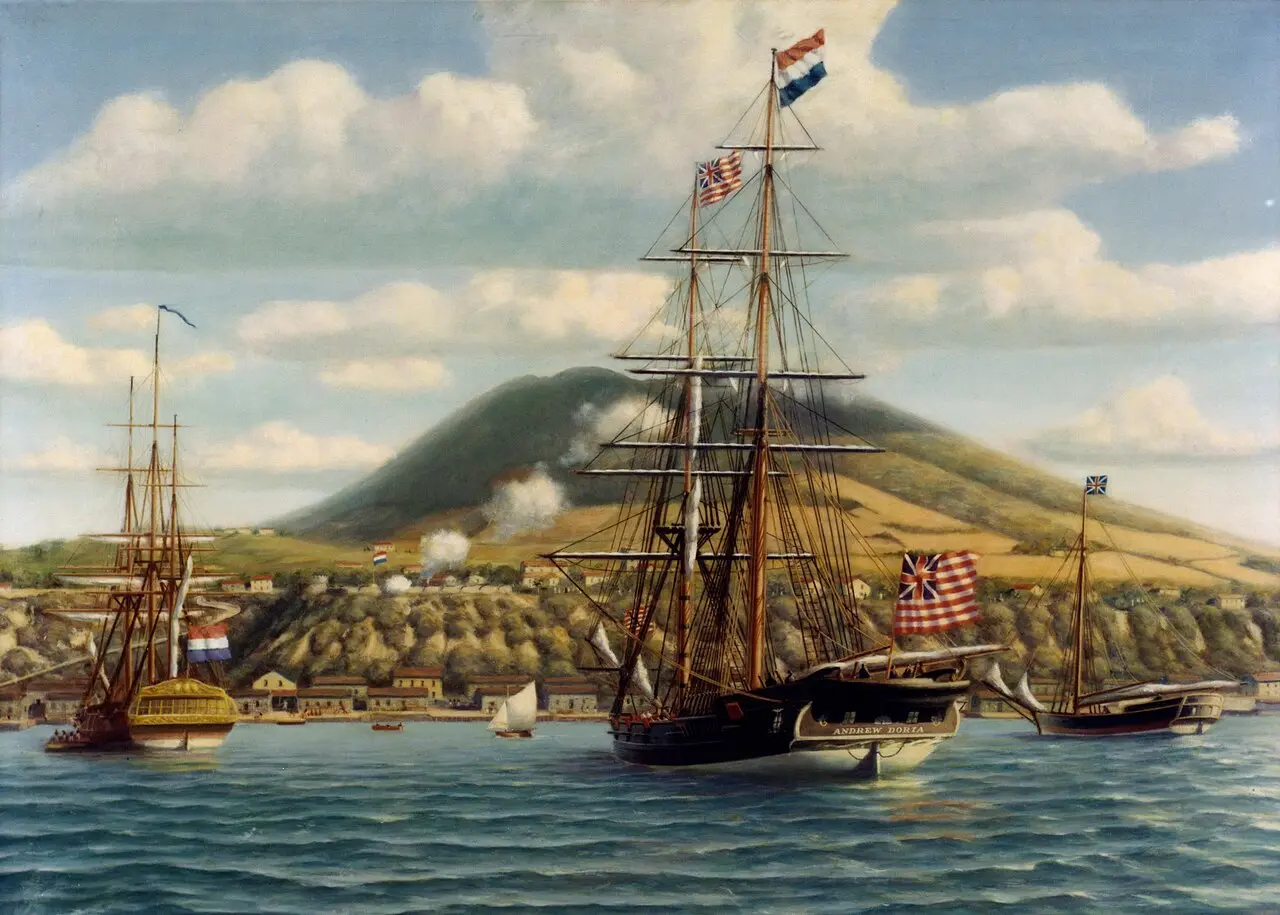
The Andrew Doria herself earned a singular honor. In November 1776, anchored off the Dutch island of St. Eustatius in the Caribbean, she received a salute from the island's fort — the first time a foreign power saluted the American flag flown from an American warship. The painting above captures that moment: the little brig Congress had authorized a year earlier, her Grand Union flag flying, greeted as a vessel of a nation.
The Continental Navy did not survive the war — it was disbanded in the 1780s, its last ships sold. But the idea survived. In 1794, Congress authorized six frigates, including the USS Constitution, and the Navy was reborn as a permanent force. From two small ships voted into existence on an October afternoon, it grew into one of the most powerful navies in history.
The Navy still celebrates its birthday every October 13 — a date chosen not for a great battle, but for a vote. No shots were fired that day in Philadelphia. There was only a resolution, two small ships, and the audacious belief that a new nation could build a navy from nothing. It did.
Image: The Continental brig Andrew Doria — one of the two vessels Congress voted to arm on October 13, 1775 — receiving the first salute to an American flag by a foreign power, off St. Eustatius in November 1776. Painting by Phillips Melville, courtesy of the U.S. Naval History and Heritage Command; public domain, via Wikimedia Commons.