The Afternoon the Presidency Changed Hands
On September 14, 1901, hours after William McKinley died, Theodore Roosevelt took the presidential oath in the library of a friend's Buffalo home.
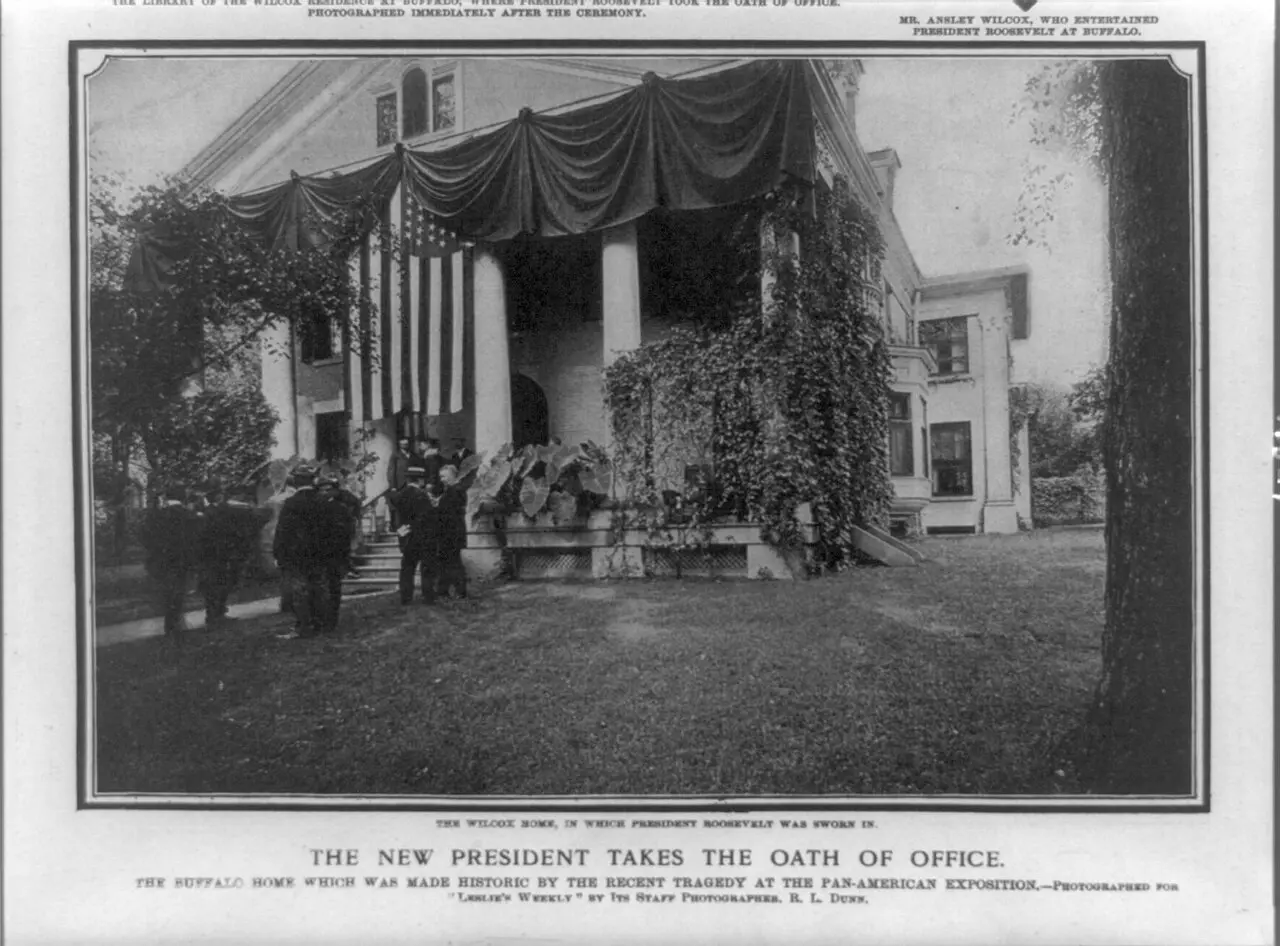
The new president arrived in borrowed clothes, in a house draped in mourning black, to take an oath nobody had planned for him to take.
Eight days earlier, on September 6, 1901, President William McKinley had been greeting the public at the Temple of Music in Buffalo's Pan-American Exposition when a young anarchist named Leon Czolgosz stepped forward, a pistol hidden under a handkerchief, and shot him twice at point-blank range. At first the president seemed to rally. Vice President Theodore Roosevelt, hiking in the Adirondack Mountains, was told the crisis had passed.
Then gangrene set in. On the night of September 13, a messenger raced up a mountainside trail to find Roosevelt. By wagon and by train, through the dark and the rain, the vice president rushed for Buffalo — for more than three hours, unaware that he was already, in the eyes of the Constitution, the president. William McKinley died at 2:15 that Saturday morning.
By mid-afternoon, Buffalo's grandest houses on Delaware Avenue were in mourning. In the library of the home of Ansley Wilcox, a wealthy friend, the members of McKinley's cabinet gathered around the 42-year-old Roosevelt. The house itself was hung with black bunting; an American flag draped the porch. Photographers were kept outside — no camera would record what happened inside.
At about half past three, federal judge John R. Hazel administered the oath of office, and Theodore Roosevelt became the 26th president of the United States — the youngest ever to hold the office. Before the small, tearful gathering, he spoke the shortest inaugural address in American history. "I shall take the oath at once," he said, "and in this hour of deep and terrible national bereavement I wish to state that it shall be my aim to continue absolutely unbroken the policy of President McKinley for the peace, the prosperity and the honor of our beloved country." The newspapers printed his words the next morning.
The words were meant to reassure a shocked nation — and a nervous Wall Street, which feared the famously combative Roosevelt would upend everything. He kept McKinley's cabinet, at least for a time. But the reassurance was only partly true. The new president would go on to shatter monopolies, conserve millions of acres of public land, build the Panama Canal, and win the Nobel Peace Prize — remaking the presidency into the powerful, personal office Americans recognize today.
Why does it matter? Power changed hands that afternoon without an election, without a crisis of succession, without a soldier in the streets — just an oath in a borrowed parlor, administered by a local judge. The peaceful transfer of power is easy to take for granted. On September 14, 1901, in a house hung with black crepe in Buffalo, New York, it worked exactly as designed.
Photo: Leslie's Weekly, public domain (via Wikimedia Commons).