The 5,300-Year-Old Man the Melting Ice Gave Back
On September 19, 1991, two hikers in the Otztal Alps spotted a body melting out of the ice — a Copper Age man who had lain there for 5,300 years.
Two hikers, off the trail on a late-summer afternoon, noticed something brown sticking out of the melting ice. What they found would turn out to be the oldest murder mystery in Europe.
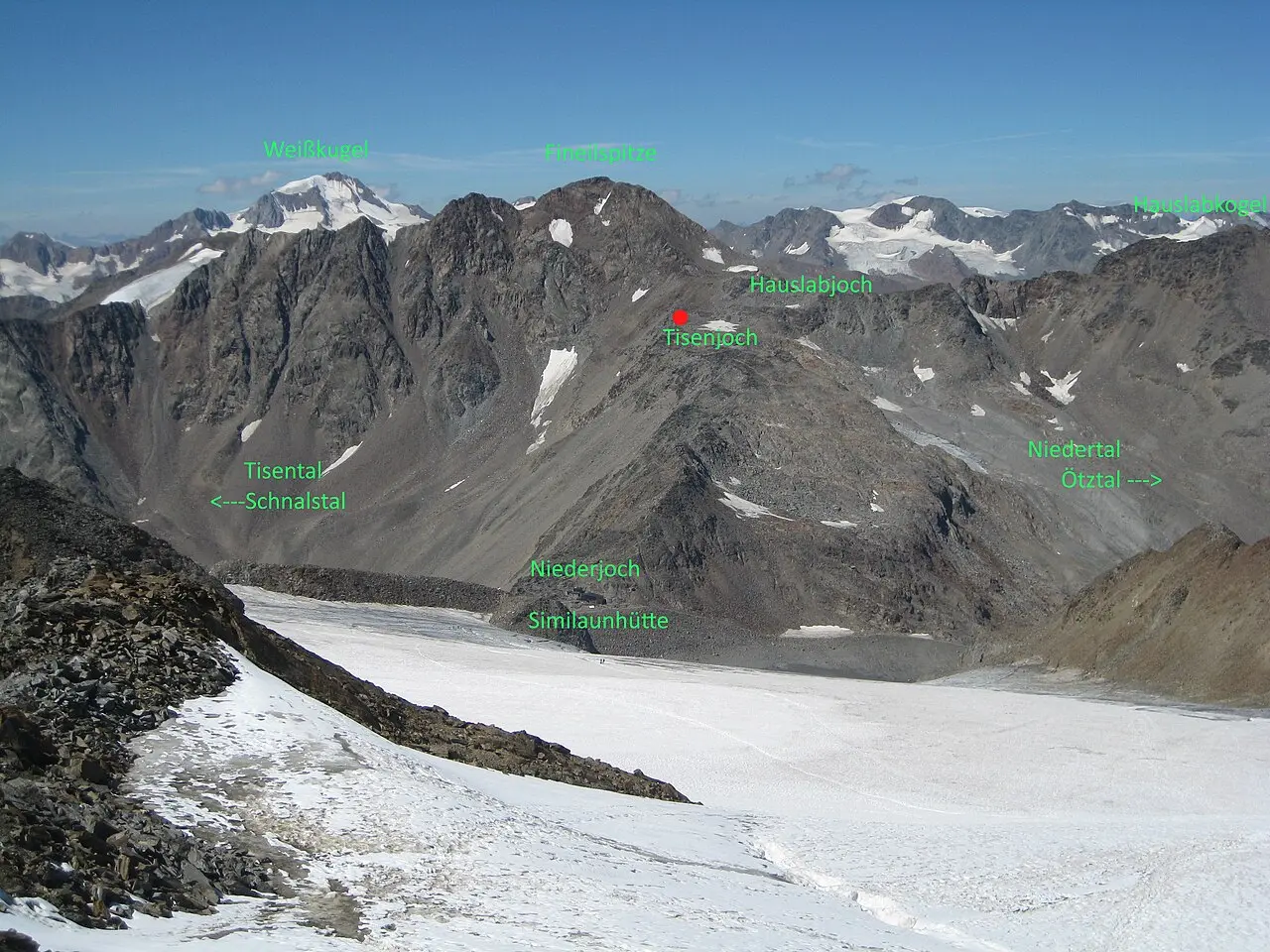
On September 19, 1991, German tourists Helmut and Erika Simon were descending from the Fineilspitze peak in the Ötztal Alps, high on the border between Austria and Italy. Taking a shortcut across the Tisenjoch pass, they spotted a body face-down in a shallow gully — the upper torso emerging from the ice, the rest still frozen in. They snapped a photograph, reported it at the nearby Similaun hut, and assumed they had found a recently lost mountaineer. Everyone who came after them made the same mistake.
Retrieving the body was a mess. Bad weather, makeshift tools, ice axes and pneumatic drills — and, worse, a parade of curious visitors who trampled fragile belongings before anyone realized what they were looking at. Climbing legend Reinhold Messner happened to pass through the area, looked at the copper axe lying near the body, and guessed that the dead man was far, far older than anyone imagined. On September 23, four days after the discovery, the body was finally freed and flown to the University of Innsbruck. By the end of that same day, researchers knew: this was no lost climber. He was ancient.
Radiocarbon dating put his death at roughly 3300 BCE — about 5,300 years ago, in the Copper Age, long before the pyramids rose in Egypt. He was about 45 years old, around 1.6 meters tall, and weighed roughly 50 kilograms. Europe had never seen a natural human mummy this old. Newspapers called him Ötzi, after the valley where he was found.
His body was a time capsule. He wore leather leggings and a woven grass cloak, shoes stuffed with grass for insulation, and a bearskin cap. He carried a copper axe — a prized, high-tech possession for his era — plus a bow, a quiver of arrows, and a flint dagger. Researchers found dozens of tattoos inked into his skin, and his last meal still in his stomach: bread, dried meat, and cheese.
The ice had kept his body, but it had also kept his secret for five millennia. Later examinations found a flint arrowhead lodged in his shoulder. He had been shot — most likely from behind — and bled to death quickly, alone in the high mountains.
Since 1998, Ötzi has rested in the South Tyrol Museum of Archaeology in Bolzano, Italy, in a specially cooled chamber, with his clothes and tools displayed alongside him. Scientists are still studying him, still learning about his diet, his illnesses, his final hours.
The Simon couple simply took a shortcut off the path. Five thousand years of ice did the rest — preserving one man's ordinary last day so completely that the modern world could read it like a book.
Photo: Mai-Sachme, CC BY-SA 4.0, via Wikimedia Commons.