The 2 A.M. Speech That Built the Peace Corps
Exhausted and campaigning at 2 a.m. in Michigan, John F. Kennedy challenged students to serve abroad — and on March 1, 1961, that dare became the Peace Corps.
It was 2 o'clock in the morning on October 14, 1960, on the steps of the student union at the University of Michigan in Ann Arbor. Some 10,000 students had waited hours in the cold to hear the young presidential candidate, John F. Kennedy, who had arrived late from a long day of campaigning. Exhausted, speaking without notes, Kennedy threw them a challenge: would they give a few years of their lives to live and work in Asia, Africa, and Latin America, helping people who needed skilled hands?
The students answered before he finished. Within weeks they had organized a petition drive and gathered 1,000 signatures backing the idea, and hundreds pledged to serve. The response stunned Kennedy's advisers — and convinced Kennedy himself to make the idea a priority. In his inaugural address a few months later, he gave the challenge its immortal form: "Ask not what your country can do for you — ask what you can do for your country."
On March 1, 1961, barely six weeks into his presidency, Kennedy signed Executive Order 10924, establishing the Peace Corps on a temporary basis inside the Department of State. That same day he sent a message to Congress recommending a permanent Peace Corps — "a pool of trained American men and women sent overseas" to help other nations meet their urgent need for skilled manpower. He named his brother-in-law, Sargent Shriver, as the program's first director, and Shriver built the organization from scratch in a matter of weeks.
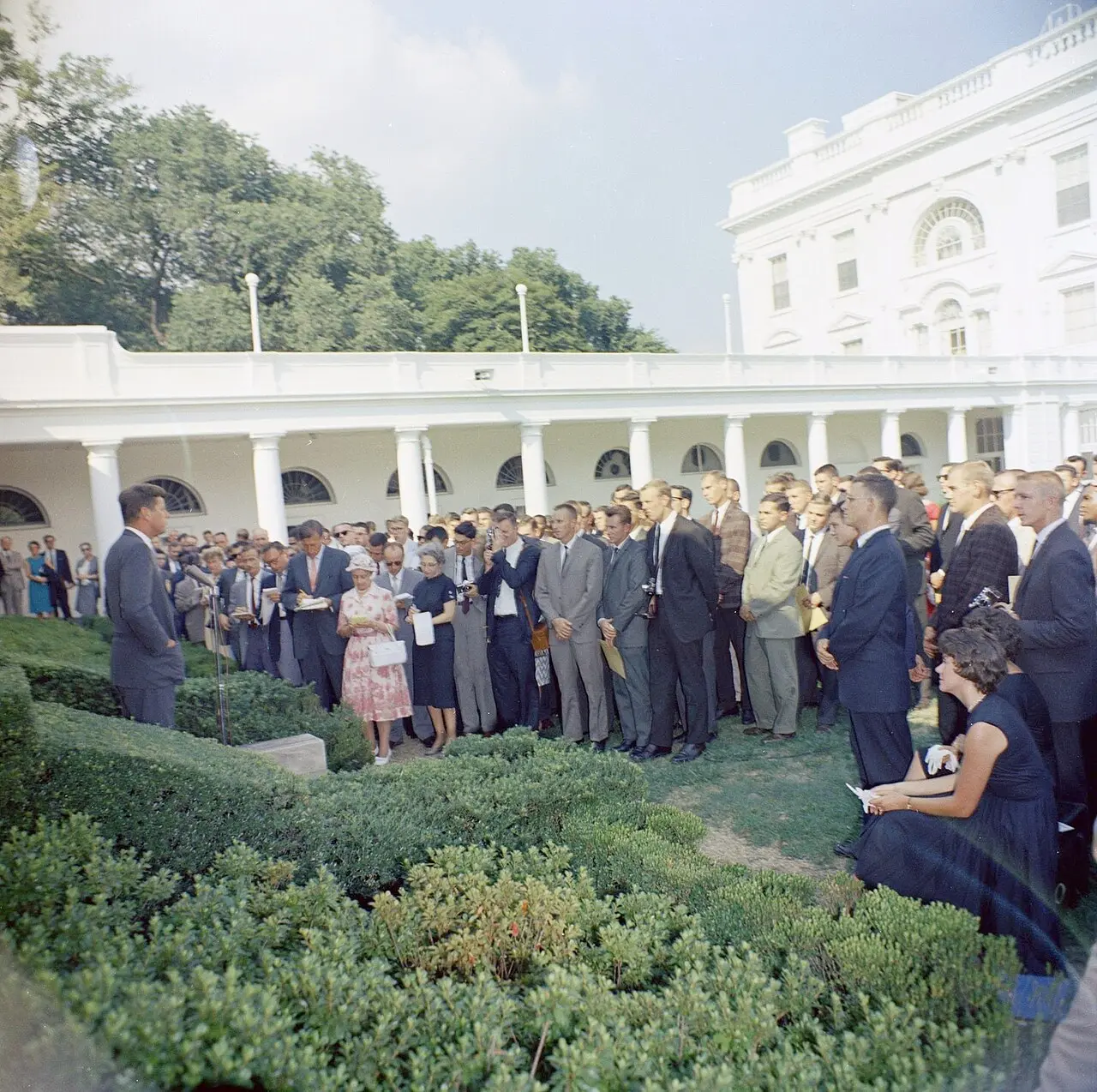
Congress made it permanent with the Peace Corps Act of September 22, 1961. That summer the first volunteers — bound for Ghana and Tanganyika — were greeted by Kennedy in the White House Rose Garden before shipping out. Training began immediately, with the goal of placing volunteers in overseas posts by late fall.
The timing was no accident. The Cold War was at full chill, and Kennedy worried about the image of the "Ugly American" — the stereotype of the arrogant Yankee abroad — especially in the newly independent nations of post-colonial Africa and Asia. The Peace Corps was his answer: instead of lecturing the developing world, young Americans would live in its villages, teach in its schools, and work alongside its farmers.
It worked. In the decades since, hundreds of thousands of Americans of all ages have served as Peace Corps volunteers in more than 140 countries — teaching, building wells, fighting disease, planting forests, and starting small businesses. Just as Kennedy hoped, the learning ran both ways: volunteers came home with a deeper understanding of the world, and whole communities abroad gained a more human picture of America.
The Peace Corps endures as proof that idealism, properly organized, can become policy — and that a speech given at 2 a.m. to tired students can still be changing lives more than sixty years later.
Photo: President Kennedy with the first group of Peace Corps volunteers in the White House Rose Garden, 1961, by an official White House photographer, public domain via Wikimedia Commons.