The Battle That Stopped an Empire: Ethiopia's Triumph at Adwa
On March 1, 1896, an African army crushed a European colonial power at Adwa — the battle that kept Ethiopia free and shattered the myth of European invincibility.
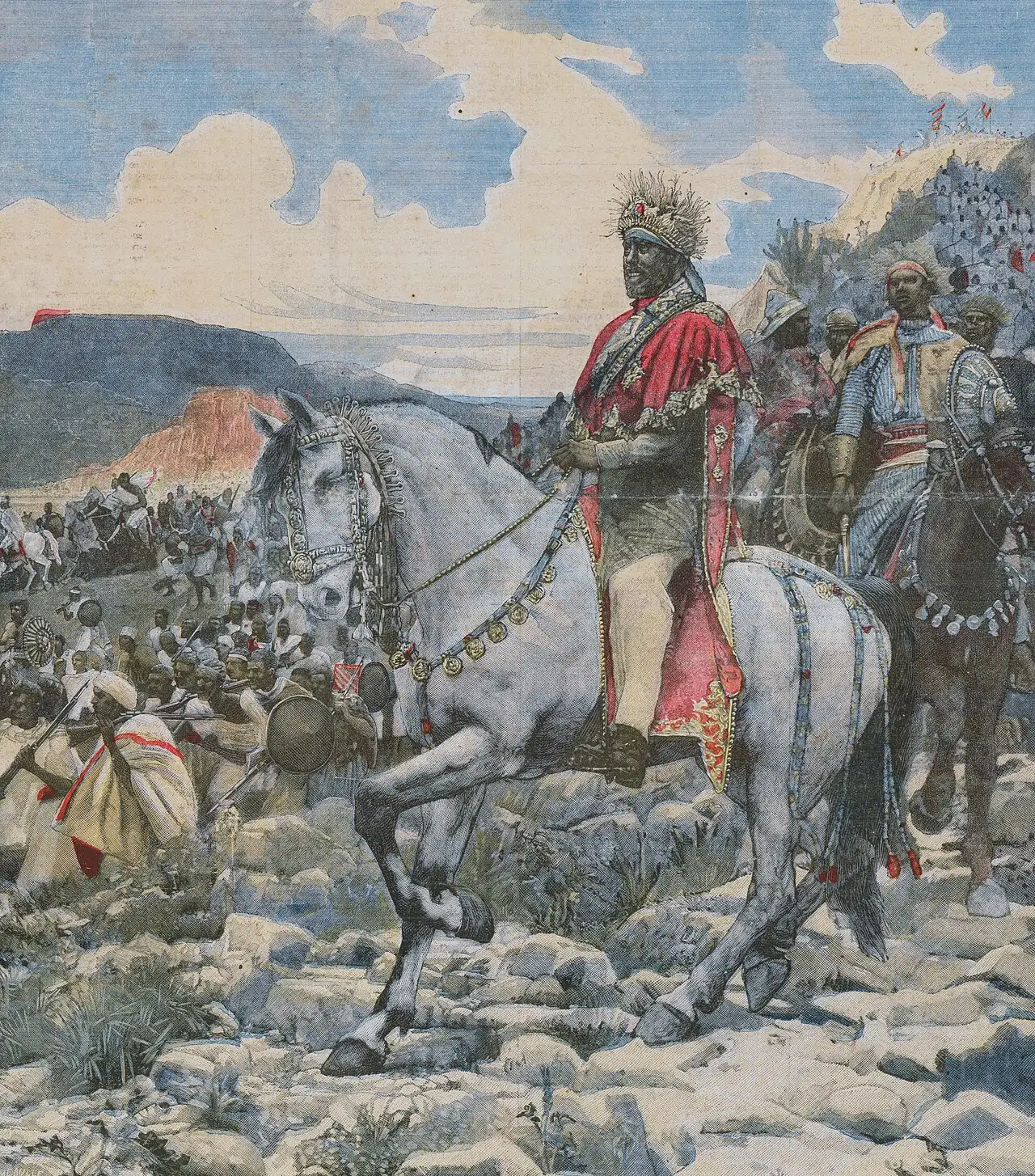
On the morning of March 1, 1896, in the rocky highlands near the town of Adwa in northern Ethiopia, an army of roughly 100,000 men stood ready in the cold dawn. Facing them was an army from Italy — smaller, supremely confident, and certain of an easy victory. By midday, the certainty was gone, and the map of Africa had been redrawn forever.
The road to Adwa began with a trick. In 1889, Emperor Menelik II of Ethiopia signed the Treaty of Wuchale with Italy. But the two versions of the treaty did not match. The Italian text of Article 17 said Menelik consented to conduct all his foreign affairs through Italy — in effect, a protectorate. The Amharic text said he merely had the option to do so. When Menelik discovered the deception, he denounced the treaty in 1891. Italy decided to take Ethiopia by force.
Menelik answered with one of the great mobilizations of the 19th century. He summoned warriors from across his empire, arming them with modern rifles bought from France and Russia. Beside him rode his wife, Empress Taytu Betul, who commanded a force of her own, including artillery. Against them marched General Oreste Baratieri with some 17,000 to 20,000 Italian and colonial troops — brave men, but strangers to the terrain, short on supplies, and pressed by politicians in Rome who demanded a quick, decisive win. After receiving an insulting telegram from Rome accusing him of cowardice, Baratieri resolved to strike first.
In the early hours of March 1, Italian columns advanced through broken, unfamiliar ground to surprise the Ethiopian camp. Instead, the columns lost contact with one another in the dark hills. As dawn broke, Ethiopian forces fell on the isolated brigades one by one. Italian artillery slowed the first waves, but the sheer weight of the Ethiopian assault overwhelmed every position. Baratieri had reportedly boasted in Rome that he would bring Menelik back "in a cage." Instead, he fled the battlefield for his life while his army disintegrated around him.
The toll was staggering: more than 6,000 Italian and colonial troops killed and some 3,800 taken prisoner. Ethiopian losses were heavy too — an estimated 4,000 to 7,000 killed — but the victory was total. The prisoners were marched to Addis Ababa, and the news raced around the world.
The consequences were immediate. In Italy, the humiliation toppled the government of Prime Minister Francesco Crispi. In the Treaty of Addis Ababa that followed, Italy formally recognized Ethiopia's sovereignty. Ethiopia remained one of only two African nations to keep its independence through the entire Scramble for Africa — the only one to defend it on the battlefield against a European great power.
Adwa matters because it broke a spell. For decades, Europeans had told themselves that African armies could not stand against modern European firepower. On a single March morning, Ethiopia proved otherwise, and the victory echoed far beyond the Horn of Africa — inspiring anti-colonial movements across the continent and the diaspora for generations. Ethiopians still celebrate the victory at Adwa every year.
Photo: 1896 illustration from Le Petit Journal depicting Emperor Menelik II at the Battle of Adwa, public domain via Wikimedia Commons.