The $100,000 Eraser: The Pencil Patent of 1858
On March 30, 1858, Philadelphia stationer Hymen Lipman patented the first pencil with an attached eraser — and four years later sold the idea for $100,000.
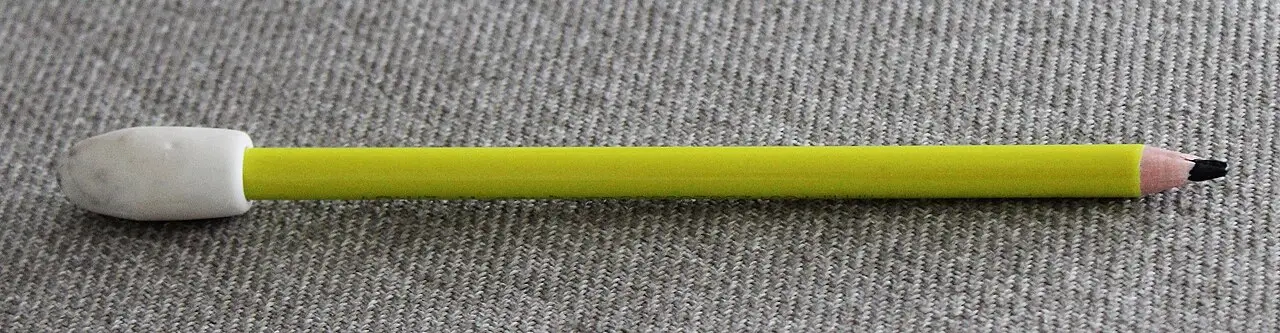
Pick up a pencil. Now look at the other end — the little eraser sitting there, ready to undo your mistakes. You have Hymen Lipman to thank for it.
Lipman was born in Kingston, Jamaica, in 1817 and came to Philadelphia as a boy, where he grew up to become one of the city's leading stationers. In 1843 he started the first envelope company in the United States. But his most famous idea came from a small, everyday annoyance: pencils and erasers were two separate things, and the eraser was always getting lost.
His solution, patented on March 30, 1858, as U.S. Patent No. 19,783, was elegantly simple. He made an ordinary lead pencil, carved a groove into one end of the wood, and inserted a piece of "prepared india-rubber," glued in place. Sharpen one end and you had the lead; sharpen the other and you exposed "a small piece of india-rubber, ready for use" — as his patent put it, "particularly valuable for removing or erasing lines, figures, &c., and not subject to be soiled or mislaid on the table or desk." For draftsmen drawing fine mathematical and architectural lines, an eraser that could itself be sharpened to a point was a quiet revolution.
In 1862, Lipman sold his patent for $100,000 — a fortune at the time — to a businessman named Joseph Reckendorfer. Reckendorfer promptly sued the great pencil maker Faber for infringement. But the courts were not impressed. In 1875, the U.S. Supreme Court declared the patent invalid: a pencil and an eraser were both already-known things, the justices ruled, and merely sticking them together was not a real invention.
The law said no. The world said yes. The eraser-tipped pencil became the global standard, and nearly every wooden pencil made since has carried one. Lipman never got his patent back, but his idea outlived the lawsuit — proof that the simplest inventions are sometimes the ones that refuse to be erased.
Photo: Boaventuravinicius, CC BY-SA 4.0.