
Seward's Folly
On March 30, 1867, the U.S. signed a treaty buying Alaska from Russia for $7.2 million — mocked at the time as "Seward's Folly."
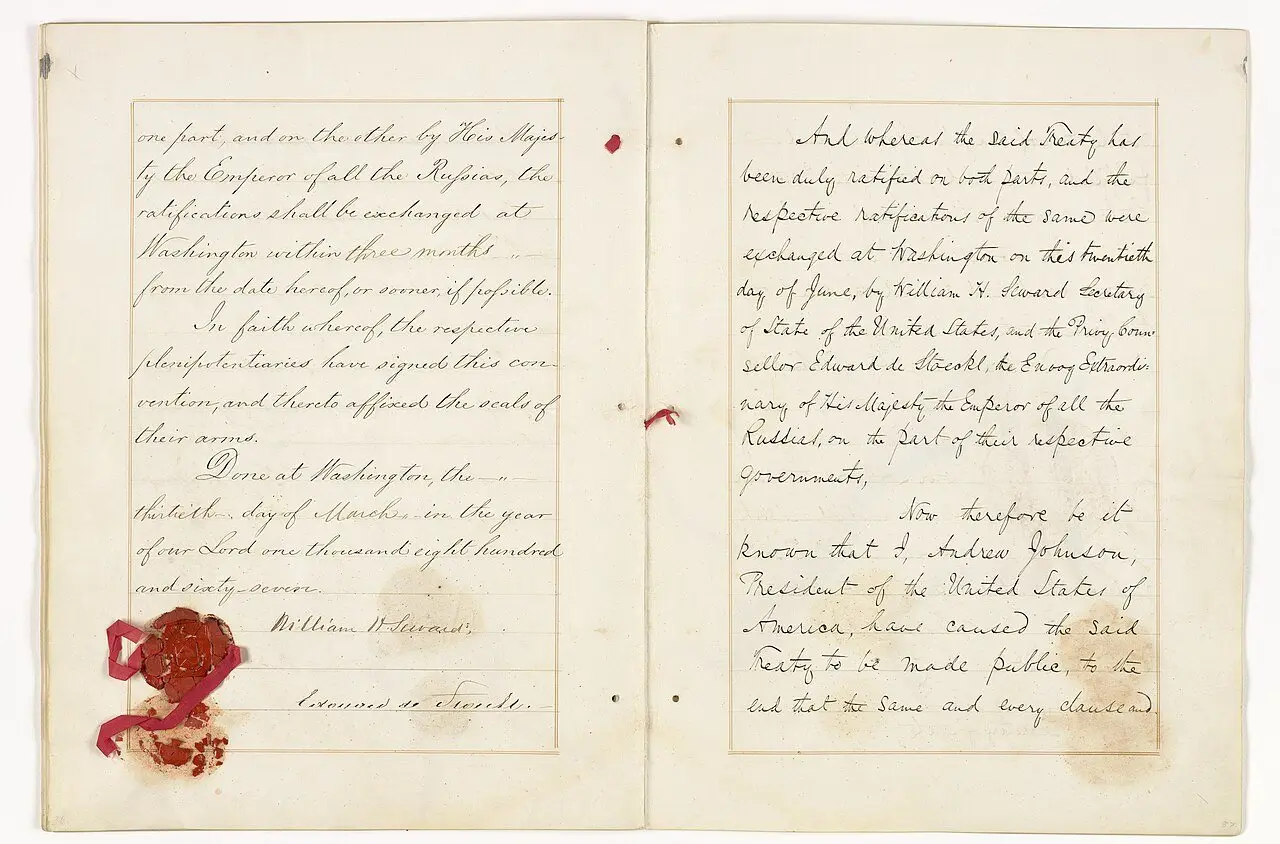
On March 30, 1867, Secretary of State William H. Seward and the Russian minister Edouard de Stoeckl signed the Treaty of Cession in Washington. With it, the United States bought Alaska from Russia for $7.2 million — roughly two cents an acre for 586,412 square miles, expanding the country by nearly a fifth in a single stroke of the pen.
Why was Russia selling? After a humiliating defeat in the Crimean War, the empire was cash-strapped, and its Alaskan colony — built on the sea-otter fur trade, now depleted — was distant, indefensible, and losing money. Russia had even offered Alaska to the United States once before, in 1859; the Civil War put the deal on ice. After the war, Seward picked it back up. Russia, for its part, would rather see Alaska in American hands than British ones.
The reaction in Washington was mockery. Newspapers and politicians called the purchase "Seward's Folly" and "Seward's Icebox" — a frozen wasteland bought with good money. The Senate ratified the treaty anyway, on April 9, and on October 18, 1867 — still celebrated as Alaska Day — several hundred Russian and American troops and dignitaries gathered at Sitka to watch the Russian imperial flag come down and the Stars and Stripes go up amid great fanfare.
The treaty’s fine print was humane for its era: the property of the Greek Orthodox Church was protected, and Alaska’s inhabitants could return to Russia within three years if they wished — those who stayed would enjoy the rights of American citizens. Nearly all the Russian settlers went home anyway, and Alaska stayed thinly populated for decades — until 1896, when the Klondike Gold Strike turned the "folly" into fortune. Gold, then oil, then fish and timber made Alaska one of the richest and most strategically important states in the union; the long road from territory to the 49th state finally ended in 1959.
The document itself survives — this story's photograph is a page of the original signed treaty, dated "the thirtieth day of March, in the year of our Lord one thousand eight hundred and sixty-seven," bearing Seward's signature and the red wax seal.
Why it matters: the Alaska Purchase was the last great continental acquisition of the United States, the final brushstroke of manifest destiny. It gave America its Arctic — a frontier of oil, gold, salmon, and wilderness — and a front-row seat to the Pacific century. All for two cents an acre. The mockers of 1867 never got a better answer than the Klondike.
Photo: U.S. Government, public domain (via Wikimedia Commons).