Roosevelt and Churchill Open the Casablanca Conference
On January 14, 1943, Roosevelt and Churchill opened ten days of secret war talks in Casablanca, committing the Allies to accept nothing less than the Axis powers’ unconditional surrender.
It was the most secret journey any American president had ever taken — and the world wouldn’t learn about it until it was over.
In January 1943, Franklin D. Roosevelt boarded a train to Miami, then a Pan Am flying boat that island-hopped across the Atlantic, stopping in Trinidad, Brazil, and Gambia before touching down in Morocco. Waiting in Casablanca was Winston Churchill, who had flown in from England aboard an unheated bomber, disguised as a Royal Air Force officer. On January 14, 1943, the two leaders opened ten days of secret talks — codenamed SYMBOL — at the Anfa Hotel to decide how the Allies would win World War II.
Secrecy was total. The leaders met inside a one-mile-square compound at the Anfa Hotel that had been built up by American troops — a building that had previously housed the German Armistice Commission. The press and the public knew nothing; the world only learned of the meeting after it was over. Roosevelt later called it simply the “unconditional surrender” meeting.
It was the first time a sitting American president had traveled abroad during wartime, and the stakes were enormous. Joined by their top military commanders, Roosevelt and Churchill hammered out a grand strategy: rather than rushing into France, the Allies would invade Sicily and then Italy to knock Mussolini out of the war; they would intensify the bombing campaign against Germany; and they would push across the Pacific, island by island, toward Japan.
The debates were not easy. America’s top general, George C. Marshall, wanted to land troops in France as soon as possible — the “second front” the Soviets had long been demanding — but the Combined Chiefs of Staff decided a direct assault was not yet possible, settling on Sicily first. They also weighed the U-boat threat to Atlantic convoys, aid to Russia and China, and the fight against Japan in the Solomon Islands.
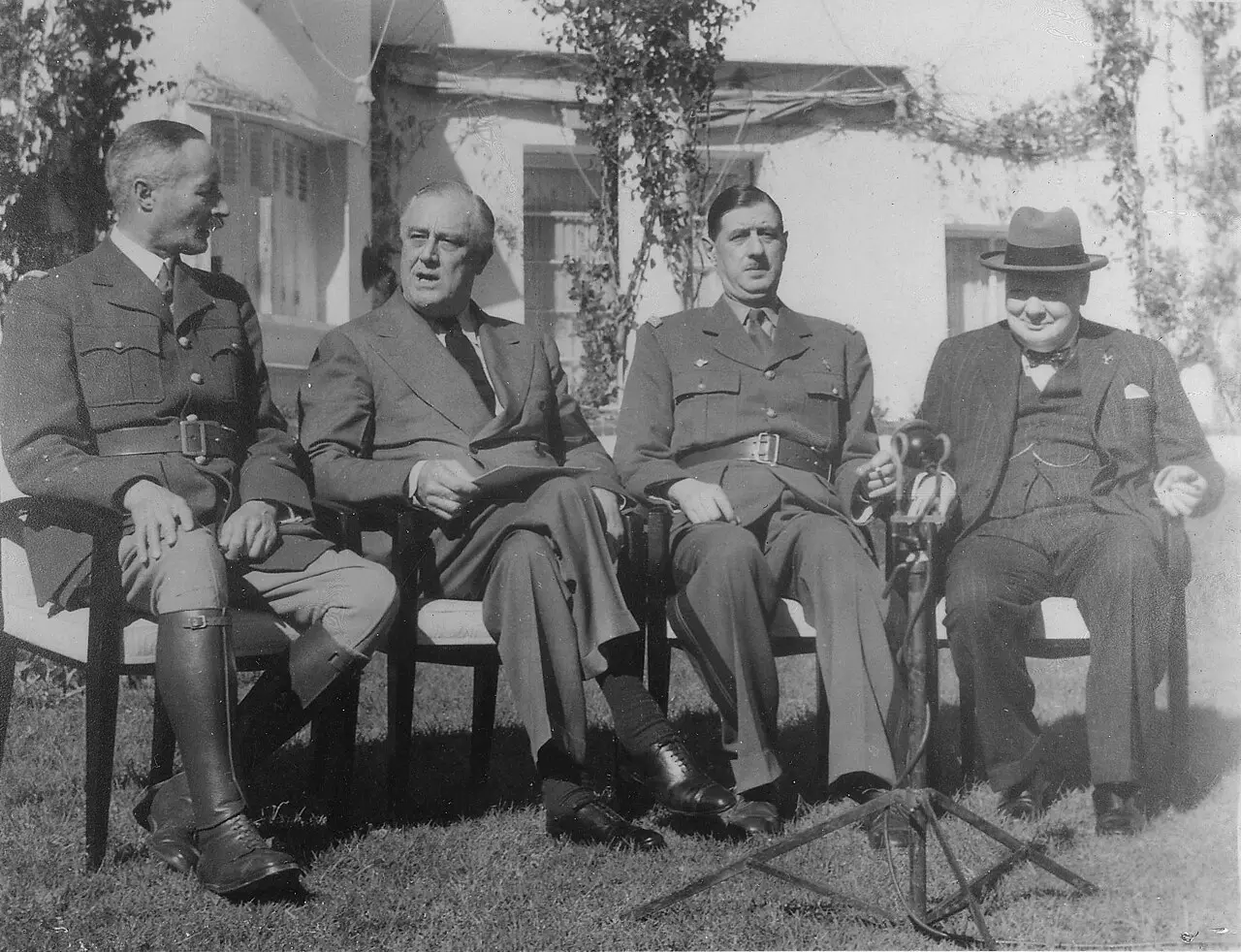
One leader was conspicuously absent: Soviet premier Joseph Stalin, who stayed home because the brutal Battle of Stalingrad demanded his presence. The French had a complicated seat at the table — rival Free French generals Charles de Gaulle and Henri Giraud were brought together in Casablanca, though they played only minor roles in the military planning. Morocco’s own ruler, Sultan Muhammad V, also attended.
The conference’s most famous decision came on its final day, when Roosevelt and Churchill announced that the Allies would accept nothing less than the “unconditional surrender” of Germany, Italy, and Japan. No negotiated peace, no partial victory — the dictatorships’ philosophies of conquest had to be destroyed completely.
The Casablanca Conference didn’t end the war, but it organized the victory. It locked the Allies into a single strategy, coordinated two fronts across the globe, and set the terms on which the war would end — shaping the world that followed.
Photo: Generals Henri Giraud and Charles de Gaulle with President Franklin D. Roosevelt and Prime Minister Winston Churchill at the Casablanca Conference — public domain image (NARA) via Wikimedia Commons.