Huygens Touches Down on a Moon of Methane Rain
On January 14, 2005, ESA's Huygens probe landed on Saturn's moon Titan, phoning home from a world of methane rain — the most distant landing in history.
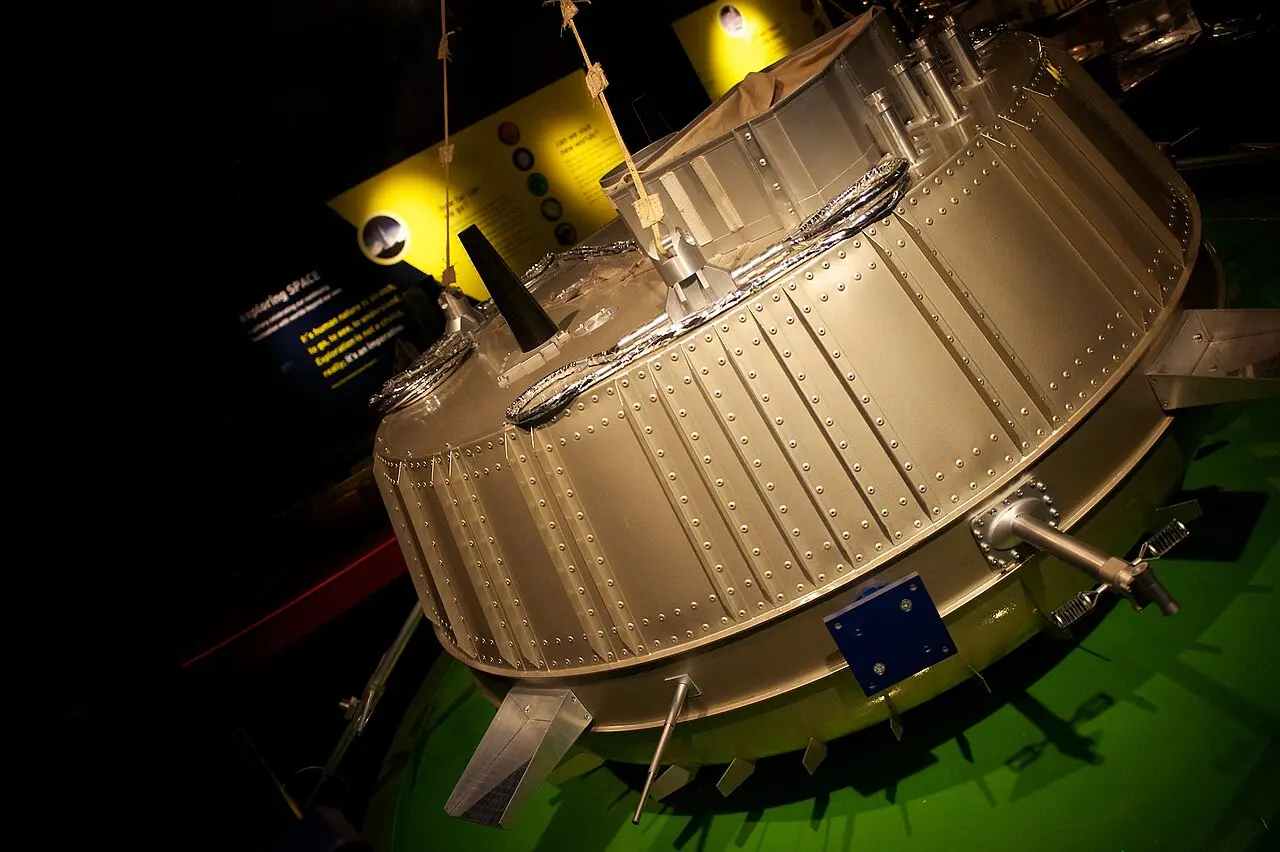
On January 14, 2005, a washing-machine-sized robot phoned home from a billion miles away. ESA’s Huygens probe had landed on Titan, Saturn’s largest moon — the most distant landing ever attempted, and the first ever accomplished in the outer Solar System.
The journey had taken more than seven years. Huygens rode to Saturn aboard NASA’s Cassini spacecraft, launched on October 15, 1997, and was released on Christmas Day 2004 for a 20-day, 4-million-kilometer cruise to Titan. Mission controllers in Darmstadt, Germany, could only watch: the round-trip light time was well over two hours, so every maneuver had been programmed in advance. The first sign of life came when the Green Bank radio telescope in West Virginia caught Huygens’s faint carrier signal from across the void.
The descent was brutal and precise. Huygens slammed into Titan’s upper atmosphere at about 18,000 kilometers per hour and braked to 1,400 km/h in three minutes behind a heat shield, then floated down under a sequence of parachutes through 160 kilometers of orange haze. The whole descent took two hours and 27 minutes. Instruments sampled the atmosphere — mostly nitrogen, like Earth’s — while a camera snapped pictures of a landscape that looked eerily familiar: river channels, drainage basins, and shorelines carved into water ice.
Titan’s rivers run with liquid methane. At 180 degrees below zero Celsius, methane plays the role water plays on Earth: it evaporates, forms clouds, rains down, and pools in lakes and seas. Huygens touched down on solid ground near a region called Adiri, and kept transmitting for about an hour and a half — far longer than its few planned minutes — relaying data up to Cassini, which beamed it back to Earth.
The probe was named for the 17th-century Dutch astronomer Christiaan Huygens, who discovered Titan in 1655. Three and a half centuries later, his namesake sent back the first close-up of that moon’s surface: rounded pebbles of water ice scattered across a damp, muddy floodplain under an orange sky.
Huygens mattered because Titan is a time machine. Its thick nitrogen atmosphere and methane cycle resemble conditions thought to exist on the early Earth, making it a natural laboratory for the chemistry that may precede life. The little probe proved that landing craft could survive the outer Solar System — and gave humanity its first foothold, however brief, on an alien shore.
Photo: Paul Hudson, CC BY 2.0 (via Wikimedia Commons). Illustrative rather than contemporaneous: the image shows a full-scale model of the Huygens probe on display at an exhibition, not the flight hardware.