New Mexico Becomes the 47th State
On January 6, 1912, after 61 years as a U.S. territory — the longest wait of any state — New Mexico joined the Union when President William Howard Taft signed its statehood proclamation.
For more than six decades, New Mexico waited at America's door. The land had been Spain's, then Mexico's, then a prize claimed by the United States in war — and for 61 years it sat as a territory, asking to become a state. On the morning of January 6, 1912, President William Howard Taft finally signed the proclamation that made it the 47th star on the American flag.
No state waited longer. Congress organized the Territory of New Mexico in 1850, and the road from there to statehood stretched over 61 years — the longest territorial wait of any U.S. state. Four times the territory drafted a constitution. Voters approved one in 1850, but Congress never acted; conventions in 1872 and 1889 produced documents the voters rejected. Some in Washington questioned whether the territory, with its large Spanish-speaking population and deep Hispanic and Pueblo roots, was "American" enough for statehood.
The breakthrough came with the Enabling Act of 1910. Delegates gathered in Santa Fe that October, adopted a proposed constitution 79 to 18 on November 21, 1910, and voters ratified it on January 21, 1911, by more than 70 percent. Congress then passed the statehood resolution, and Taft put his signature to the proclamation on January 6, 1912.
The same day, New Mexico's first governor took office. William C. McDonald, a Democrat, had won the November 7, 1911 election over Republican Holm O. Bursum by about 3,000 votes out of 61,000 cast, and he assumed the governorship the moment statehood arrived. That fall, New Mexicans voted in their first presidential election as a state, choosing Woodrow Wilson.
The new state's roots ran centuries deep. Spanish explorers pushed through the region in the 1500s, Francisco Vásquez de Coronado led a full expedition in 1540, and in 1610 Pedro de Peralta founded Santa Fe as the colonial capital. The Pueblo Revolt of 1680 drove the Spanish out for twelve years before they returned. After Mexico won independence in 1821, New Mexico became a Mexican province and the Santa Fe Trail opened trade with the United States. General Stephen W. Kearny seized Santa Fe without a fight in 1846 during the Mexican-American War; the Treaty of Guadalupe Hidalgo ceded the region to the U.S. in 1848, and the Gadsden Purchase of 1853 fixed its present borders.
Today New Mexico is the Land of Enchantment — home to desert, mountains, ancient Pueblo communities, Los Alamos and the atomic age, and a culture where Spanish, Indigenous, and Anglo traditions have braided together for centuries. It joined the Union last among the states admitted before Alaska and Hawaii, and it had to wait the longest of all. But on January 6, 1912, the wait finally ended.
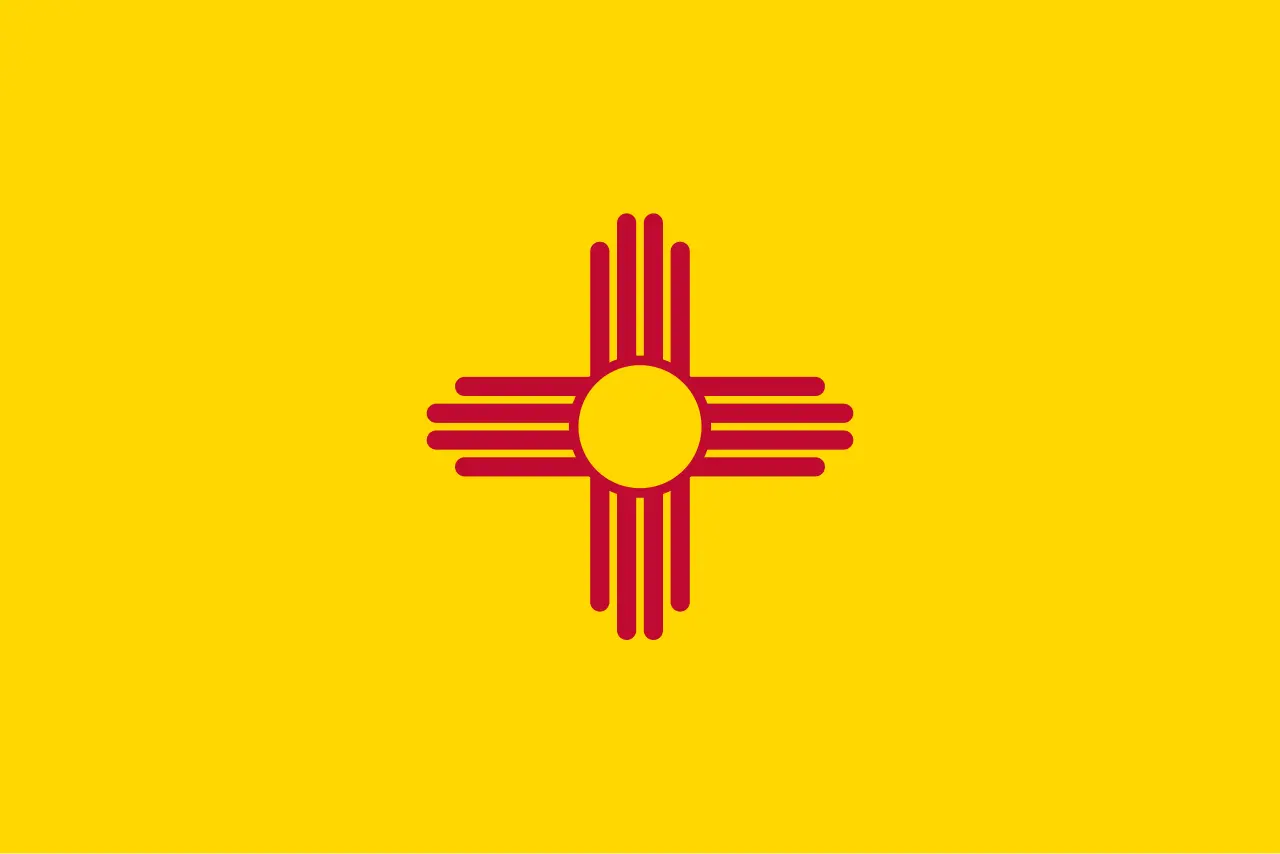
Photo: the flag of New Mexico, with the red Zia sun symbol on a field of yellow (public domain), via Wikimedia Commons.