Four Freedoms for the World: FDR's Boldest Promise
On January 6, 1941, eleven months before Pearl Harbor, Franklin D. Roosevelt told Congress the world must be founded on four essential human freedoms.
Eleven months before Pearl Harbor, with Nazi Germany master of Europe and most Americans determined to stay out of the war, Franklin D. Roosevelt stood before Congress and described the world he believed was worth fighting for. On January 6, 1941, in his annual State of the Union address to the 77th Congress, he gave that vision a name the world has never forgotten: the Four Freedoms.
Roosevelt had just won an unprecedented third term, and he used it to say what no isolationist audience wanted to hear. America, he warned, could not survive as "a lone island in a world dominated by the philosophy of force." Weeks earlier, in a fireside chat, he had called on the country to become "the great arsenal of democracy"; now he pressed Congress to expand defense production and send Lend-Lease aid to the nations resisting aggression.
Then, more than half an hour into the address, he turned from policy to principle. "In the future days, which we seek to make secure," he said, "we look forward to a world founded upon four essential human freedoms." The first, he said, was "freedom of speech and expression — everywhere in the world." The second was "freedom of every person to worship God in his own way — everywhere in the world." The third was "freedom from want," meaning economic security for every nation. The fourth was "freedom from fear," meaning worldwide disarmament so complete "that no nation will be in a position to commit an act of physical aggression against any neighbor — anywhere in the world."
"That is no vision of a distant millennium," Roosevelt insisted. "It is a definite basis for a kind of world attainable in our own time and generation."
The words had not come easily. The speech went through seven drafts, prepared by his closest advisers — Harry Hopkins, Samuel Rosenman, and Robert Sherwood. The Four Freedoms themselves were a late addition, introduced by Roosevelt only in the fourth draft, when he sketched out the peroration he wanted for the speech's close.
The phrase caught fire. The Four Freedoms became the moral charter of America's war effort, the staple of its war aims, and the seed of the Atlantic Charter that Roosevelt and Churchill would sign that August. Norman Rockwell painted them in four beloved canvases for the Saturday Evening Post in 1943, carrying the ideals into millions of American homes. Eleanor Roosevelt would later help write them into the Universal Declaration of Human Rights.
Roosevelt did not live to see that world. But the Four Freedoms outlived him — and outlived the war. They remain the clearest statement ever made of what America claimed to be fighting for: not territory, not empire, but the simple proposition that every human being, everywhere, deserves to speak, to worship, to live without want, and to live without fear.
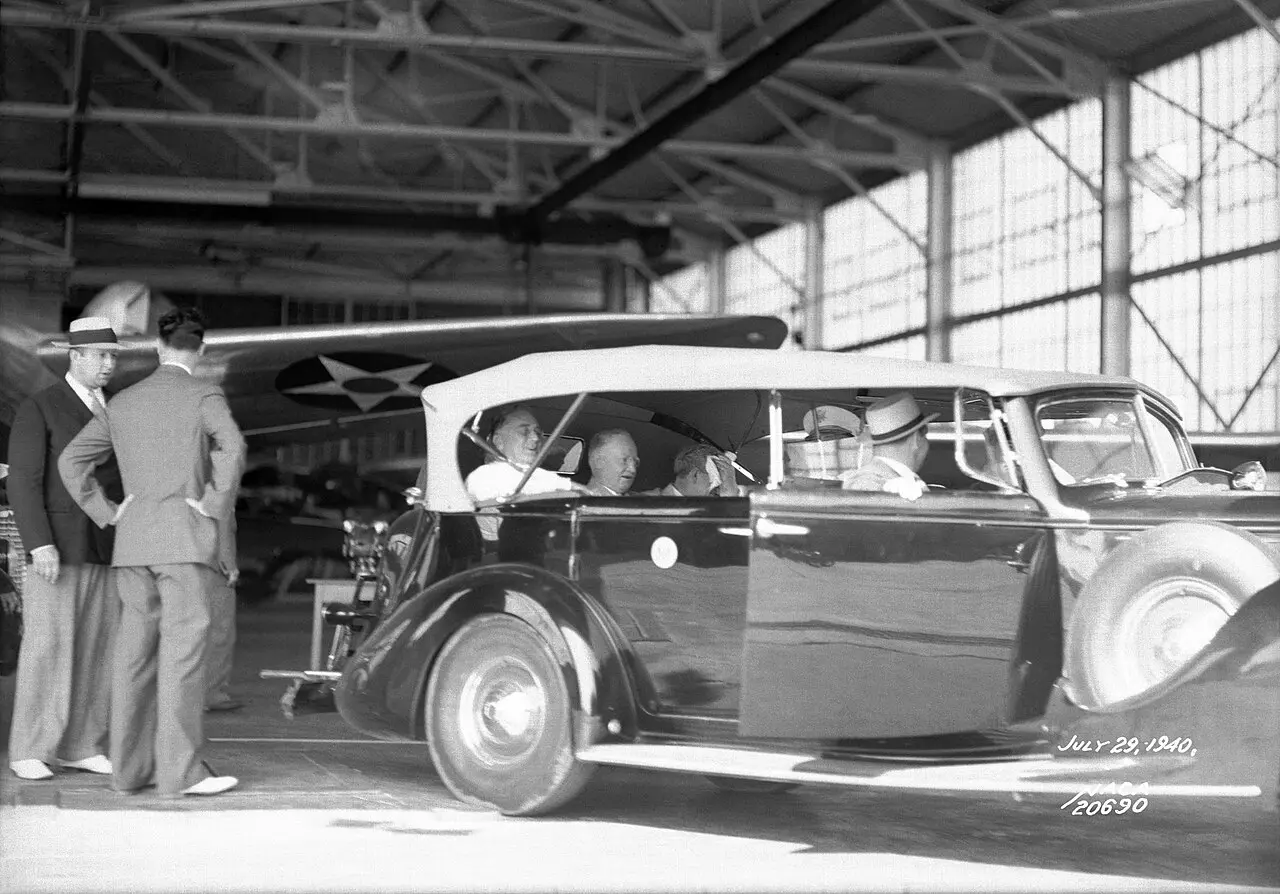
Photo: NACA (the predecessor of NASA), public domain (via Wikimedia Commons). Roosevelt at Langley Field on July 29, 1940 — months before the address — illustrative rather than a photograph of the speech itself.