Mir, the World's First Modular Space Station, Launches
On February 20, 1986, the Soviet Union launched the core module of Mir, the first space station built in pieces in orbit and the blueprint for the International Space Station.
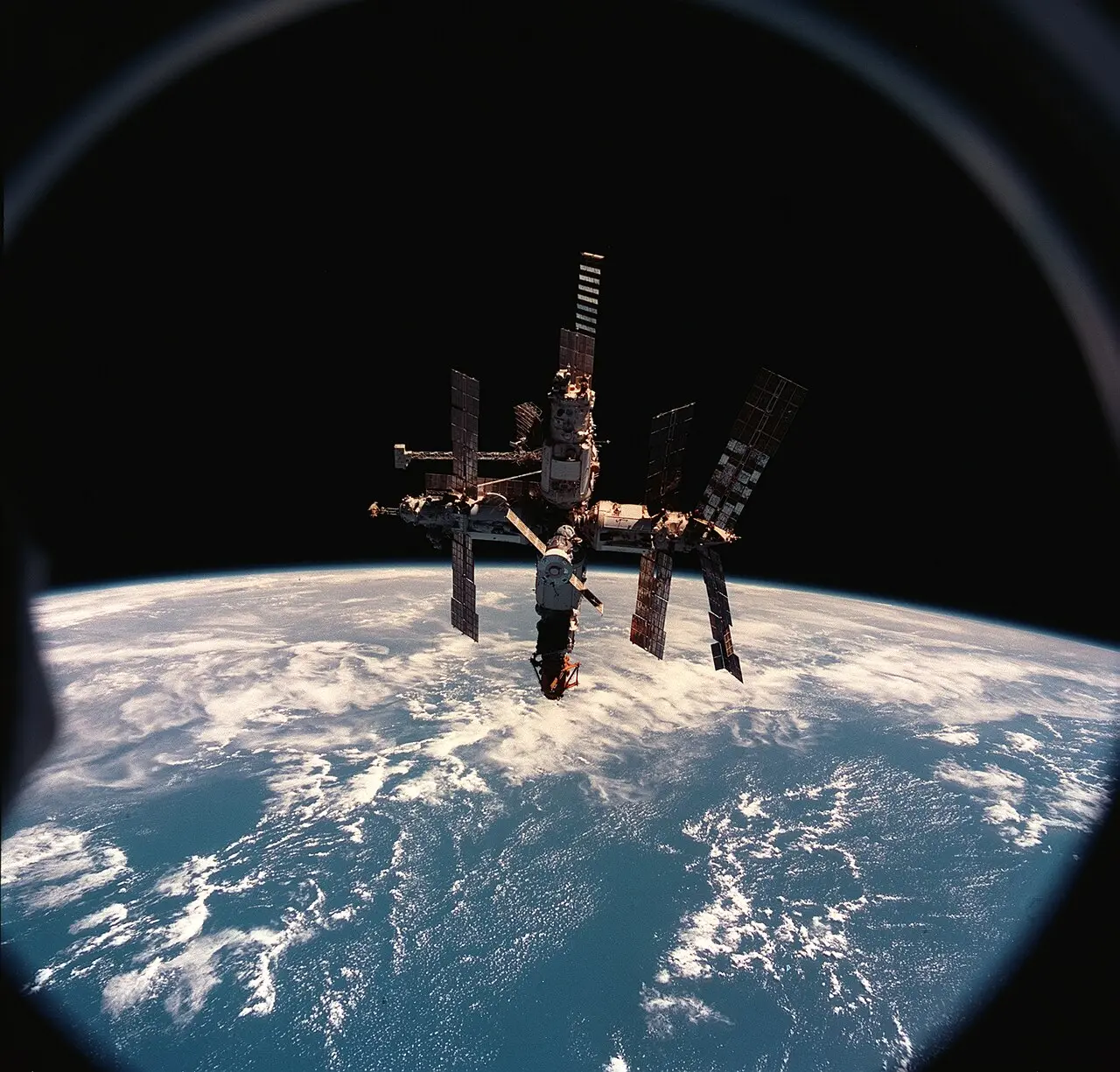
On February 20, 1986, a Proton-K rocket rose from the Baikonur Cosmodrome in Kazakhstan carrying a 13-meter stepped cylinder into low Earth orbit. It was the core module of Mir — Russian for "peace" or "world" — and the first piece of the first space station ever assembled in orbit.
Until then, every space station had been a single structure launched all at once: the Soviet Salyut series, America's Skylab. Once in orbit, there was no way to resupply or enlarge them. Mir proved a new idea — build the station like a Tinker Toy, launching modules one by one and docking them together in space. Between 1987 and 1996, five more modules were added to the core: Kvant-1, an astrophysics observatory; Kvant-2, with life-support equipment and a large airlock; Kristall, a materials-science laboratory; and Spektr and Priroda, two Earth-observation science modules. Power came from the core module's own solar arrays, later supplemented by additional panels delivered with Kvant-1, which grew the core's solar-collecting area to 98 square meters.
Mir's first crew, cosmonauts Leonid Kizim and Vladimir Solovyov, arrived just weeks after launch, on March 13, 1986. Over the next 15 years, Mir supported human habitation almost continuously, including an unbroken stretch of nearly ten years with people aboard. More than 100 people from a dozen countries lived and worked there — including a series of American astronauts in the mid-1990s, when the Shuttle-Mir program had U.S. space shuttles docking with the Soviet-born station in one of the great acts of cooperation of the post–Cold War era. Cosmonaut-physician Valery Polyakov spent 438 continuous days aboard in 1994–95, still one of the longest single spaceflights ever made — longer than a crewed voyage to Mars would take.
Mir aged visibly in orbit: the station survived a collision with a cargo ship in 1997 that punctured one of its modules, fires, and years of strain on its systems. When it was finally guided to a fiery reentry over the Pacific on March 23, 2001, it had been aloft for 15 years — three times its intended lifespan.
Its legacy is the template for everything that came after. The techniques invented for Mir — launching modules independently, docking them robotically, expanding a station over years — are exactly how the International Space Station was built, and a spare of Mir's own core-module design became the ISS's Zvezda service module. The little Proton launched on that February morning was the seed of humanity's permanent presence in space.
Photo: NASA, public domain (via Wikimedia Commons).