Humanity's First Glimpse of Mercury (1974)
On March 29, 1974, NASA's Mariner 10 became the first spacecraft to fly past Mercury, revealing a cratered, moonlike world no telescope had ever resolved.
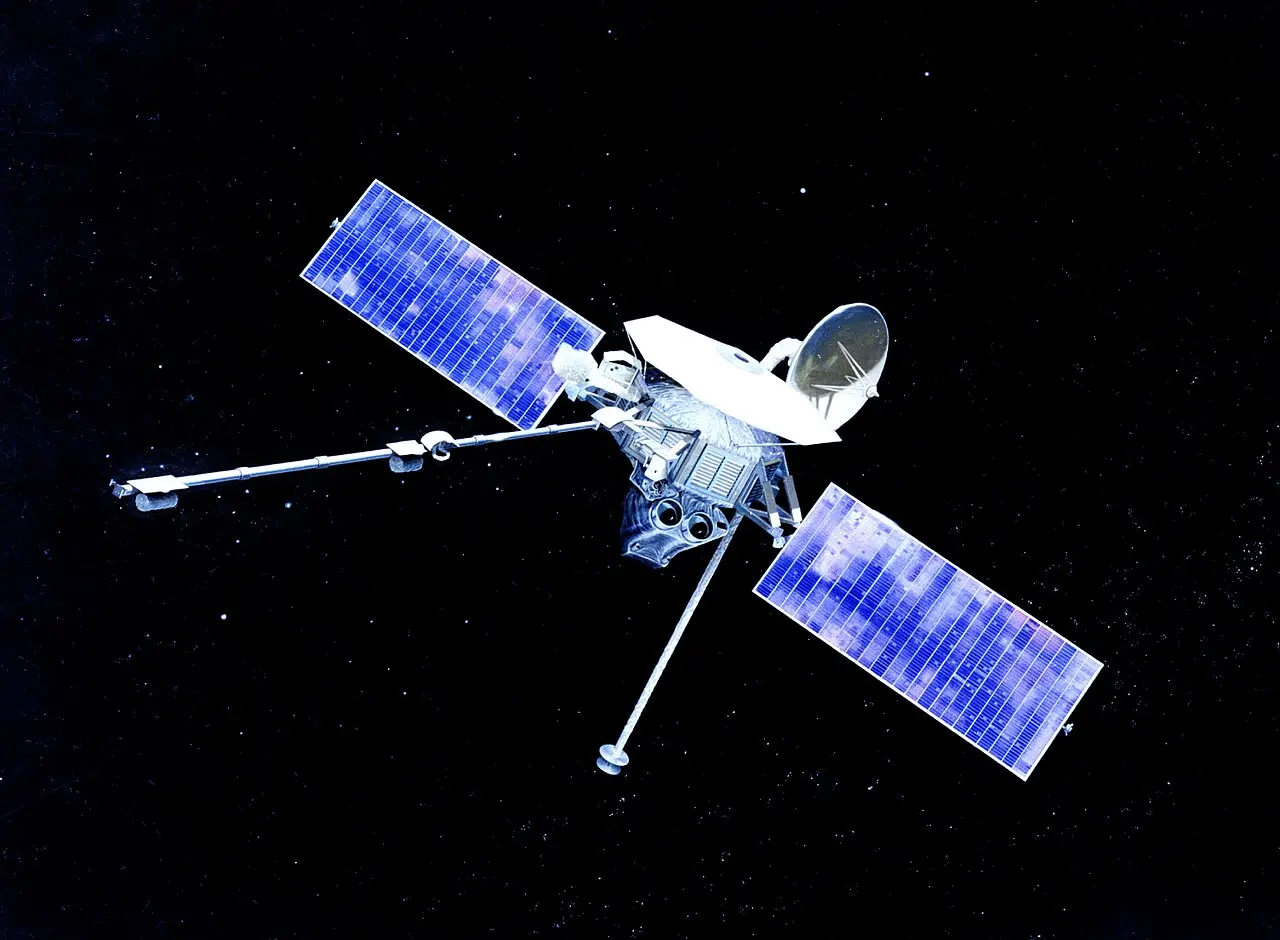
Mercury is the hardest planet in the solar system to reach. It races around the Sun at more than 100,000 miles an hour, and any spacecraft that dives toward it must fight the Sun's enormous gravity every inch of the way. For centuries, astronomers could see Mercury only as a tiny, shimmering point of light — its surface forever blurred by sunlight.
On March 29, 1974, a small American spacecraft finally got close enough to look.
Mariner 10 had launched the previous November, the last mission in NASA's decade-long Mariner program. Its trick was audacious: instead of flying straight at Mercury, it first swung past Venus and let Venus's gravity bend its path inward, flinging it toward the innermost planet. No spacecraft had ever used one planet's gravity to reach another. The maneuver worked — and mission control needed every bit of luck it could get. Electrical components failed, the antenna kept malfunctioning, and flecks of the spacecraft's shiny paint kept chipping off and confusing the star tracker it used to navigate.
On March 29, Mariner 10 swept past Mercury at an altitude of about 756 kilometers, cameras snapping. The images that came back showed a bleak, battered world — intensely cratered, looking much like Earth's moon. For the first time, humanity could see Mercury's face.
The flyby kept delivering surprises. Mercury turned out to have a faint atmosphere of mostly helium, a weak magnetic field, and an enormous iron-rich core. Its temperature readings told a story of extremes: hundreds of degrees above zero on the day side, hundreds below at night — the widest temperature swing of any planet. Mariner 10 would loop back for two more encounters, in September 1974 and March 1975, photographing more than 2,800 pictures in all before its fuel ran out and it was switched off in March 1975, still orbiting the Sun where it drifts today.
Why does it matter? Mariner 10 mapped nearly half of Mercury's surface and pioneered the gravity-assist technique that later missions — from Voyager to Cassini — would use to tour the outer solar system. No spacecraft would visit Mercury again for more than three decades. But on a March day in 1974, for the first time, the innermost planet stopped being a rumor of light and became a real place.
Photo: NASA, public domain.