Homonhon, 1521: The Day Magellan Reached the Philippines
On March 16, 1521, after three months crossing the Pacific without landfall, Ferdinand Magellan's starving crew sighted the mountains of Samar in the Philippines.
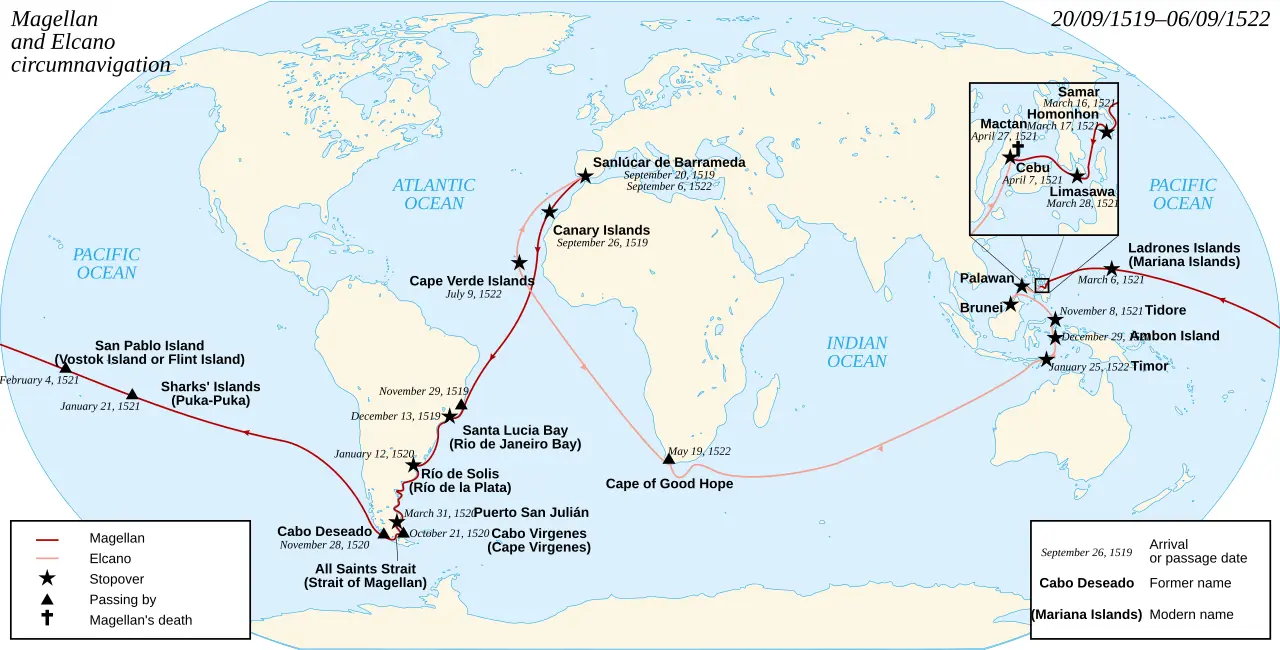
Three months. No land. Men dying of scurvy. Then, on the horizon: mountains.
On the morning of March 16, 1521, lookouts aboard Ferdinand Magellan's ships sighted the mountains of the island of Samar. After crossing the entire Pacific Ocean — the first Europeans in history to do so — the expedition had reached what is now the Philippines. The ships anchored off a small, uninhabited island called Homonhon, and the starving crew staggered ashore.
Magellan was Portuguese, but he sailed for Spain. In September 1519, five ships had departed Spain seeking a western sea route to the Spice Islands of Asia. By the time they reached the Philippines, only three ships remained, and only a fraction of the men who had set out — the rest lost to storms, hunger, and disease on the longest ocean crossing anyone had ever attempted.
On Homonhon, the survivors finally found help. Local leaders from the nearby island of Suluan arrived with food and supplies to trade — the first proper meal the crew had seen in months. Magellan named the archipelago for Saint Lazarus, whose feast day fell near their arrival.
It was the first documented arrival of Europeans in the Philippine archipelago, and it changed the islands' history forever. The Venetian scholar Antonio Pigafetta, who sailed with the expedition, kept the detailed journal that preserved all of it — the starving Pacific crossing, the welcome on Homonhon, the weeks that followed. Decades later, in 1543, the Spanish explorer Ruy López de Villalobos named the archipelago Las Islas Filipinas for the crown prince who became Philip II of Spain — the name the country still carries. Within weeks of the landing, Magellan was involving himself in local rivalries, and on April 27 he was killed in battle on Mactan Island, fighting alongside one local ruler against the chief Lapulapu. The expedition sailed on without him.
Only one ship, the Victoria, completed the journey, limping into Spain in September 1522 with just 18 men aboard — the first circumnavigation of the globe in human history.
Why does it matter? March 16, 1521, was the day the Philippines entered world history. It was the beginning of more than three centuries of Spanish rule and the spread of Christianity across the archipelago — and the final proof that the world's oceans were all connected. It began with starving sailors, a small island, and a mountain on the horizon.
Photo: Map of the Magellan–Elcano circumnavigation route, 1519–1522, marking Homonhon on March 16, 1521; CC BY-SA 3.0, Uxbona (after Sémhur), via Wikimedia Commons.