Faster Than Sound: Jacqueline Cochran Breaks the Barrier
On May 18, 1953, Jacqueline Cochran became the first woman to break the sound barrier, flying a borrowed F-86 Sabre jet over Rogers Dry Lake, California.
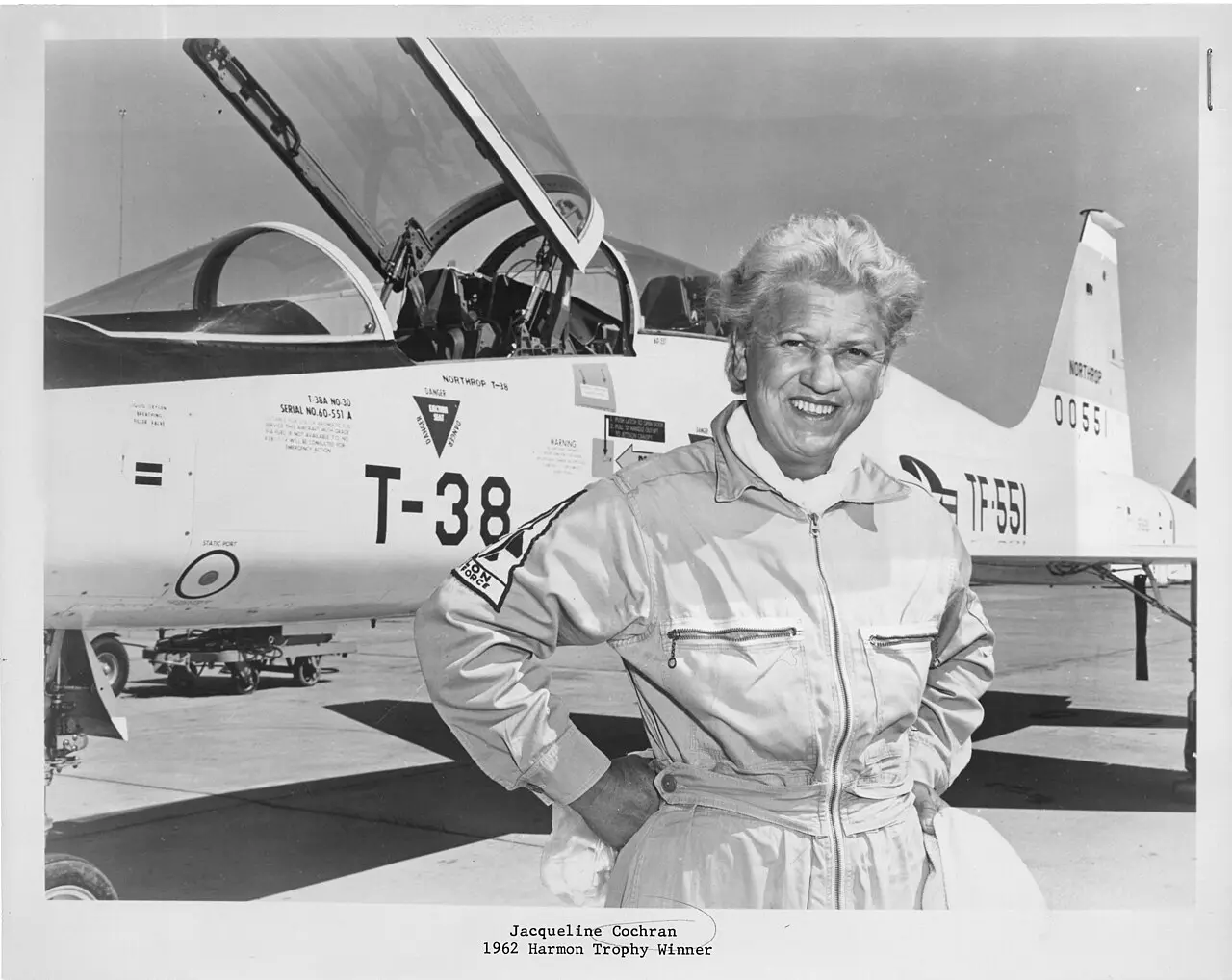
She climbed into the cockpit knowing she would get exactly two chances — just two — because that was all the fuel the borrowed jet could carry. On May 18, 1953, Jacqueline Cochran took off over Rogers Dry Lake, California, and became the first woman to break the sound barrier.
Cochran was already the most decorated female pilot alive. Born into grinding poverty in Muscogee, Florida, in 1906, she had worked in cotton mills as a child, then as a beautician, then built a successful cosmetics business. She married wealthy businessman Floyd Odlum, who suggested she try flying; approaching thirty, she earned her license in just three weeks. By the 1930s she was winning air races, including the prestigious Bendix Trophy in 1938. During World War II she founded and directed the Women Airforce Service Pilots, proving that women could ferry the military's toughest aircraft. After the war she kept setting records — more, by one reckoning, than any pilot, male or female, of her time.
The sound barrier was the one frontier no woman had crossed. American military jets were not available to a civilian — least of all a woman — so Cochran borrowed a Canadian-built F-86 Sabre from the Royal Canadian Air Force, and Canadair sent a sixteen-person support team to California to help. Her target was the 100-kilometer speed record of 1,023.04 kilometers per hour set by Colonel Fred Ascani in 1951. Coaching her from a chase plane was Air Force Major Charles "Chuck" Yeager, who six years earlier had become the first human to fly faster than sound.
The flight was as dramatic as its stakes. On her first pass Cochran felt the shock waves roll off the canopy as she hit Mach 1 — but the sonic boom was not heard on the ground, so she immediately made a second attempt, and the control tower confirmed it: she had gone through the barrier. Over the course of the flight she recorded a speed of 1,050.15 kilometers per hour, beating Ascani's mark by 27 and shattering the women's world record.
She wasn't finished. In 1964 she flew an F-104G Starfighter at twice the speed of sound, setting a women's world speed record of 1,429 miles per hour. She became the first woman to take off from an aircraft carrier, the first to make a blind instrument landing, and the first woman inducted into the Aviation Hall of Fame. She served in the U.S. Air Force Reserve, retiring as a colonel in 1970, and in 1958 she was elected the first woman president of the international aviation federation — the FAI's highest honor, its Gold Air Medal, among her many decorations.
Cochran's achievement mattered because it demolished a physical argument against women pilots: that the violent, unstable physics of supersonic flight was something women could not handle. On May 18, 1953, over a dry lakebed in California, one borrowed jet and one determined pilot proved otherwise — at 652 miles per hour.
Photo: Smithsonian Institution, no known copyright restrictions (via Wikimedia Commons).