Eleven Sails in Botany Bay: The First Fleet Reaches Australia
On January 18, 1788, the lead ship of Britain's First Fleet sailed into Botany Bay, beginning the European settlement of Australia — and the dispossession of its first peoples.
After 252 days at sea, the shout from the masthead must have sounded like deliverance: land. On January 18, 1788, the first of eleven British ships sailed into Botany Bay on the southeastern coast of Australia — and the modern history of a continent began.
The fleet, commanded by Captain Arthur Phillip, had left Portsmouth, England, on May 13, 1787, on a voyage of some 24,000 kilometers — one of the longest organized sea migrations the world had yet seen. Aboard the eleven vessels were more than 1,400 people: Royal Navy sailors, marines, colonial officials, a few free settlers — and about 780 convicts, men and women sentenced to transportation for crimes that were often petty, in an age when stealing a loaf of bread could earn seven years' exile. Forty-eight of them died on the voyage.
Britain's plan was born of desperation and ambition. With the American colonies lost, Britain could no longer send its convicts across the Atlantic, and its prisons and prison hulks were overflowing. The naturalist Joseph Banks, who had visited Botany Bay with Captain Cook in 1770, promoted the distant bay as the answer: a penal colony at the far end of the Earth. Phillip carried sealed instructions to establish the colony of New South Wales.
The reality disappointed him within hours. The advance ship, HMS Supply, reached Botany Bay on January 18; the rest of the fleet straggled in over the next two days. But the bay was shallow, the surrounding land swampy, and fresh water scarce. Phillip — to his credit, an unusually conscientious commander — refused to settle for a bad site. He took a party north to explore Port Jackson, a vast natural harbor Cook had noted but never entered, and found what he needed. On January 26, the fleet moved to Sydney Cove, the Union Jack was raised, and the colony was formally claimed.
That date, January 26, is now Australia Day. But it is worth remembering whose land the flag was raised over. The Eora peoples — including the Gadigal people of the Sydney coast — had lived around those harbors for thousands of years. For them and their descendants, the arrival of the First Fleet was not a founding but an invasion, and the anniversary is marked by many Indigenous Australians as a day of mourning. Both stories are true, and Australia is still reckoning with both.
The First Fleet's arrival set in motion the European settlement of Australia — its cities, its democracy, its modern multicultural identity — and simultaneously began the dispossession of the continent's first peoples, a wound that remains open. January 18, 1788, is the day the wider world sailed in uninvited, and never left.
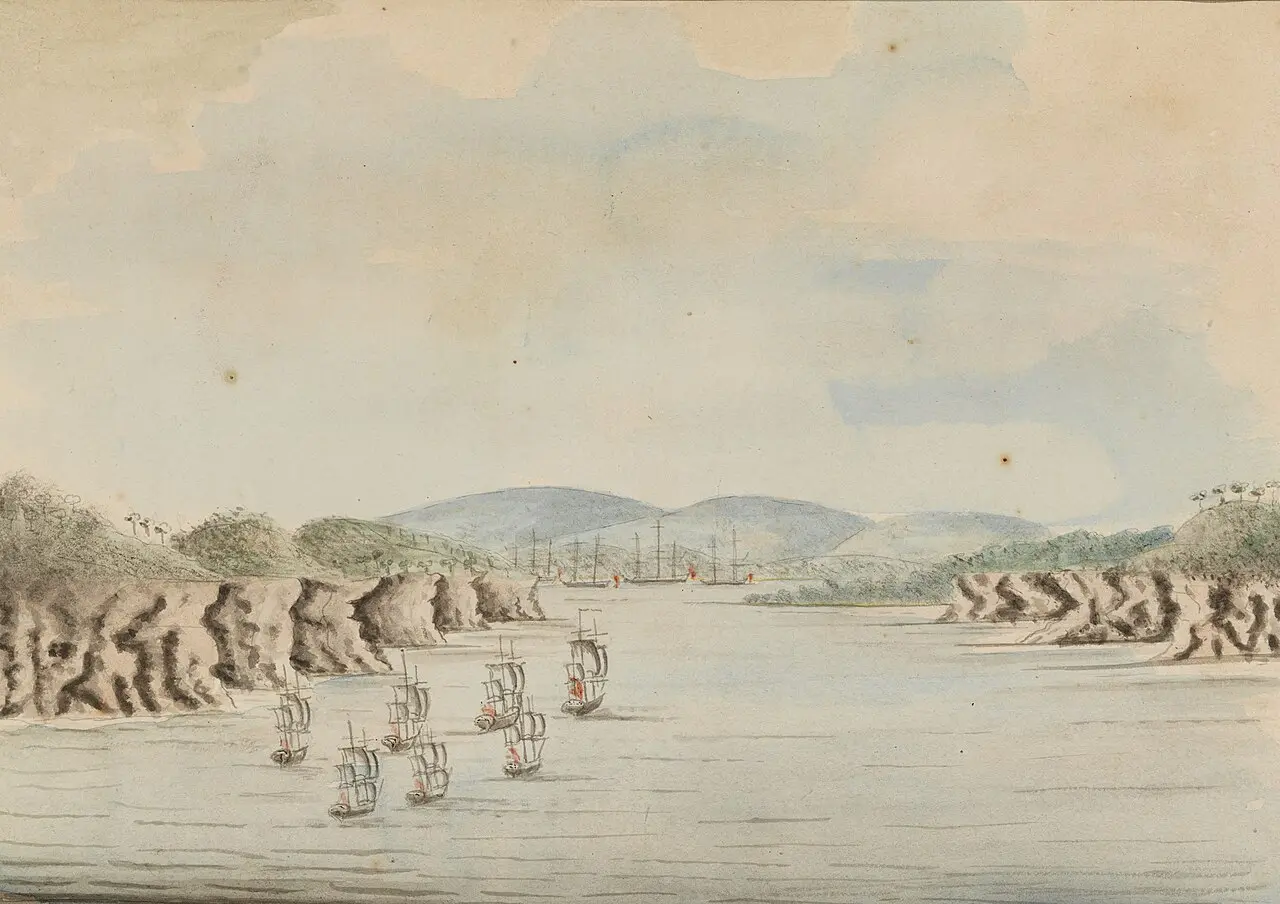
Image: William Bradley's watercolour of the First Fleet's ships entering Botany Bay, painted on the spot on January 21, 1788 — just three days after the fleet's arrival — public domain (via Wikimedia Commons).