An Empire Proclaimed in the Enemy's Palace: Germany, 1871
On January 18, 1871, Prussia's Wilhelm I was proclaimed German Emperor in the Hall of Mirrors at Versailles, forging a new empire in the palace of a defeated France.
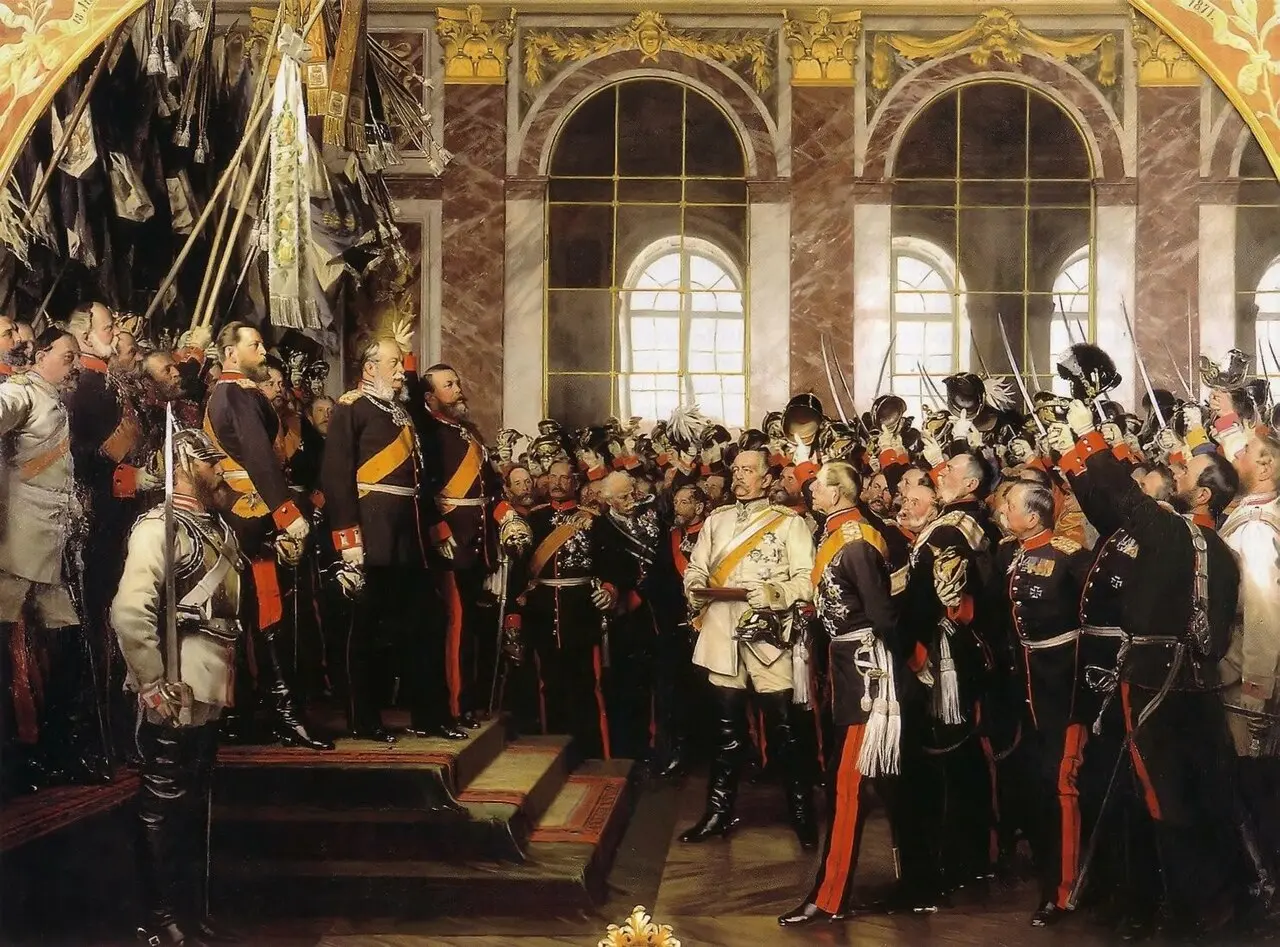
They proclaimed an empire in the palace of the enemy they were still besieging. On January 18, 1871, in the glittering Hall of Mirrors at Versailles, the princes and generals of Germany gathered to do something no German had done in centuries: crown a German emperor.
The choice of place was the point. France and Prussia were at war — the Franco-Prussian War — and Paris itself was under German siege, starving through its fourth month. The Hall of Mirrors, built to glorify Louis XIV, the Sun King who had humiliated German princes two centuries earlier, had been converted into a German military hospital. Now, beneath Charles Le Brun's ceiling paintings celebrating French victories over German lands, the Germans would stage their revenge for all of it — Chancellor Otto von Bismarck savored it as payback for Napoleon's humiliation of Prussia at Jena in 1806.
The man of the hour was Wilhelm I, the 73-year-old King of Prussia, and he nearly spoiled the ceremony by sulking. Bismarck had spent a decade maneuvering the patchwork of German states toward unity — through war with Denmark, war with Austria, and now war with France — and the southern states of Bavaria, Württemberg, Baden and Hesse-Darmstadt had finally agreed to join. But Wilhelm balked at the title, wanting to be "Emperor of Germany" rather than the more modest "German Emperor" Bismarck insisted on, lest the grander style imply claims on Austria and Switzerland. He relented, grudgingly.
The date was no accident either: January 18 marked exactly 170 years since the coronation of Frederick I as the first King in Prussia at Königsberg in 1701. Some 600 officers and nearly all the German princes packed the hall — every one except Ludwig II of Bavaria, who stayed away. An altar was erected for a religious service; then Bismarck, resplendent in the white uniform of a cuirassier, read the proclamation. At the end, the Grand Duke of Baden stepped forward and cried, "Long live His Majesty, Emperor Wilhelm!" — and the hall erupted.
In strict constitutional terms, the empire had already existed since New Year's Day, when the new constitution took effect. But in the German national memory, January 18 became the founding day, celebrated for decades to come. A new great power had been born at the center of Europe: industrial, militarized, and ruled by a Kaiser.
The proclamation redrew the map of Europe and the logic of its politics. German unification ended centuries of fragmentation — and created a power so strong that its neighbors spent the next seventy years organizing against it. The humiliation of 1871, sharpened by the annexation of Alsace-Lorraine, poisoned French politics for a generation and helped set the stage for the catastrophes of the twentieth century. Empires proclaimed in mirrors have a way of shattering them.
Painting: Anton von Werner's "Proclamation of the German Empire" (1885), depicting the January 18, 1871 ceremony in the Hall of Mirrors — public domain (via Wikimedia Commons).