Easter Sunday Discovery: Roggeveen Finds Easter Island
On April 5, 1722 — Easter Sunday — Dutch navigator Jacob Roggeveen made the first recorded European landing on Easter Island, naming it for the holy day.
Jacob Roggeveen was hunting a continent that didn't exist. In 1721, the Dutch navigator sailed from the Netherlands with three ships — the Arend, the Thienhoven, and the Afrikaansche Galey — to find Terra Australis, a mythical southern landmass, and "Davis Land," a phantom island reported by an English buccaneer.
On April 5, 1722 — Easter Sunday that year — his lookouts sighted a small, isolated island in the southeastern Pacific. Roggeveen named it Paasch-Eyland, Dutch for "Easter Island," for the holy day on which he found it.
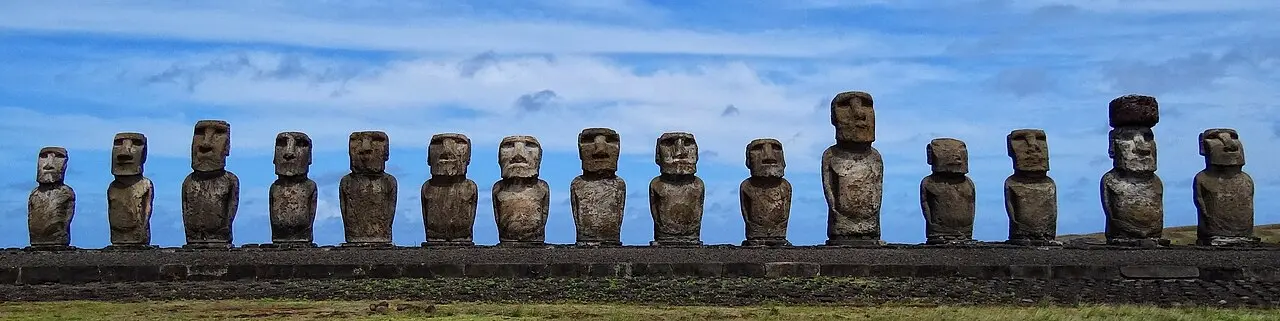
His party stayed about a week. Roggeveen estimated the island held two to three thousand people farming rich soil. His men marveled at the "remarkable, tall, stone figures, a good 30 feet in height" — the moai. One of his officers, Karl Friedrich Barons, wrote of islanders paddling out unarmed to greet the strangers, fascinated by the great ship: one man brought aboard stared at his own reflection in a mirror, then peered behind the glass, searching for the cause of the apparition. His men also noted that "all the country was under cultivation" — a thriving, farmed landscape.
But Roggeveen had not found an empty island. Polynesian voyagers had settled it centuries earlier — oral tradition names the chief Hotu Matu'a, and archaeology places the first settlement roughly between 700 and 1200 CE. Between about the 13th and 16th centuries, the Rapa Nui people carved nearly nine hundred moai from volcanic tuff: towering stone figures honoring their ancestors.
The island's later history was harsher. Its Polynesian name, Rapa Nui — "Big Rapa" — dates to the 1860s, after slave raids devastated the population. Chile annexed the island in 1888, and in 1995 UNESCO inscribed Rapa Nui National Park as a World Heritage Site. Today, about 60 percent of its roughly 5,800 residents are descended from the original Rapa Nui.
The decades after first contact were cruel. European diseases and Peruvian slave raids in the 1860s ravaged the islanders, and by 1877 only 111 Rapa Nui remained — a civilization nearly erased within a century and a half of Roggeveen's visit.
Why it matters: Easter Island is one of the most remote inhabited places on Earth, more than 3,500 kilometers from South America. Its giant statues still rank among archaeology's most iconic achievements — and a reminder that the "discoveries" of European explorers were, to the people already there, simply home.
Photo: Bjørn Christian Tørrissen, CC BY-SA 3.0 (via Wikimedia Commons).