Columbus Sees 'Mermaids' — and Finds Manatees Instead
On January 9, 1493, Christopher Columbus recorded three 'mermaids' he had seen off Hispaniola the day before — manatees, and decidedly 'not half as beautiful as they are painted.'
On January 9, 1493, sailing home from his first voyage across the Atlantic, Christopher Columbus made a strange entry in his ship's journal. The day before, off the Rio del Oro on the coast of Hispaniola, he wrote, he had seen three mermaids rise well out of the sea. They were, he reported with the disappointment of a man who had read too many sailors' tales, "not half as beautiful as they are painted" — though they did have, to some extent, the form of a human face.
They were not mermaids. They were manatees. Columbus had in fact seen the animals before, on the coast of Guinea, and still the old sea legends colored what his eyes told him. He was six months into the first of the four voyages that would change the world — he had set sail from Spain with the Niña, the Pinta, and the Santa María hoping to find a western route to Asia, and had instead reached the Americas — and on the voyage home, even his diary could not quite escape the mythic ocean of his imagination.
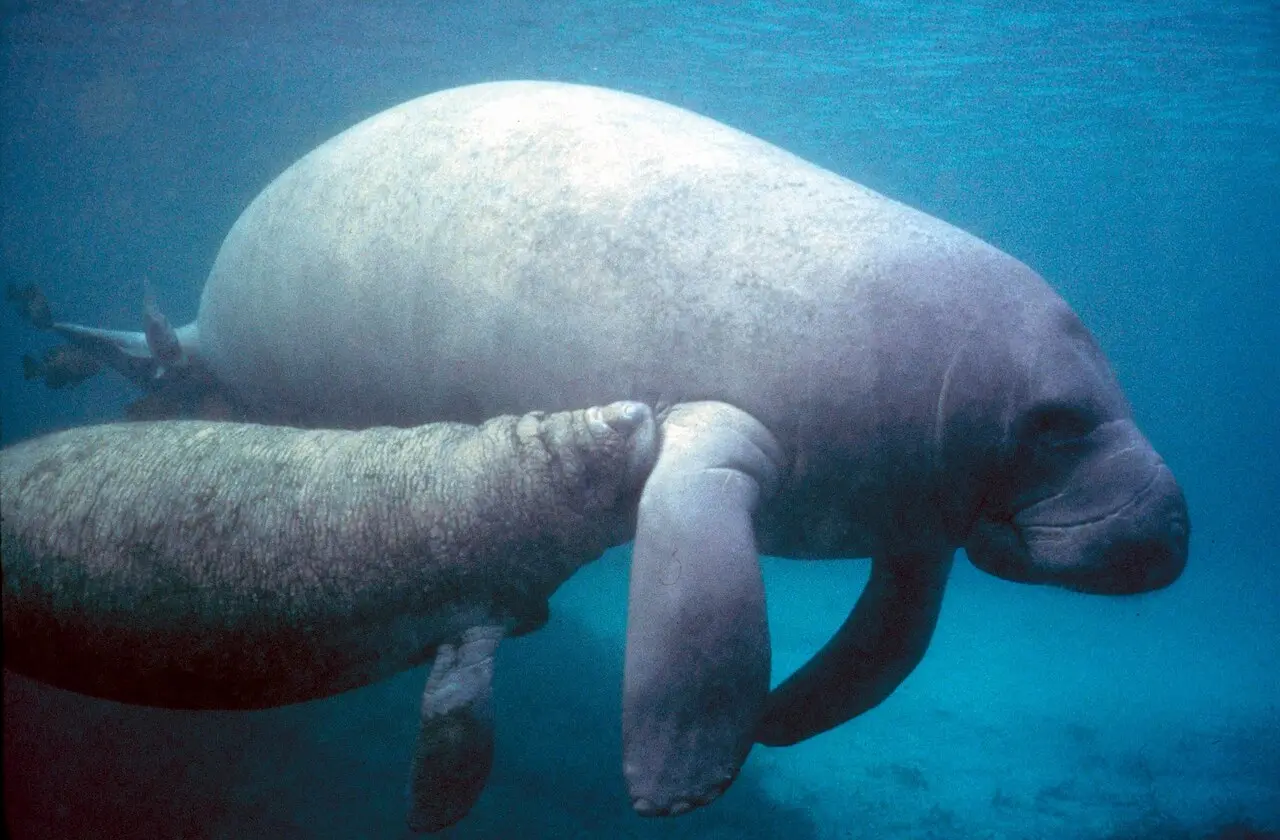
It is not hard to see how sailors made the mistake. Manatees are slow-moving sea mammals, ten to twelve feet long and weighing up to twelve hundred pounds, with bulbous faces, human-like eyes, and paddle-like tails. Glimpsed from a ship's deck through spray and distance, after months at sea, a surfacing manatee could suggest almost anything a lonely sailor already believed. The confusion was so common that scientists eventually named the manatee's whole order Sirenia, after the sirens of Greek myth whose songs lured sailors to their doom.
Columbus's entry is believed to be the first written record of manatees in North American waters. The animals themselves were entirely unbothered by their literary fame: gentle herbivores that graze on seagrasses in warm coastal waters, they are most closely related to the elephant, live fifty to sixty years, and today survive as an endangered species, threatened above all by collisions with boats.
The mermaids, of course, were never real. But the journal entry endures as a perfect snapshot of the Age of Exploration — that strange moment when the known world was cracking open, and sailors sailing off the edge of every map carried their myths along with their compasses, and sometimes wrote them down as fact.
Photo: a modern photograph of a West Indian manatee and her calf by Galen Rathbun (public domain), via Wikimedia Commons, shown to illustrate the animal Columbus mistook for a mermaid.