America's First Flight: Blanchard's Balloon Rises Over Philadelphia
On January 9, 1793, Jean-Pierre Blanchard rose from a Philadelphia prison yard in a hydrogen balloon — the first manned flight in America, watched by George Washington.
The first flight in America didn't happen at Kitty Hawk. It happened 110 years earlier — and it launched from a prison yard.
On January 9, 1793, Jean-Pierre Blanchard, a French showman-aeronaut who had already crossed the English Channel by balloon in 1785, inflated his yellow silk balloon with hydrogen in the courtyard of the Walnut Street Prison in Philadelphia, then the nation's capital. Tickets to watch the ascent sold for as much as five dollars, and the crowd that packed the streets included President George Washington — along with John Adams, Thomas Jefferson, James Madison, and James Monroe, four future presidents gathered to watch one Frenchman try to fly.
Blanchard spoke no English, so Washington handed him a letter of introduction asking everyone he met to let him pass unmolested — America's first piece of air mail. Waving a flag that bore the colors of the United States on one side and France on the other, and tipping his feathered cap to the roaring crowd, Blanchard climbed into the basket with his scientific instruments and one small dog, and let go.
The balloon rose about 1,200 feet and caught a gentle wind, drifting southeast over Philadelphia while thousands watched from rooftops, steeples, and streets. Looking down, Blanchard was astonished at the sheer number of people covering every open space below. On board the basket besides the aeronaut rode his meteorological instruments, provisions of food and wine, and the small dog who would become America's first aerial passenger. In less than an hour it crossed the Delaware River — the first aerial crossing of the river — and settled into a field near Deptford, New Jersey, about fifteen miles away. Local farmers helped the shaken but delighted aeronaut out of his basket, and by 6:30 that evening he was back in Philadelphia, recounting his adventure to Washington himself.
The founding fathers were already balloon enthusiasts: Benjamin Franklin had watched the first Paris ascents a decade earlier and, when asked what use such a contraption could possibly be, reportedly replied, "What good is a newborn baby?" Blanchard's Philadelphia flight proved the baby's promise. It fired the American imagination — balloon ascensions became a sensation across the young nation — and it marked the start of a long romance between America and the sky, from hydrogen balloons to the Wright brothers to the Moon.
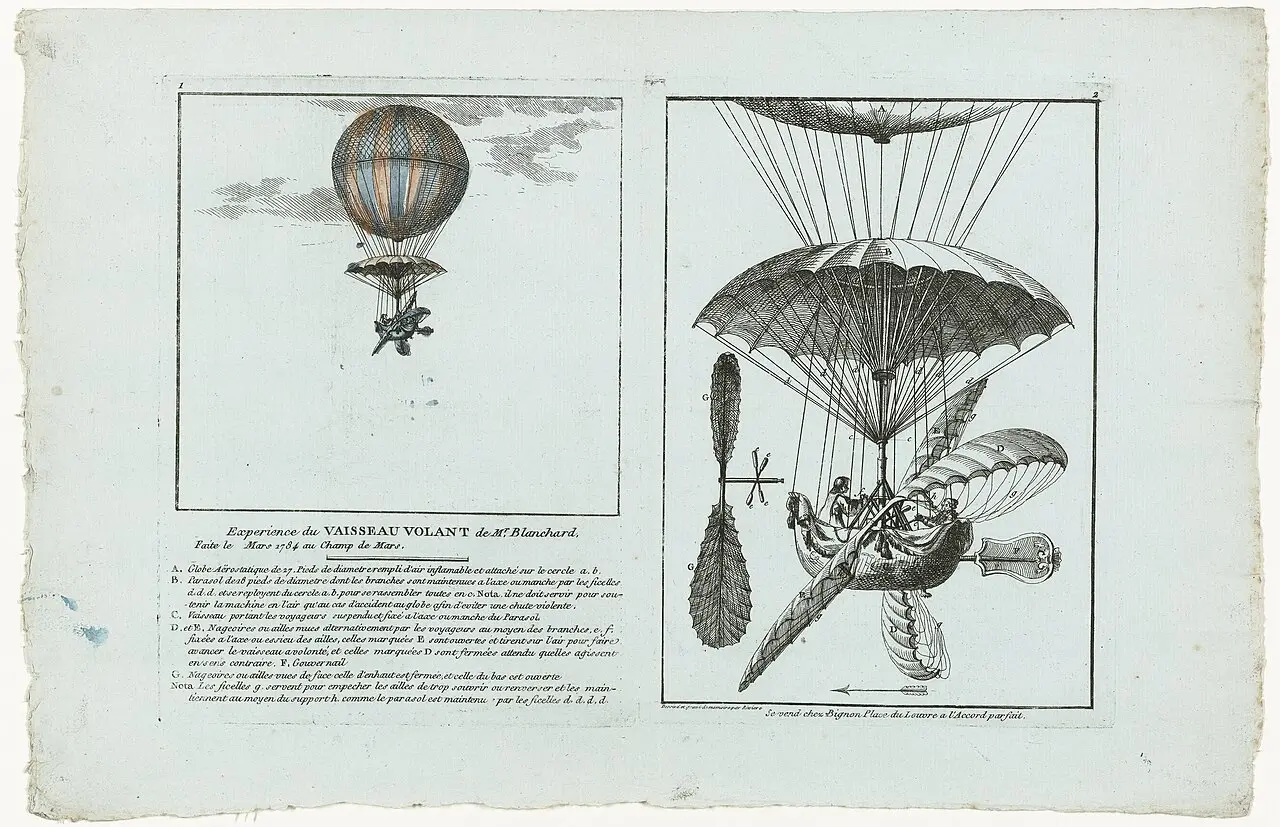
Photo: an engraving of Jean-Pierre Blanchard's balloon design, depicting his March 7, 1784 ascent at the Champ de Mars in Paris (public domain, Rijksmuseum), via Wikimedia Commons. The engraving is illustrative; it shows the balloon design he later flew in America.