A Mob, a Jail, and a Martyr: Joseph Smith's Last Day
On June 27, 1844, a mob stormed the jail in Carthage, Illinois, and murdered Joseph Smith — the first American presidential candidate ever assassinated — and his brother Hyrum.
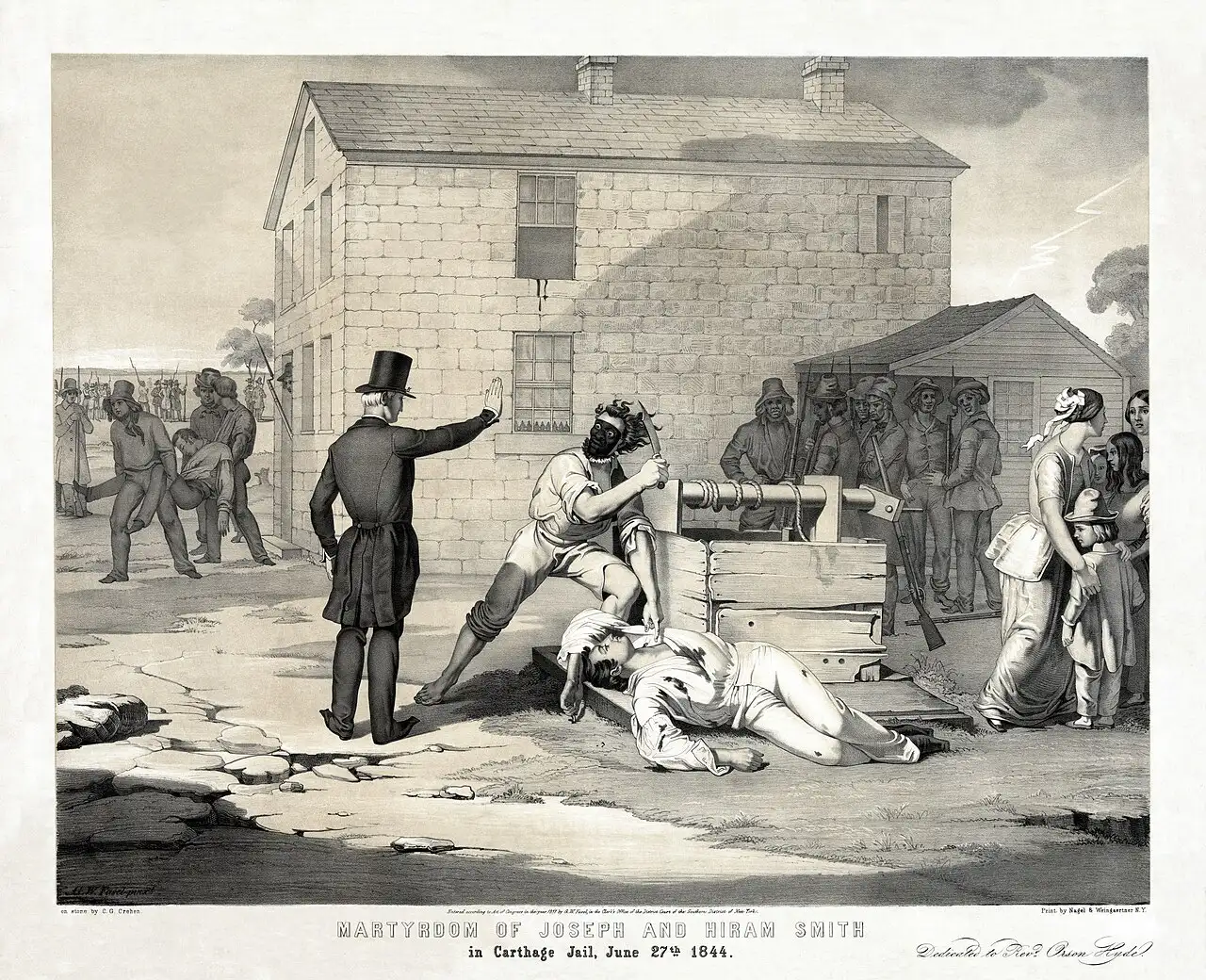
At about five o'clock on the afternoon of June 27, 1844, an armed mob with blackened faces stormed the jail in Carthage, Illinois — and American religious history changed forever.
The man they came for was Joseph Smith, founder of the Latter Day Saint movement. Born in Vermont in 1805, Smith said he had been guided by an angel to an ancient record, which he published in 1830 as the Book of Mormon. That same year he organized the Church of Christ, and his followers built thriving communities — most ambitiously Nauvoo, Illinois, a city of some 12,000 people that rivaled Chicago in size. Smith was its mayor, commanded its 2,500-man militia, the Nauvoo Legion, and in 1844 was even running for president of the United States.
But success bred enemies. A dissident newspaper, the Nauvoo Expositor, published a single explosive issue on June 7, 1844, accusing Smith of polygamy and of aiming to rule as a theocratic king. Smith, acting as mayor with the city council's backing, ordered the press destroyed. Illinois authorities charged him with treason for declaring martial law, and Governor Thomas Ford personally pledged the state's protection if Smith would stand trial. Trusting that promise, Joseph and his brother Hyrum surrendered at Carthage.
The protection failed. On June 27, a mob of some 150 to 200 men rushed the jail. Hyrum was shot and killed first; Joseph fell from a second-story window under a hail of gunfire. Two fellow church leaders were in the room: John Taylor was badly wounded, while Willard Richards escaped miraculously unharmed. Within days, the official announcement of the killings — drawn from the survivors' accounts — was written into the church's scriptures.
The scale of what Smith had built helps explain the fear he inspired. Nauvoo's roughly 12,000 residents made it the second-largest city in Illinois, and the Nauvoo Legion's 2,500 men made it nearly a third the size of the entire U.S. Army — a religious militia answering to a mayor who was running for president. To his followers he was a prophet; to his neighbors he looked like a theocratic king in the making. The official announcement of the killings, composed by the wounded John Taylor from the survivors' accounts, was canonized in the church's scriptures as section 135 of the Doctrine and Covenants.
The assassination made Smith the first American presidential candidate ever killed. It also threw his young church into a succession crisis that Brigham Young resolved by leading the faithful west to Utah — a migration that shaped the American West. Nearly two centuries later, the movement Smith founded has grown into one of the largest home-grown religions in the United States, and Carthage Jail remains a landmark of its founding tragedy.
Photo: G. W. Fasel (artist) and Charles G. Crehen (lithographer), public domain (via Wikimedia Commons).