
A Dream on the National Mall
On August 28, 1963, a quarter of a million people filled Washington, D.C., for the March on Washington, where Martin Luther King Jr. delivered his 'I Have a Dream' speech.
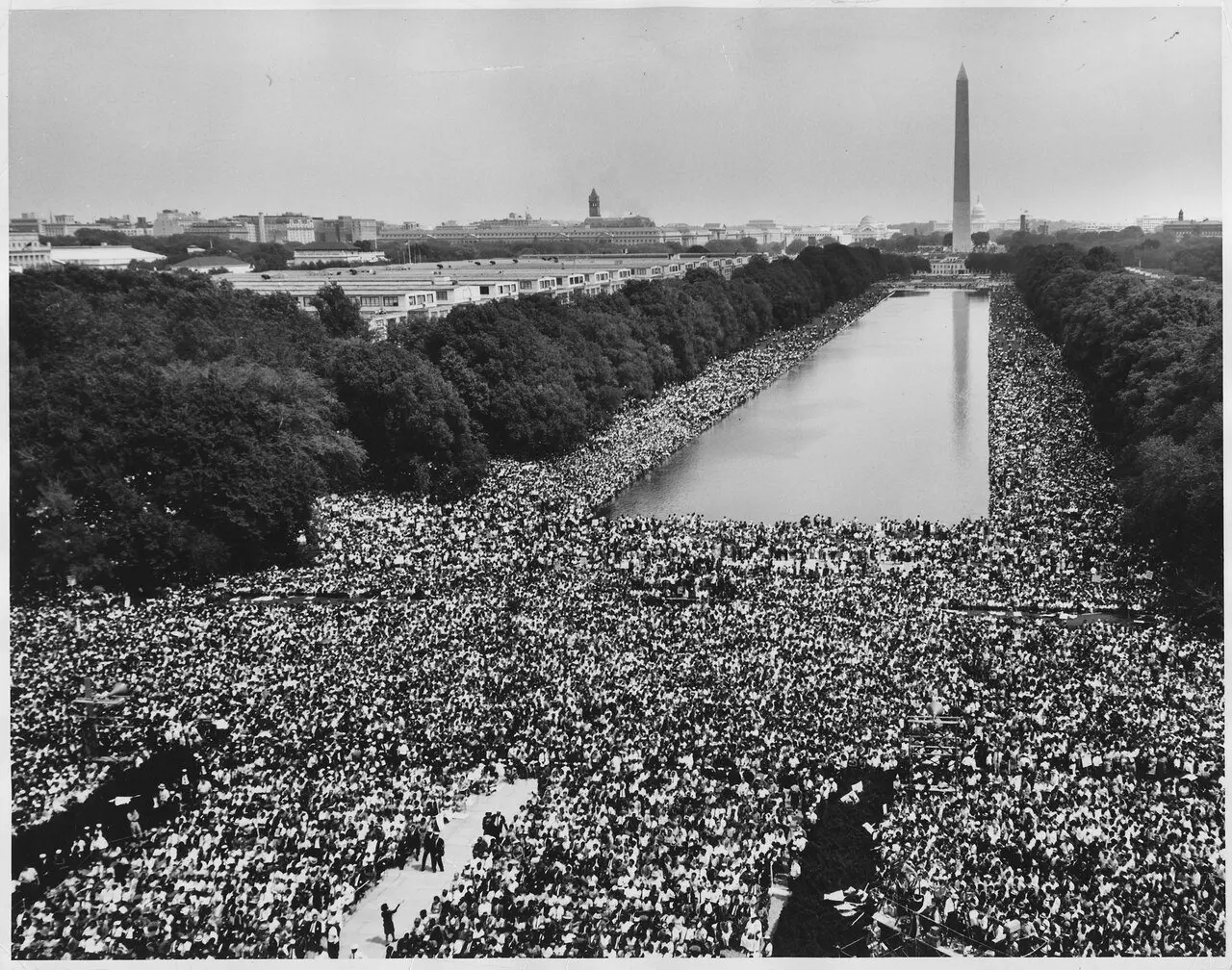
By mid-morning on August 28, 1963, they were already streaming in — by bus, by train, by car, from every corner of the country. Students and sharecroppers, ministers and union members, Black families and white allies. They carried hand-lettered signs and packed lunches, and they had pledged, to a person, that this would be peaceful. By afternoon, some 250,000 people — one of the largest political gatherings in American history — filled the National Mall from the Washington Monument to the Lincoln Memorial.
The scale was no accident — it was Rustin's masterpiece. His team marshaled more than 2,200 chartered buses and 40 special trains to bring people to the capital. Volunteers prepared 80,000 boxed lunches, sold for 50 cents each, with 21 portable water fountains, eight 2,500-gallon tank trucks, and 22 first-aid stations for the August heat. The gathering unfolded in perfect peace.
It was called the March on Washington for Jobs and Freedom, organized chiefly by labor leader A. Philip Randolph and his deputy Bayard Rustin, who built an extraordinary alliance of civil rights, labor, and religious organizations. The demands were concrete: an end to segregation, fair employment, a higher minimum wage, voting rights. Singers Mahalia Jackson and Marian Anderson performed. Speaker after speaker addressed the sea of people.
The idea was two decades old. In 1941, Randolph and Rustin had threatened to bring 100,000 Black protesters to Washington over discrimination in the defense industries. President Franklin Roosevelt, unwilling to face that spectacle on the eve of war, headed the march off with Executive Order 8802 on June 25, 1941 — banning racial discrimination in defense hiring and creating the Fair Employment Practices Committee. Randolph called off the march. But he kept the dream, and twenty-two years later, he finally got it.
The final speaker was a 34-year-old Baptist minister from Atlanta. Standing on the steps of the Lincoln Memorial, Martin Luther King Jr. began his prepared remarks — and then, near the end, he did something unplanned. With Mahalia Jackson calling out from behind him, 'Tell 'em about the dream, Martin!', King set his notes aside and improvised the peroration that would become one of the most famous speeches ever delivered: his vision of a nation where his children would be judged by the content of their character.
That improvised ending had been rehearsed — just not in Washington. King had used the 'I have a dream' refrain before: in Rocky Mount, North Carolina, in November 1962, and in Detroit on June 23, 1963, where 125,000 people joined the Great Walk to Freedom and 25,000 heard him speak at Cobo Hall. There he first preached, 'I have a dream this afternoon.' Mahalia Jackson, who sang just before King's Washington speech, had heard the Detroit version — which is when she called out, 'Tell 'em about the dream, Martin.'
One of the day's sharpest moments almost didn't happen. John Lewis, the 23-year-old chairman of the Student Nonviolent Coordinating Committee and the youngest speaker on the program, arrived with a draft denouncing President Kennedy's civil rights bill as 'too little and too late.' Archbishop O'Boyle, slated to give the invocation, warned he would pull out unless the speech was toned down. Rustin negotiated with Lewis, who agreed to soften the wording — changing 'we cannot support the administration's civil rights bill' to 'we support it with great reservation.'
The march did what its organizers hoped. It showed the country — and the world, through television — the dignity, discipline, and scale of the freedom movement, and it is widely credited with building the pressure that carried the Civil Rights Act of 1964 into law, followed by the Voting Rights Act of 1965.
What endures is not just the speech but the method: a quarter of a million people, furious at injustice, choosing nonviolence as their weapon — and proving that peaceful assembly, at scale, can move a nation.
Photo: U.S. National Archives and Records Administration, public domain (via Wikimedia Commons).