A Continent at Last: Columbus Reaches South America
On August 1, 1498, on his third voyage, Columbus reached the mainland of South America near Venezuela's Orinoco delta — the first recorded European encounter with the continent.
The ships had been becalmed for days in the breathless heat of the doldrums, their food spoiling and their water going foul, when the lookout's cry finally came. On July 31, 1498, Christopher Columbus and his men sighted the island of Trinidad, which he named for the Holy Trinity. But the real shock came the next day. On August 1, 1498, sailing west along Trinidad's southern coast, Columbus's three ships reached the green, hazy coastline of a vast landmass near the mouth of the Orinoco River — in what is now Venezuela. For the first time, a European expedition had reached the mainland of South America.
This was Columbus's third voyage, and the ocean had nearly broken him before he ever saw land. He had left Spain on May 30, 1498, with six ships, sending three straight to the struggling colony on Hispaniola while he took the other three south past the Cape Verde Islands and then west, under orders to find the passage to Asia the Spanish crown still demanded. The crossing was brutal: days trapped in the windless mid-Atlantic, heat warping the timbers and rotting the stores.
What Columbus found at the Orinoco's mouth astonished him. An enormous volume of fresh water was pushing far out into the salty sea — the discharge of one of the world's great rivers. Such a river, he reasoned, could only drain a continent. He called the land an "otro mundo," an other world — yet he could not release his old dream. He decided this must be Asia after all, and perhaps even the outer regions of the Earthly Paradise.
Columbus was in no condition to celebrate. He had endured a month of sleeplessness, and his eyes were so bloodshot and swollen he could barely see. When his men finally went ashore on the Paria Peninsula on August 5, he stayed aboard and let his captains go first: one planted a cross, and another formally recorded the admiral taking the province for Spain. The expedition traded for pearls — the first Spaniards had seen in the New World — and tasted maize wine offered by the local people. Days earlier, a sudden tsunami had nearly capsized his flagship.
On August 19, Columbus sailed for Hispaniola, where he found the colony in open rebellion against his rule. Within two years he would be sent home to Spain in chains. He never understood what he had found that August day: a continent. He died in 1506 still insisting he had reached the outskirts of Asia.
That is why August 1, 1498, matters. On that day the European map of the world quietly doubled in size. A whole continent — with its rivers, peoples, pearls, and forests — had entered recorded history, even if the man who found it never grasped what it was.
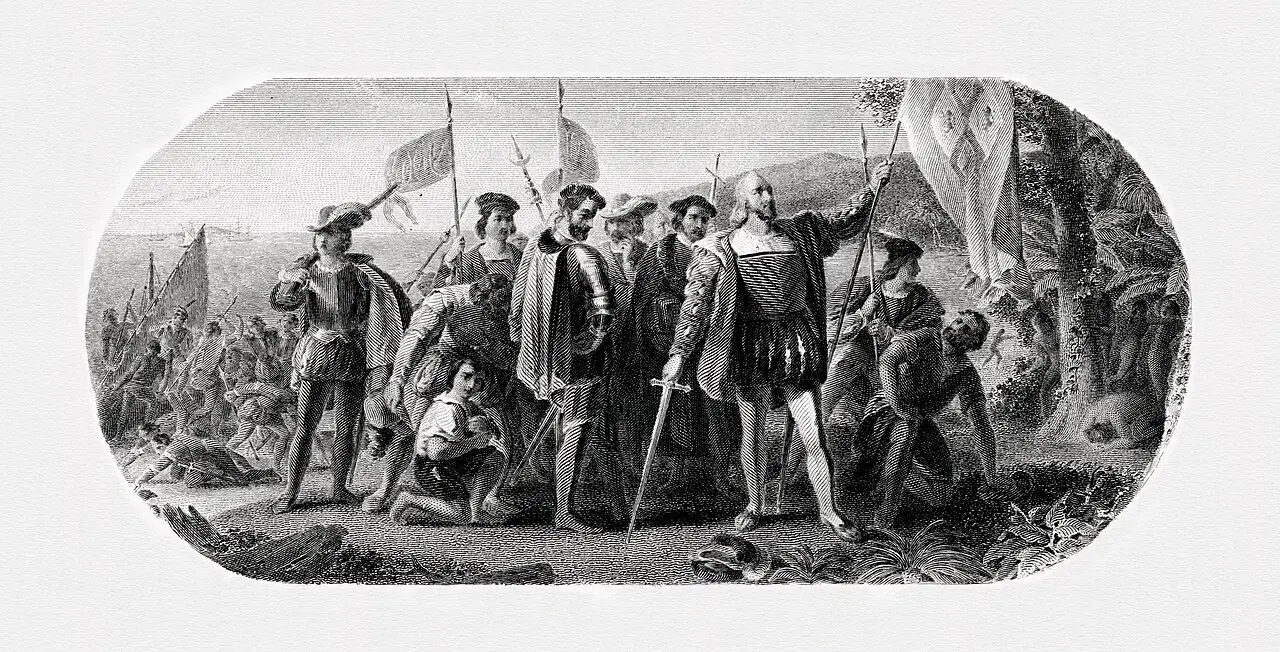
Engraving after John Vanderlyn's "Landing of Columbus" (1847), public domain (via Wikimedia Commons).