A Charter for Half a Continent: Hudson's Bay Company, 1670
On May 2, 1670, Charles II granted the Hudson's Bay Company a royal charter — and with it, a fur-trade monopoly over a third of modern Canada.
On May 2, 1670, King Charles II of England signed a document that gave away an empire he had never seen. Written on five sheets of sheepskin parchment and stamped with the Great Seal, the royal charter created "The Governor and Company of Adventurers of England, trading into Hudson's Bay" — the Hudson's Bay Company — and handed it a monopoly over every river, lake, and stream draining into Hudson Bay.
The company owed its existence to two Frenchmen. Pierre-Esprit Radisson and Médard des Groseilliers, fur traders who had seen the riches of the Canadian interior, failed to interest the French crown — so they took their plan to England, where the king's cousin Prince Rupert became their backer and the company's first governor. The vast territory was named Rupert's Land in his honor.
What the charter granted was staggering: some 1.49 million square miles — over a third of what is now Canada — plus the right to trade exclusively, administer justice, and govern the territory. Europe was hungry for beaver pelts to make fashionable felt hats, and the company's founding investors, who paid £300 a share, included men like the chemist Robert Boyle. The Bay's traders built a network of posts across the wilderness, trading with Indigenous nations whose lands the charter had simply given away, without their consent.
The venture's worth was proven quickly: the first sale of Hudson's Bay furs at Garraway's Coffee House in London took place in 1671. Rivals came and went — the Montreal-based North West Company fought the Bay so fiercely that the two merged in 1821 under the Hudson's Bay name. Under Governor Sir George Simpson, who led the company from 1821 to 1856, it reached its peak: a fur empire stretching from the Atlantic to the Pacific.
When Canada became a dominion in 1867, the age of the company-state ended — but the Bay adapted, diversifying into land, transportation, and retail, and remaining Canada's largest corporation into the 1920s. It is still with us today: North America's longest-operating company.
Why it matters: the Hudson's Bay Company shows how a single piece of parchment could redraw a continent. Its trading posts became towns, its trade routes became roads, and its story — of ambition and enterprise, and of the Indigenous peoples it displaced — is inseparable from the making of Canada itself.
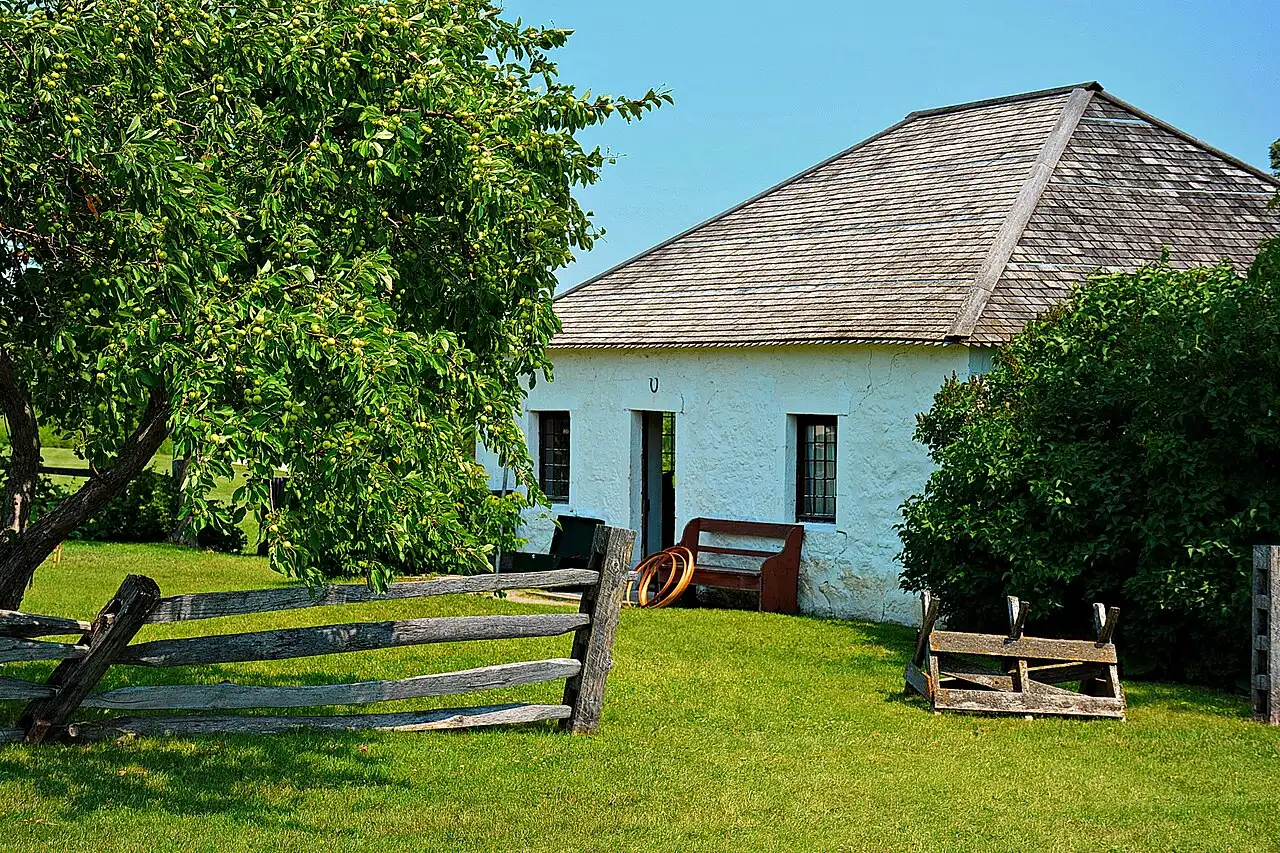
Photo: Stan Kucera, CC BY-SA 4.0 (via Wikimedia Commons). (Lower Fort Garry, a historic Hudson's Bay Company trading post — not from 1670.)