3.11: Japan's Great Earthquake and Tsunami
On March 11, 2011, a magnitude 9.0–9.1 earthquake and tsunami devastated Japan's northeast coast, killing nearly 20,000 people.
At 2:46 on the afternoon of March 11, 2011, the seafloor off northeastern Japan ruptured. For six minutes — an eternity in an earthquake — the ground heaved with a force Japan had never recorded. Seismometers around the world caught it: magnitude 9.0 to 9.1, the most powerful earthquake in Japan's history and the fourth strongest ever measured anywhere since modern instruments began in 1900.
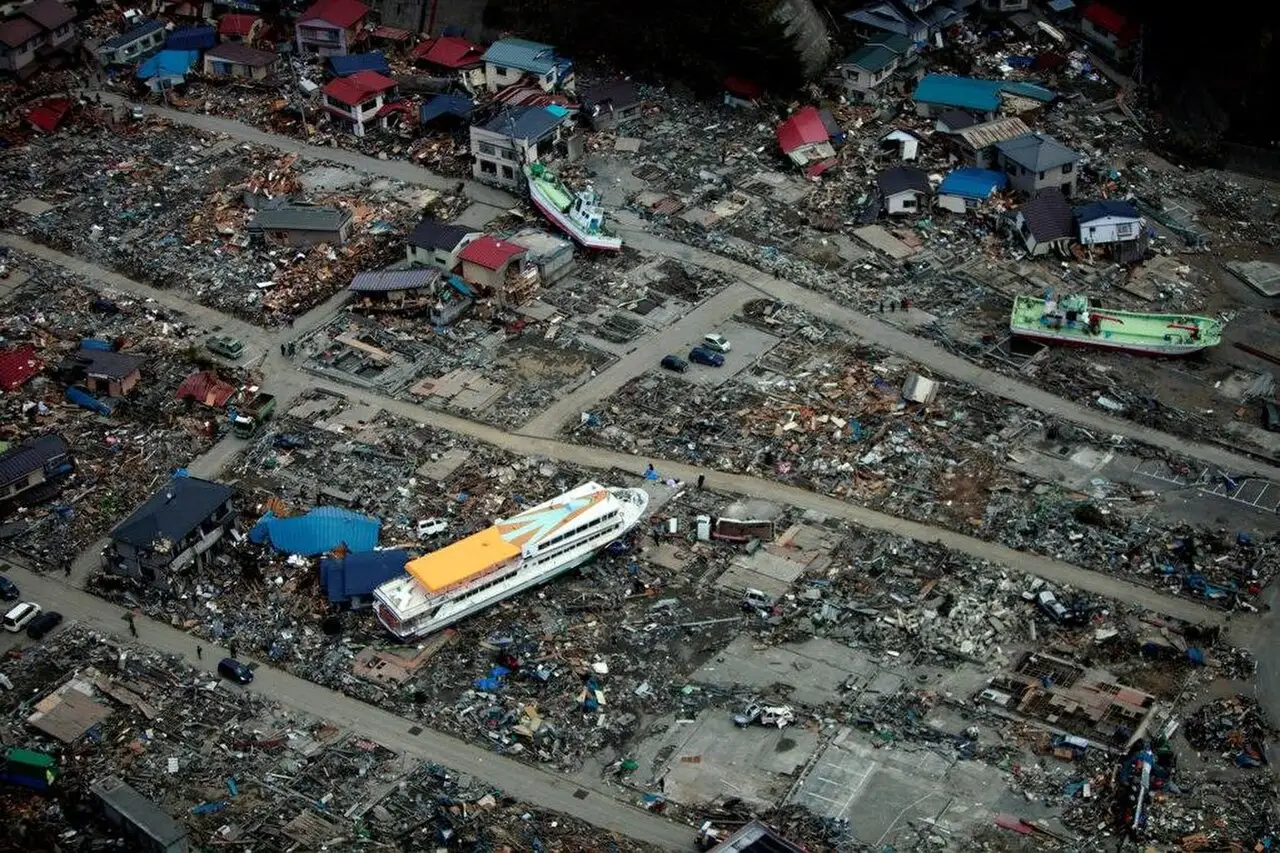
The shaking was only the beginning. The quake, centered about 70 kilometers off the Oshika Peninsula, shoved the seafloor upward and set the ocean itself in motion. Within half an hour, walls of water were racing toward the coast. In Miyako, in Iwate Prefecture, the tsunami reached 40.5 meters — 133 feet — high. Seawalls built to hold back the sea were overtopped like sandcastles. In towns across Iwate, Miyagi, and Fukushima prefectures, whole neighborhoods vanished under black water carrying ships, cars, and houses. A large ferry came to rest amid shattered homes, far from the sea.
When the waters receded, the toll was staggering: nearly 20,000 people dead — 19,759 confirmed — and more than 2,500 still missing. Damage was estimated at some $360 billion, making it the costliest natural disaster ever recorded. And at the Fukushima Daiichi nuclear plant, the tsunami swamped backup generators, sending three reactors into meltdown and forcing the evacuation of entire towns. It was the worst nuclear accident since Chernobyl.
The recovery became one of the great rebuilding efforts of modern times. Coastal towns raised massive seawalls — some more than 12 meters high — and moved entire neighborhoods to higher ground. Debris from the tsunami drifted across the Pacific for years, eventually washing up on North American shores. Scientists, meanwhile, learned a humbling lesson: the tsunami had exceeded every official hazard map, a warning now studied by coastal planners worldwide.
Yet amid the devastation, the world saw something else: order. Survivors queued patiently for supplies. Strangers shared blankets. Across the Pacific, donations poured in, and the U.S. military launched Operation Tomodachi — "Friend" — to help with relief. Japan, a nation built on earthquake drills and early-warning systems, had been as prepared as any country on earth — and the disaster still overwhelmed it, a humbling lesson for every coastal nation.
3.11, as Japan calls it, reshaped the world — accelerating debates over nuclear power on every continent, rewriting tsunami science, and proving that even the best-prepared nation can be humbled by nature. But it also left a quieter legacy: the discipline and mutual care of ordinary people in catastrophe. Every March 11, Japan pauses to remember — and to promise the sea will never catch it unready again.
Photo: U.S. Navy aerial photo of tsunami damage in Japan, March 2011, public domain.