Voyager 1 Meets Jupiter: Volcanoes, a Ring, and 19,000 Photos
On March 5, 1979, a car-sized robot swept past Jupiter and rewrote the textbooks — finding erupting volcanoes on Io and a ring no one expected.
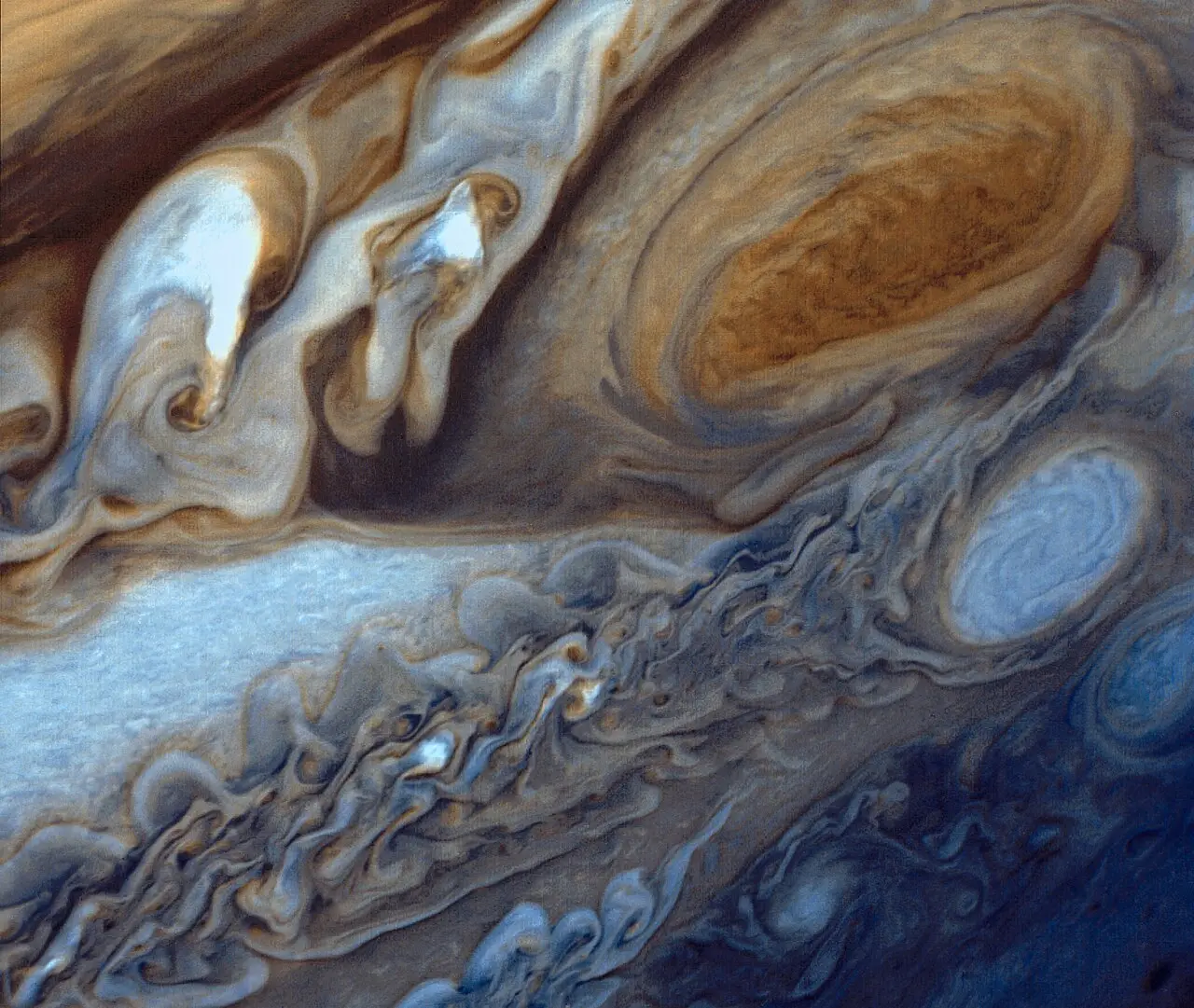
On March 5, 1979, a robot the size of a small car swept past Jupiter at 12:05 in the morning, Universal Time — and the giant planet would never look the same again.
Voyager 1 had been traveling for a year and a half since its launch from Cape Canaveral on September 5, 1977. It crossed the asteroid belt, endured the long dark cruise, and began photographing Jupiter in January 1979, when the banded planet already looked sharper than any telescope on Earth had ever shown it. On March 5, still inbound, it photographed the small inner moon Amalthea up close for the first time, revealing an oblong, reddish world. About five hours later came the main event: closest approach, flying within 174,000 miles of Jupiter's cloud tops.
What Voyager 1 found in those days rewrote the textbooks. Jupiter's atmosphere was far more turbulent than the earlier Pioneer flybys had suggested — a churning, multicolored storm system dominated by the Great Red Spot, a vortex larger than the entire Earth. But the real shocks were the moons. On Io, Voyager's cameras revealed active volcanoes erupting plumes into space — the first volcanoes ever seen on another world. Europa, Ganymede, and Callisto each turned out to be utterly unique, strange new worlds rather than the dead rocks astronomers had expected.
Voyager 1 also found things nobody had predicted at all. Looking back at Jupiter backlit by the Sun, it discovered a thin, faint ring encircling the planet. It found two previously unknown moons, later named Thebe and Metis. In total, the encounter that began in January and ended in early April returned almost 19,000 images and a flood of measurements of the planet's magnetic field, radiation belts, and atmosphere.
The flyby was only the beginning of the journey. Jupiter's immense gravity bent Voyager 1's trajectory and hurled it onward toward Saturn, which it reached in November 1980, photographing the ringed planet and its haze-shrouded moon Titan. Then the spacecraft kept going — past the edge of the planetary system entirely. In August 2012, Voyager 1 crossed into interstellar space, becoming the first human-made object to leave the bubble of the Sun's influence.
Today Voyager 1 is the most distant human-made object in existence, more than 15 billion miles from Earth, still sending back faint data through NASA's Deep Space Network. Its nuclear power source is steadily fading, but its March 1979 encounter with Jupiter remains one of the great exploration feats in history: a machine built in the 1970s that showed us, for the first time, what the outer solar system really looks like.
Photo: NASA/JPL-Caltech, public domain (Voyager 1 image of Jupiter, 1979).