The "Iron Curtain" Speech That Framed the Cold War
On March 5, 1946, Winston Churchill warned that "an iron curtain has descended" across Europe, in a speech at a small Missouri college widely seen as the Cold War's opening statement.
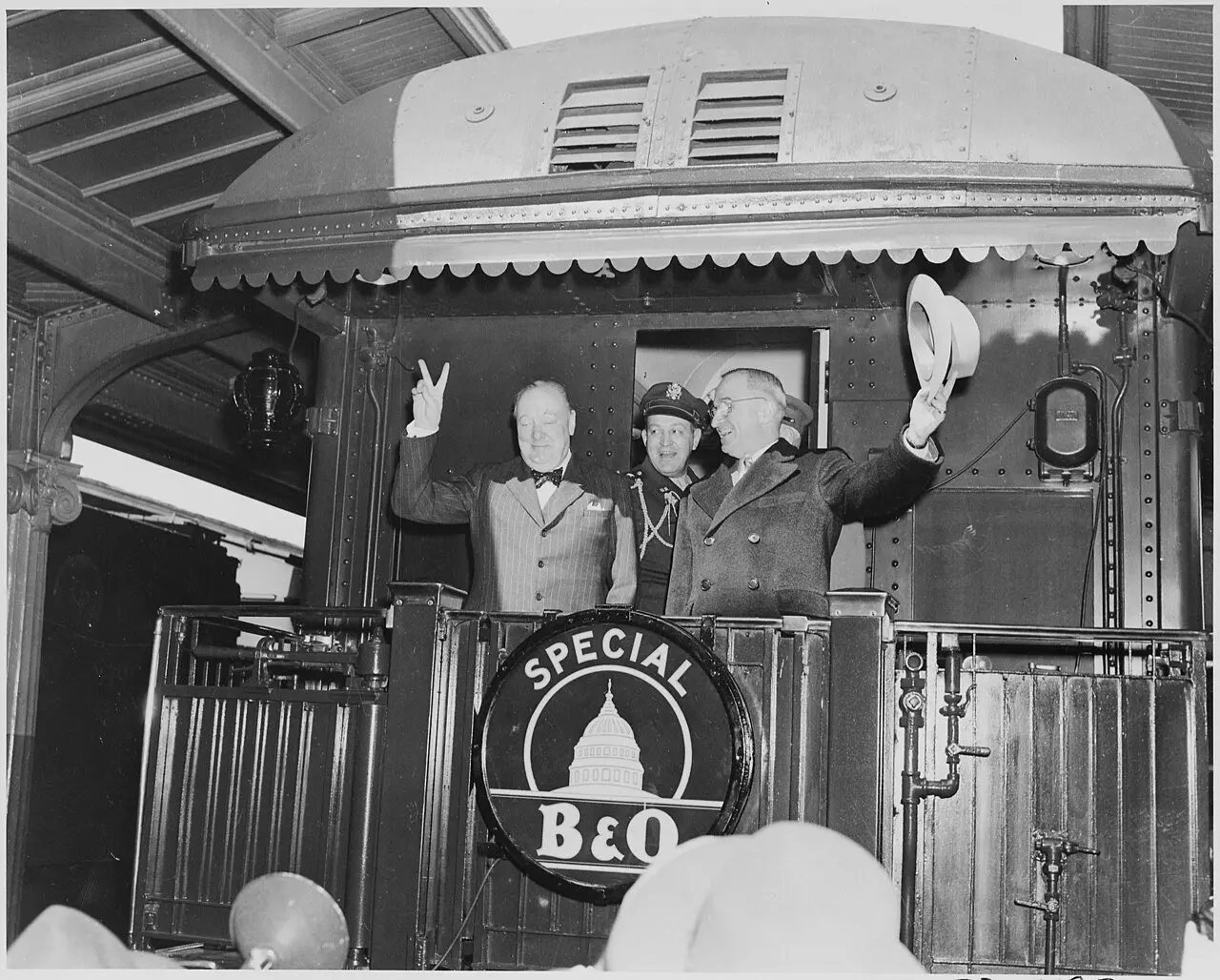
It was an unlikely stage for a speech that would define a century: the gymnasium of Westminster College in tiny Fulton, Missouri. On March 5, 1946, Winston Churchill — no longer prime minister, having lost the 1945 election and now merely Leader of the Opposition — stepped to the podium after an introduction by President Harry S. Truman himself, who had traveled with him by train from Washington and added his own personal note to the invitation that brought Churchill there.
Churchill titled the address "The Sinews of Peace," and he spoke for 46 minutes to a crowd that packed the college gymnasium and filled the small town around it. He began not with geopolitics but with a plea for the war's homeless — urging Americans to aid the millions of refugees in Europe and Asia left destitute by the fighting. Then he turned to his theme: the Soviet Union must not be allowed to keep expanding, and only Britain and the United States could stop it. Invoking the disaster of appeasing Hitler in the 1930s, he warned that "there never was a war in history easier to prevent by timely action than the one which has just desolated such great areas of the globe."
But one sentence made history. Warning that Soviet power was swallowing Eastern Europe, he said: "From Stettin in the Baltic to Trieste in the Adriatic, an iron curtain has descended across the Continent." He named the capitals behind it — Warsaw, Berlin, Prague, Vienna, Budapest, Belgrade, Bucharest, Sofia — and called for a "fraternal association" of the English-speaking peoples, coining in the same breath the phrase the "special relationship" between Britain and America.
The timing was electric. Less than a year after the end of World War II, the wartime alliance was fracturing, and Churchill gave the division a name everyone could picture. Moscow denounced the speech; in the West, it was read as a declaration that the Cold War had begun. Whether or not the conflict truly started that day, the Fulton address became its defining metaphor — and it shaped Western policy for the next four decades, until the curtain finally lifted in 1989.
The speech never left Fulton. Westminster College later imported a bombed-out 17th-century London church, St. Mary Aldermanbury, stone by stone, and rebuilt it on campus as America's National Churchill Museum. In 2026, Congress passed legislation to designate it a National Historic Landmark — eighty years after a retired prime minister stood in a college gym and told the world exactly where the line had been drawn.
Photo: Abbie Rowe (U.S. National Archives), public domain (via Wikimedia Commons).