The 'Massacre' That Was Really Propaganda: Boston, March 5, 1770
Five colonists died on King Street — but it was Paul Revere's viral engraving, not the muskets, that pushed America toward revolution.
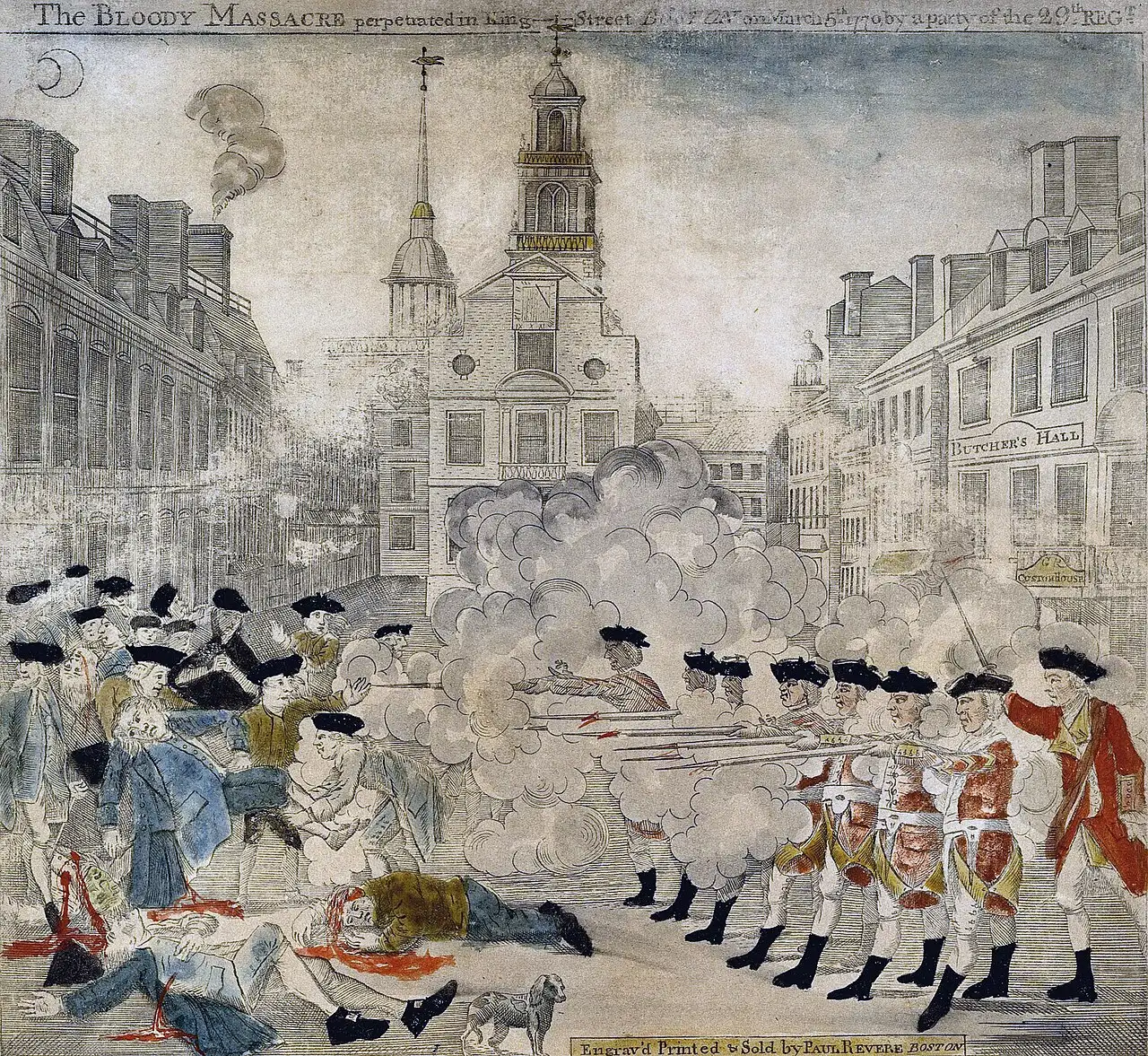
The most famous picture of the Boston Massacre is a lie — and everyone knew it.
On the evening of March 5, 1770, a crowd of colonists faced off against British soldiers outside the Customs House on King Street in Boston. Snowballs, chunks of ice, and insults flew. Then muskets fired. When the smoke cleared, three men lay dead in the snow, and two more would die of their wounds in the days that followed. But within weeks, a print began circulating through the colonies showing something else entirely: a neat line of redcoats, an officer calmly giving the order to fire, and a crowd of helpless, well-dressed Bostonians mowed down like wheat.
That engraving, printed and sold by silversmith Paul Revere, turned a chaotic street clash into propaganda gold. It was the 18th-century equivalent of a viral post — and it helped push America toward revolution.
The road to King Street had been paved with taxes. In 1767, Britain's Parliament passed the Townshend Acts, slapping duties on lead, glass, paper, paint, and tea imported into the colonies. Bostonians, who had no representatives in Parliament, were furious. Britain stationed regiments of soldiers in Boston to enforce the laws and protect royal officials, and the troops — underpaid, bored, and resented — brawled regularly with townspeople.
Tensions had already turned deadly two weeks earlier. On February 22, a customs informer named Ebenezer Richardson fired into a crowd of boys harassing him and killed 11-year-old Christopher Seider. The boy's funeral drew thousands of mourners, and anger simmered for days. On March 5, a handbill warned that British soldiers were preparing to defend themselves, and a crowd gathered around a lone sentry outside the Customs House.
Reinforcements arrived under Captain Thomas Preston, and the crowd — now numbering in the hundreds — dared the soldiers to fire. One musket discharged, then the rest. Crispus Attucks, a Black sailor who had become a symbol of colonial resistance, was among the first to fall, along with Samuel Gray and James Caldwell. Samuel Maverick and Patrick Carr died of their wounds later. The acting governor, Thomas Hutchinson, calmed the mob from a balcony by promising an inquiry, and the troops were withdrawn to Castle Island.
What happened next was remarkable. The soldiers were put on trial for murder — and defended by John Adams, a leading patriot who believed even redcoats deserved a fair trial. Six were acquitted; two were convicted of manslaughter and branded on the thumb, the era's punishment. Adams later called the defense "one of the most gallant, generous, manly and disinterested actions of my whole life."
But the verdicts barely mattered. Revere's engraving — which borrowed heavily from a design by fellow engraver Henry Pelham — had already done its work. Samuel Adams and other patriots made sure every colony saw it. The "Boston Massacre," as they named it, became a rallying cry. Six years later, when the founders declared independence, the memory of March 5, 1770 was still fresh: proof, in their telling, that British rule meant tyranny.
The truth was messier — a panicked volley, not an ordered execution. But the story the colonies told themselves about that night mattered more than the facts. The Boston Massacre shows how a single evening of violence, reframed by a brilliant piece of propaganda, can change the course of history.
Photo: Paul Revere, public domain (engraving, 1770).