Vesuvius Erupts: The Grand Eruption of 1906
On the night of April 7, 1906, Mount Vesuvius reached the peak of its most violent modern eruption, burying villages in lava and ash and darkening the skies over Naples.
By the evening of April 7, 1906, Naples had vanished into darkness — not nightfall, but a vast cloud of ash spreading from the mountain on the horizon.
Mount Vesuvius had been rumbling for a year, and its eruption had begun on April 4. But the night of April 7 into April 8 brought the climax, in what Italians would call La Grande Eruzione — the Grand Eruption, the volcano's worst in modern times and the deadliest of the 20th century.
On the slopes, rivers of lava poured down on Boscotrecase, effectively obliterating the village. But it was the ash that killed most. In San Giuseppe, east of the crater, terrified residents crowded into a church for shelter; the roof collapsed under the weight of ash, and the church became the single greatest loss of life in the disaster. In neighboring Ottaviano (then spelled Ottojano), ash fell more than a meter deep and poorly built houses crumbled. Estimates of the dead range from about 100 to as many as 216.
Naples itself was smothered. Scientists later calculated that some 315,000 tons of hot volcanic dust fell on the city; streets and gardens were unrecognizable, citizens shielded their faces with umbrellas and protective glasses, and even the robust roof of the Monte Oliveto market gave way, killing shoppers inside. Around 150,000 people fled the villages around the volcano, many arriving in Naples as refugees.
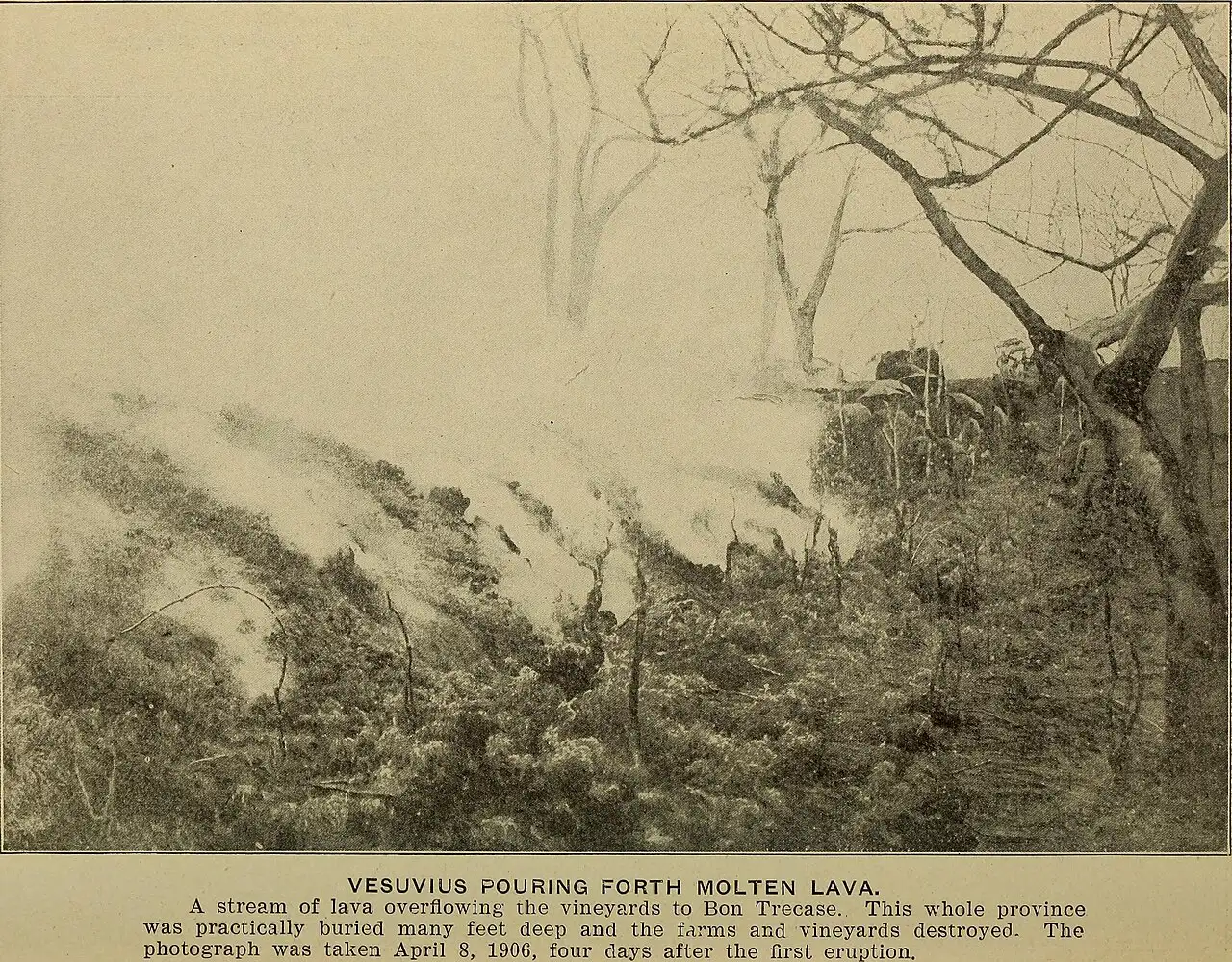
One contemporary photograph, taken on April 8 and printed in a 1906 account, shows lava streaming through the vineyards toward Boscotrecase — "a stream of lava overflowing the vineyards," the caption reads, noting that "this whole province was practically buried many feet deep and the farms and vineyards destroyed." Britain's journal Nature reported on the eruption that same month, marveling that the damage at Ottaviano and San Giuseppe came not from lava but from "a very heavy fall of ash."
The eruption reshaped more than the landscape. Italy had to divert so much money to rebuilding Naples that Rome gave up its plans to host the 1908 Olympic Games, which were moved to London instead.
Why it matters: Vesuvius had destroyed Pompeii in 79 AD, but 1906 was a reminder that the volcano is not ancient history — it is a living mountain above a modern city of millions, and the Grand Eruption remains the benchmark against which every evacuation plan for Naples is still measured.
Photo: from The History of the San Francisco Disaster and Mount Vesuvius Horror (1906), public domain (via Wikimedia Commons).