Under the Hudson: The Holland Tunnel Opens
In the early hours of November 13, 1927, the Holland Tunnel opened to traffic — the first underwater tunnel built for cars, named for the engineer who never saw it finished.
The celebration started the day before the opening. At 4:55 p.m. on November 12, 1927, President Calvin Coolidge — sitting aboard his yacht on the Potomac River, miles away — pressed a telegraph key and ceremonially opened the Holland Tunnel. It was the same key that had opened the Panama Canal in 1915, which Time magazine called "the golden lever of the Presidential telegraphic instrument." The signal rang a giant brass bell at the tunnel entrances and parted American flags on both sides of the Hudson.
Then some 20,000 people walked the nearly two-mile length of the tunnel before it was closed to pedestrians at 7 p.m. And at 12:01 a.m. on November 13, 1927, the Holland Tunnel officially opened to traffic. More than a thousand vehicles had already gathered on the New Jersey side, waiting to pay the toll. The first car through was driven by the daughter of the chairman of New Jersey's Bridge and Tunnel Commission; in the second vehicle rode the widows of the tunnel's first two chief engineers.
The tunnel bore the name of the first of them, Clifford Holland, who had died in 1924 before his great work was finished. Holland had been hired in 1920 to solve what many considered an impossible problem: boring a tunnel for automobiles beneath the Hudson River, linking Jersey City with Lower Manhattan. Cars meant exhaust fumes, and exhaust fumes in a long underwater tube meant death — unless someone could figure out how to keep the air breathable.
That someone was Ole Singstad, the engineer who completed the project. He designed the world's first mechanically ventilated tunnel: a system of 84 enormous fans, housed in ventilation towers on both shores, that could replace all the air inside the tunnel every 90 seconds. The innovation made long road tunnels possible everywhere, and engineers have been copying it ever since. The tunnel was later designated a National Historic Civil and Engineering Landmark.
At its opening, the Holland Tunnel was the longest continuous underwater vehicular tunnel in the world — and the first tunnel anywhere designed specifically for car and truck traffic. Nearly a century later, it still carries tens of millions of vehicles a year beneath the river, the fans still turning, the air still changing every minute and a half, inside the tunnel that a president opened with a telegraph key.
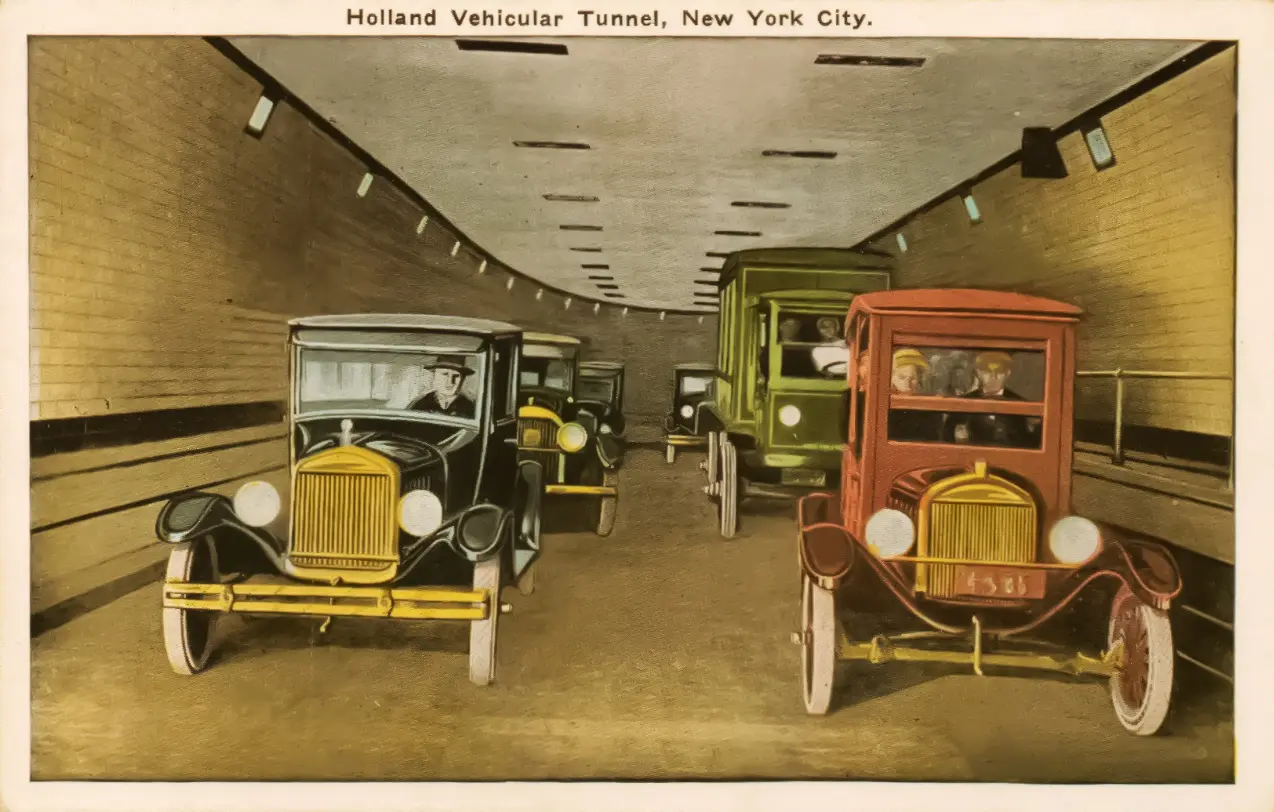
Photo: vintage 1927 postcard of the Holland Vehicular Tunnel, released to the public domain under CC0 (via Wikimedia Commons).