The Treaty That Redrew North America
On February 2, 1848, the Treaty of Guadalupe Hidalgo ended the Mexican–American War and transferred roughly half of Mexico's territory — including California — to the United States.
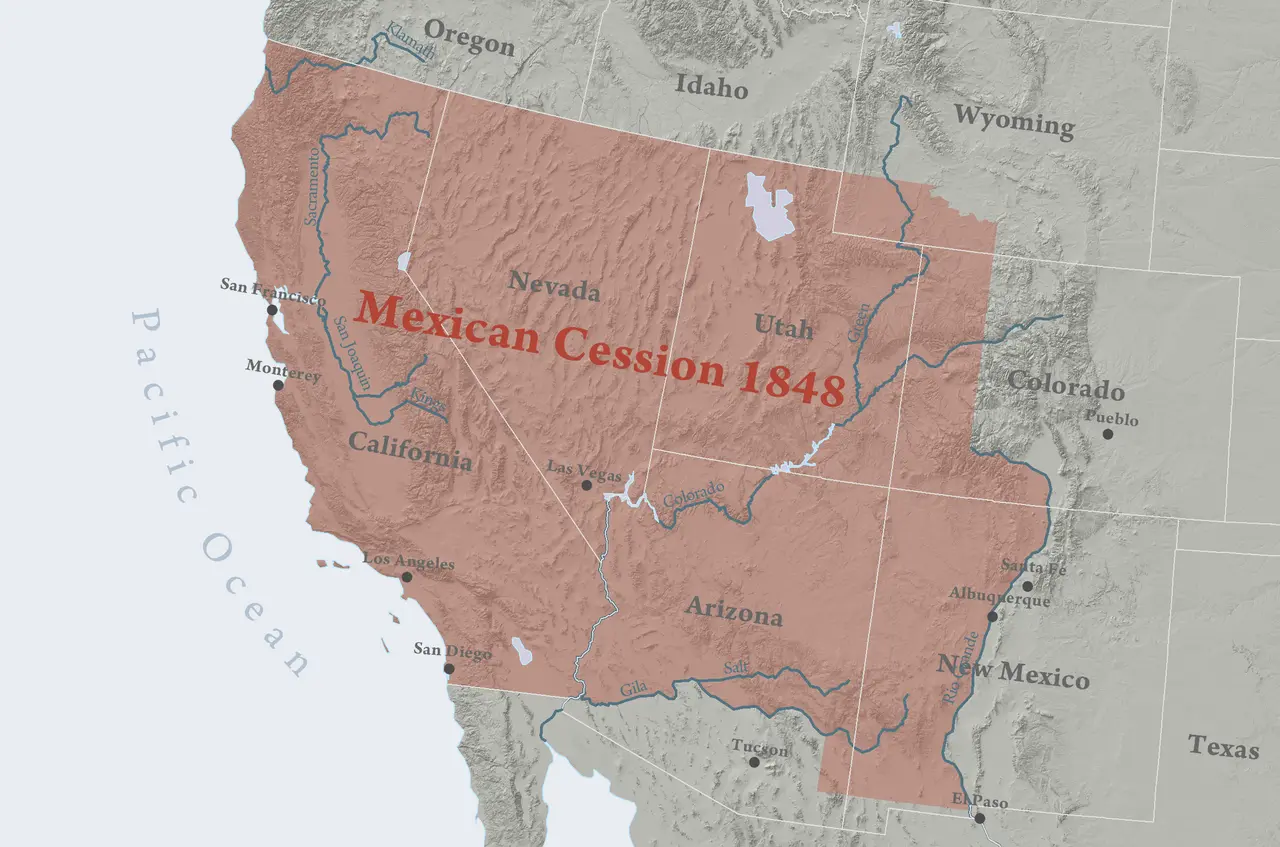
In a small town outside Mexico City, on February 2, 1848, a diplomat who had been ordered to come home signed the treaty that gave the United States California, Nevada, Utah, and most of the American Southwest. His name was Nicholas Trist, and his disobedience redrew the map of a continent.
The Mexican–American War of 1846–1848 had been brutal and decisive. American forces under Zachary Taylor and Winfield Scott had won battle after battle, and Mexico City fell in September 1847. With Mexico's army defeated and its government in disarray, President James K. Polk sent Trist to negotiate peace — then recalled him when the envoy pushed for more territory than Polk wanted. Trist stayed anyway, judging the moment too fragile to abandon. In the town of Guadalupe Hidalgo, he hammered out terms with the Mexican commissioners Luis Gonzaga Cuevas, Bernardo Couto, and Miguel Atristain.
The treaty, formally titled the Treaty of Peace, Friendship, Limits, and Settlement, was staggering in scope. Mexico ceded about 55 percent of its territory — roughly 525,000 square miles encompassing present-day California, Nevada, and Utah, most of Arizona, and parts of New Mexico, Colorado, and Wyoming. Mexico also recognized the U.S. annexation of Texas and accepted the Rio Grande as the border. In return, the United States paid Mexico $15 million and assumed $3.25 million in claims owed to American citizens. The roughly 80,000 Mexicans living in the ceded lands were promised they could stay and become American citizens with full civil rights.
The U.S. Senate ratified the treaty 38–16 in March, Mexico ratified it in May, and it was proclaimed on July 4, 1848. That same year, gold was discovered in California, and the new territory exploded with settlers, boomtowns, and statehood debates that would help push the nation toward civil war. The treaty's promises to the region's Mexican residents fared worse: Congress weakened the articles protecting their land and rights, and in the decades that followed, many families lost ancestral land grants in American courts.
Guadalupe Hidalgo remains one of the largest territorial transfers in American history — and one of the most consequential. It created the Southwest's enduring Latino heritage, fixed a border still contested in politics today, and turned some 80,000 Mexicans into Americans overnight. Two signatures in a Mexican town; a continent rearranged.
Image: Kballen, CC BY-SA 3.0 (via Wikimedia Commons)