
The Day a Groundhog Became a Weatherman
On February 2, 1887, a group of Pennsylvanians climbed Gobbler's Knob to ask a groundhog about spring — and Groundhog Day was born.
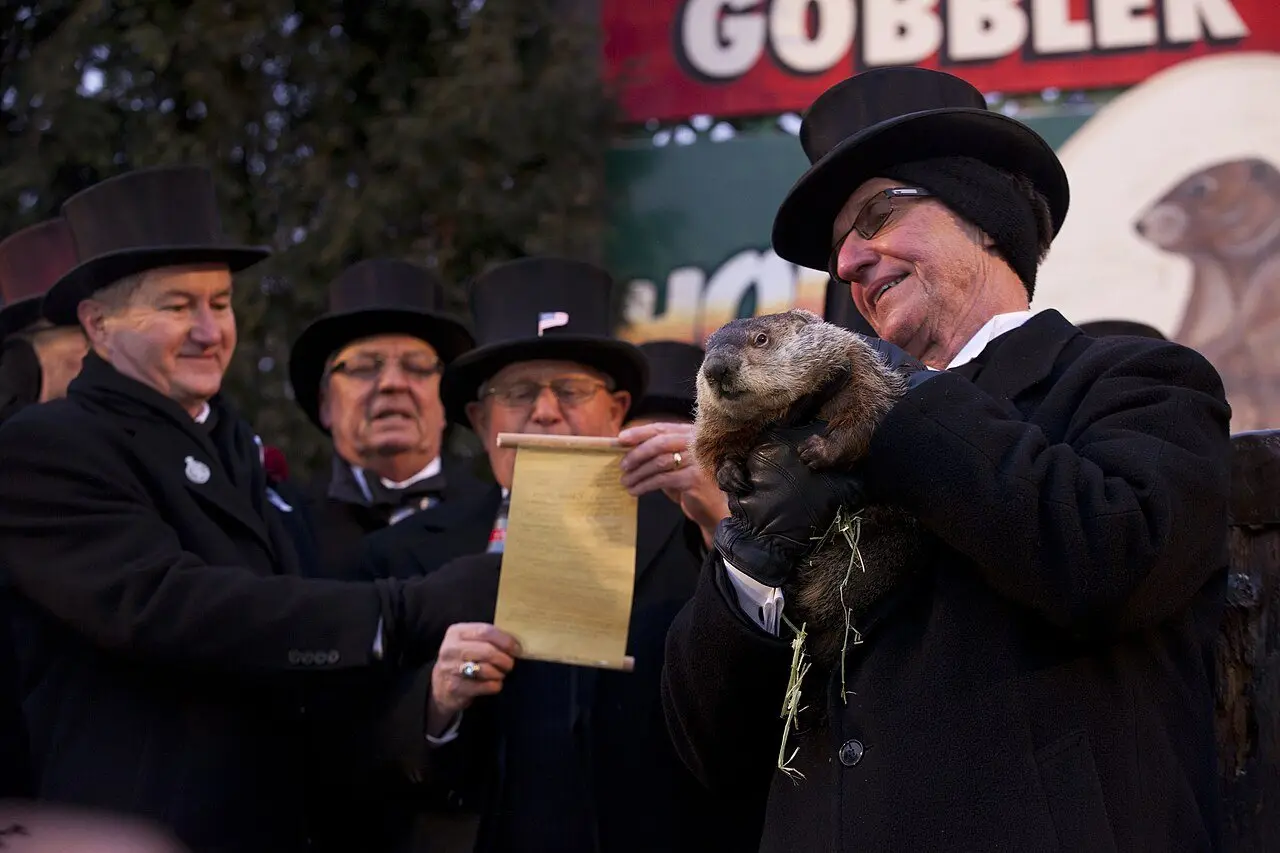
It happens every February 2 in a small Pennsylvania town: thousands of people gather before dawn, in top hats and tuxedos, to watch a groundhog predict the weather. It is completely absurd. It is also one of America's oldest and most beloved traditions — and it began, officially, on February 2, 1887.
The roots go back much further. In the Christian calendar, February 2 is Candlemas, the day clergy blessed the candles needed for the rest of winter — and the day's weather was read as an omen of how much winter remained. German immigrants brought a twist: in Germany, the weather prophet was the hedgehog, in a tradition called Dachstag, or Badger Day. When the Pennsylvania Dutch settled in Pennsylvania, there were no hedgehogs — but there were plenty of groundhogs, the burrowing rodents also called woodchucks. The forecasting job was reassigned.
The rule is simple: if the groundhog emerges on February 2 and sees its shadow, it gets scared and ducks back into its burrow, and winter will last six more weeks. No shadow? An early spring.
The earliest written trace of the American version comes from a diary entry dated February 2, 1840, by James L. Morris of Morgantown, Pennsylvania, commenting on his German neighbors' custom. But the ceremony we know today started with a hunting club. In the late 1800s, members of the Punxsutawney Elks Lodge had taken to hunting groundhogs every summer — the animals were, among other things, dinner. By the 1880s the hunt and its banquet had become a festive occasion, and the hunters called themselves the Punxsutawney Groundhog Club.
Then, in 1886, the local newspaper, the Punxsutawney Spirit, noted that "up to the time of going to press, the beast has not seen its shadow." The next year, on February 2, 1887, the club climbed Gobbler's Knob — a wooded clearing on the edge of town — and consulted a groundhog for the first time as an official event. The animal was called Br'er Groundhog at first; the name Punxsutawney Phil came later. The club declared its groundhog the one true weather-forecasting groundhog in all the land.
Much of the credit goes to Clymer Freas, the city editor of the Punxsutawney Spirit, remembered as the "father" of Groundhog Day. He and the club turned a folk custom into a full-blown ceremony, and it never stopped. Today the club's Inner Circle insists Phil is the same groundhog who made that first prediction in 1887 — a claim that would make him well over a century old.
As for his track record, let us be generous. The Farmer's Almanac scores Phil at about 50 percent — a coin flip with whiskers. Other scorekeepers put him lower, though one university team found he did better when measured against temperature highs and lows. Meteorologists, meanwhile, gently note that male groundhogs emerge in February mainly to look for a mate, not to forecast weather.
None of that matters. Groundhog Day endures because it is joyful: a midwinter festival of top hats, tall tales, and hope, invented by people who decided winter was better with a party in the middle of it. Hollywood immortalized it in the 1993 film Groundhog Day, and tens of thousands of visitors now make the pilgrimage to Gobbler's Knob every year.
Why does it matter? Traditions don't have to be accurate to be meaningful. For well over a century, a town has gathered in the dark of winter to laugh together — and that is a forecast about human nature that always comes true.
Photo: Anthony Quintano, CC BY 2.0 (via Wikimedia Commons).