The Speech That Ended Apartheid
On February 2, 1990, South African president F. W. de Klerk stunned parliament by unbanning the ANC and announcing Nelson Mandela's release, starting the end of apartheid.
On the afternoon of February 2, 1990, South Africa's president walked into parliament and did what almost no one — not his cabinet, not the press, not even most of his own party — expected: he began to dismantle apartheid on live television.
Frederik Willem de Klerk had been president for less than five months, having taken over from P. W. Botha in September 1989. He inherited a country in crisis: apartheid, the system of institutionalized racial segregation imposed in 1948, had made South Africa an international pariah under crushing sanctions; the economy was buckling; townships were in near-perpetual unrest; and Nelson Mandela, the imprisoned leader of the African National Congress, had been behind bars for 27 years. Two days before the speech, de Klerk swore his cabinet to secrecy about what he planned to say.
At the opening of the 1990 parliamentary session in Cape Town, de Klerk announced the unbanning of the ANC, the Pan Africanist Congress, and the South African Communist Party, along with their affiliated organizations. He suspended the death penalty, eased restrictions imposed under the state of emergency, and committed to releasing political prisoners — including Mandela, unconditionally. The chamber audibly gasped. He closed by inviting every political leader in the country to join negotiations for a new, democratic constitution with equal rights for all.
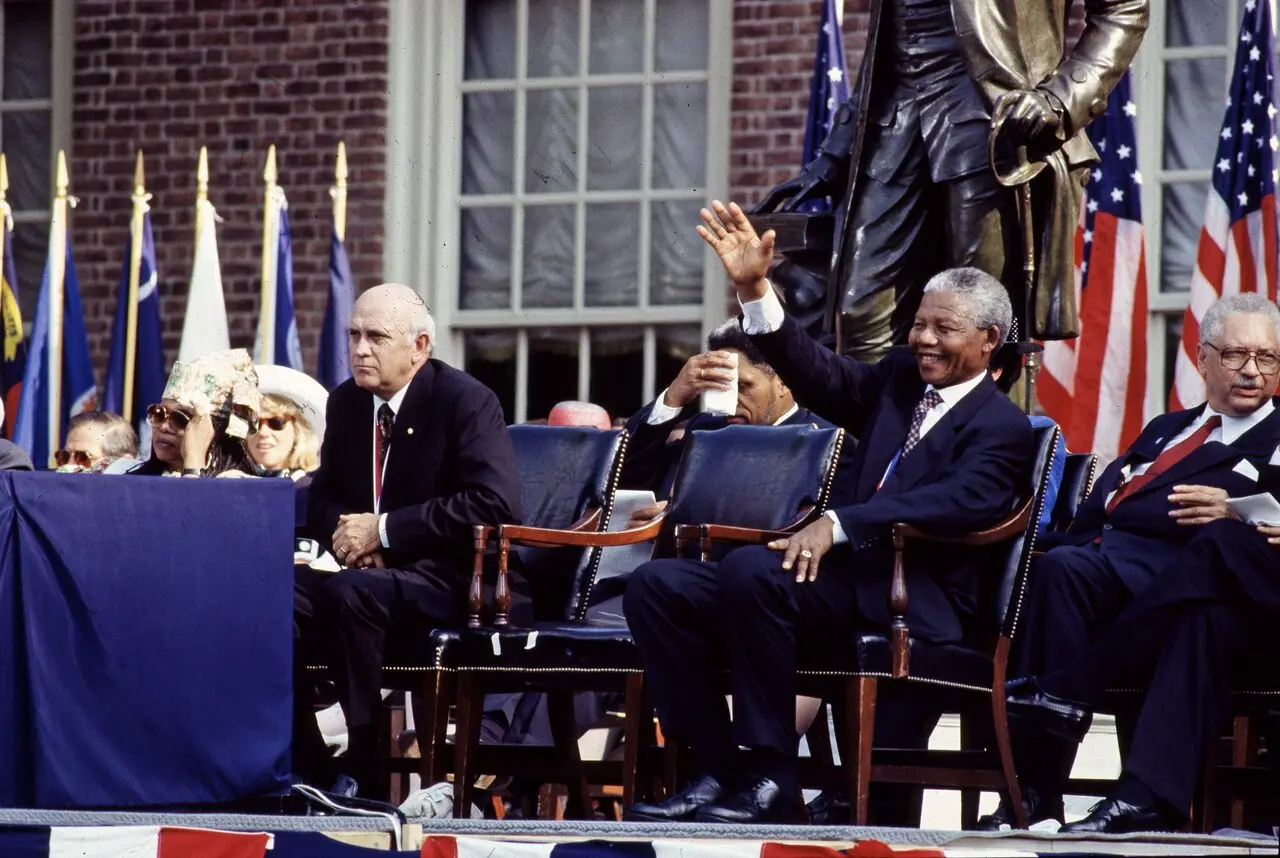
Nine days later, on February 11, 1990, Mandela walked free from Victor Verster Prison, fist raised, after 27 years in captivity. Years of hard negotiations followed, punctuated by violence and setbacks, but the direction was set. In April 1994, South Africa held its first multiracial democratic election, and Mandela became president. In 1993, he and de Klerk shared the Nobel Peace Prize. Critics at the time noted what the speech did not do — it left apartheid's legislative pillars, like the Population Registration Act, still on the books — but nobody doubted that the country had crossed a point of no return.
De Klerk's speech matters because it opened a door that could have been kicked down at terrible cost. Instead of civil war, South Africa got a negotiated revolution — imperfect, incomplete, but peaceful enough to build a democracy on. Sometimes the bravest thing a leader can do is announce, in front of everyone, that the old order is over.
Photo: Carol M. Highsmith, Library of Congress, public domain (via Wikimedia Commons)