The Speech That Started the Gold Rush
On December 5, 1848, President James K. Polk told Congress that California's gold was real — and within a year, 100,000 fortune-seekers were racing west.
For eleven months, the stories had sounded too good to be true. Gold — just lying in California's riverbeds, nuggets you could pick up with your hands, a whole mountainside glittering with it. When the first rumors drifted east in 1848, most Americans dismissed them as frontier tall tales. Then, on December 5, 1848, the President of the United States stood before Congress and announced: it is all true.
The gold was real enough. On January 24, 1848, a carpenter named James Marshall spotted shining flakes in the millrace of Sutter's Mill on California's American River. His employer, John Sutter, tried desperately to keep the discovery secret — and failed completely. By summer, Colonel Richard B. Mason, the U.S. military governor, toured the diggings and reported roughly 4,000 men already working the placers. Still, back east, disbelief reigned. California was a distant, half-mapped territory, fresh from the Mexican-American War. Who could trust such stories?
James K. Polk could. In his State of the Union message to the 30th Congress on December 5, the president devoted a striking passage to the news from the Pacific: "The accounts of abundance of gold are of such an extraordinary character as would scarcely command belief were they not corroborated by the authentic reports of officers in the public service." The explorations, he added, "warrant the belief that the supply is very large." He even proposed establishing a branch of the U.S. Mint on the Pacific coast to handle the flood he saw coming.
The effect was electric. As the Library of Congress later put it, Polk's official confirmation "triggered a mass exodus to California. The 'Forty-Niners' were on their way." In 1849 alone, some 100,000 people poured into California from across the United States, Europe, and around the world — by wagon train, by ship around Cape Horn, by mule across Panama. San Francisco, a sleepy outpost of about 800 people, exploded into a chaotic boomtown of more than 100,000 within a couple of years.
The rush remade the nation. California became the 31st state in 1850. The gold financed railroads, banks, and the growth of the West — and it came at a terrible price for California's Native peoples, whose communities were devastated by the invasion. The Gold Rush was triumph and tragedy at once, as American expansions so often were.
Polk did not discover the gold. What he did, on a December day in 1848, was make the world believe it. Sometimes the most powerful sentence a president can utter is not a policy or a promise — it is a confirmation. It is true. And with those words, more or less, the greatest migration in American history began.
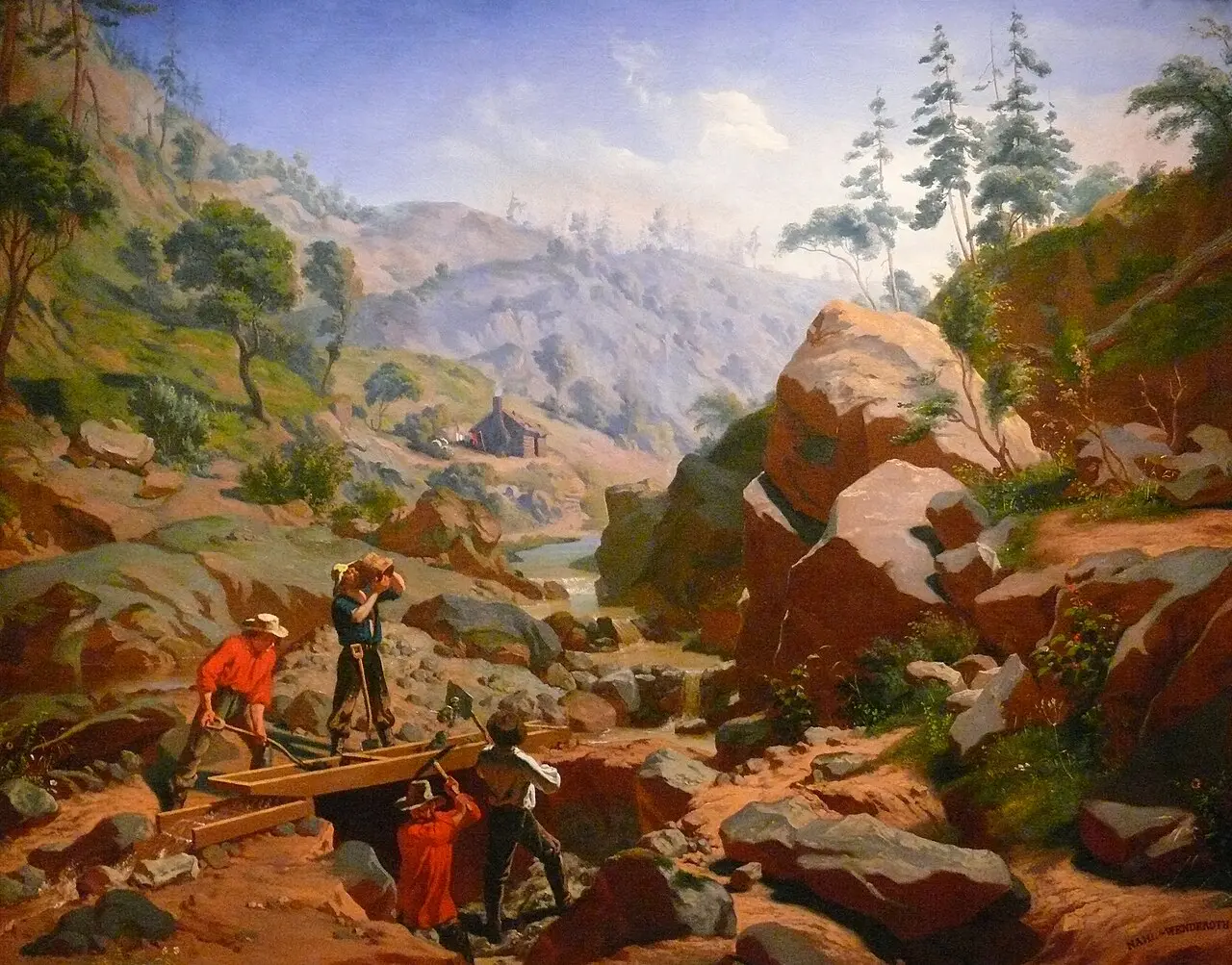
Photo: Charles Christian Nahl and Frederick August Wenderoth, Public domain (via Wikimedia Commons).