The Ship That Sank on Its Parade: Vasa, August 10, 1628
On August 10, 1628, Sweden's proudest warship sailed out of Stockholm before thousands of cheering onlookers — and sank before it cleared the harbor.
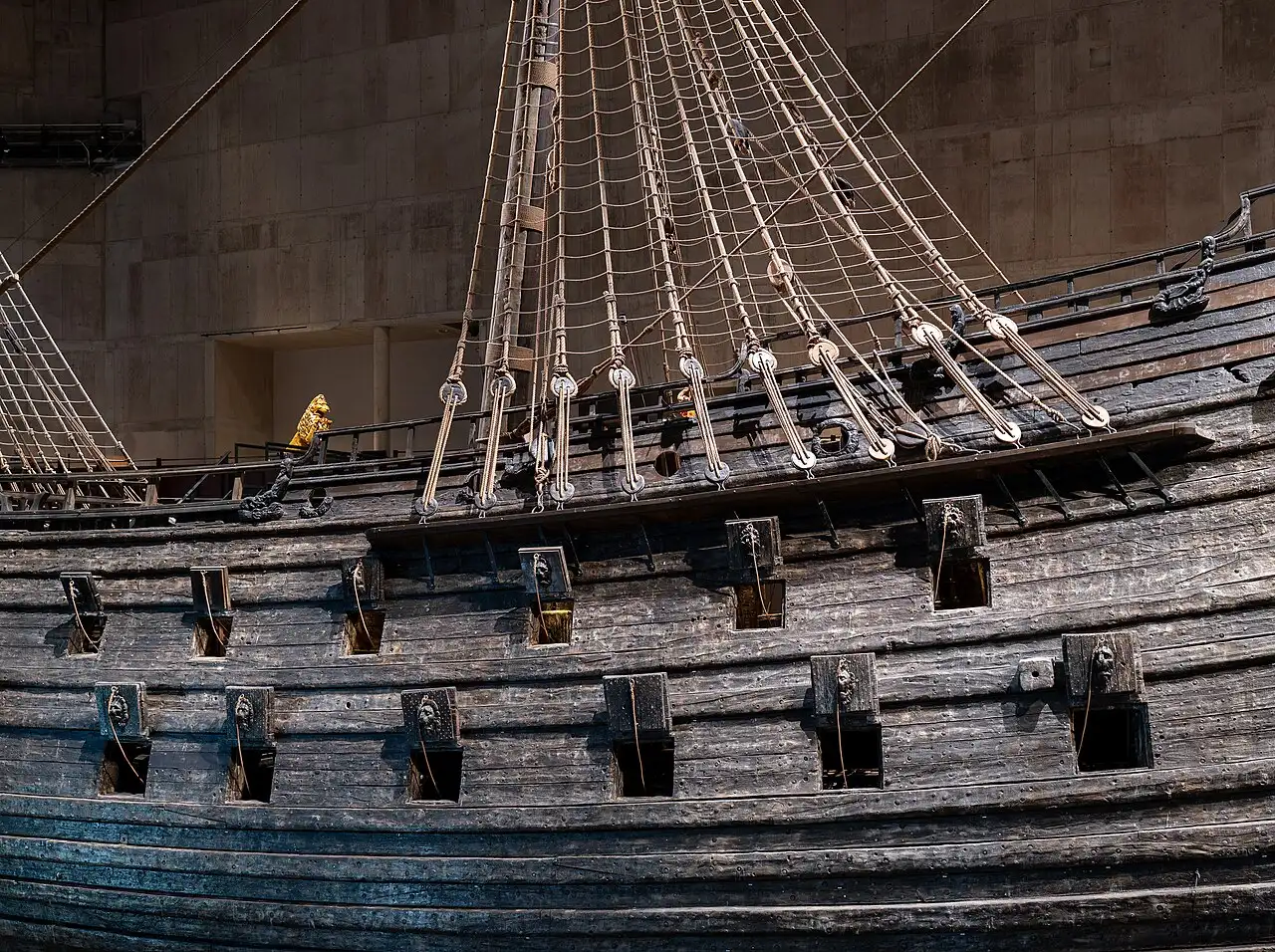
It was supposed to be the proudest day in the young Swedish navy's history. On August 10, 1628, crowds — hundreds, perhaps thousands of ordinary Stockholmers, plus foreign ambassadors who were effectively spies — lined the harbor to watch the great warship Vasa set sail on her maiden voyage. She traveled about 1,300 meters. Then she sank.
Vasa was the pet project of King Gustav II Adolf, who was building Sweden into a great power and fighting a war with Poland. He wanted a flagship that would terrify enemies: 69 meters long, masts rising 50 meters, some 1,200 tonnes, and 64 bronze cannon — a broadside twice as heavy as anything rival navies floated. Her designer, Henrik Hybertsson, died before the ship was finished, and his successor found the hull already too narrow and top-heavy to safely carry two full gun decks. He widened it by about 42 centimeters, but construction was too far along to fix the real problem.
The warning signs were impossible to miss. Before the maiden voyage, Captain Söfring Hansson ordered thirty men to run back and forth across the deck as a stability test. The ship rolled alarmingly. Hansson reported his fears to Vice Admiral Klas Fleming — but the king, away in Prussia, was pressing for the ship to sail, and Fleming ordered her out anyway.
The day was calm, with only a light breeze from the southwest. Vasa was warped along the waterfront to the harbor mouth, where four sails were set and the gunports were left open for a departure salute. As she passed under the lee of the bluffs south of the city, a gust filled her sails and she heeled suddenly to port, then righted herself. At a gap in the bluffs near Tegelviken, a stronger gust knocked her down again — this time pushing the open lower gunports under the surface. Water poured onto the gun deck, ran down into the hold, and within minutes the great ship was gone, settling 32 meters down, barely 120 meters from shore. About 30 people — crew and the families of guests aboard for the short trip — died in sight of land.
An inquest was held, and in the end nobody was convicted: the designer was dead, the king was untouchable, and everyone else swore they had done their duty. Vasa sat in Stockholm's mud for 333 years. Divers using an early diving bell salvaged her cannon in the 1660s, but the hull waited until 1956, when the engineer Anders Franzén located it. On April 24, 1961, Vasa broke the surface — astonishingly intact, preserved by the cold, brackish water.
Today she stands in the Vasa Museum in Stockholm, 98 percent original — the world's only preserved 17th-century warship and Sweden's most visited museum. Engineers study her as a masterclass in what happens when ambition outruns physics. The crowds still come to watch her. Only now, she stays put.
Photo: Jules Verne Times Two, CC BY-SA 4.0 (via Wikimedia Commons).